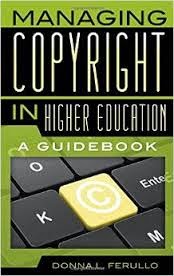
I read a copy of Managing Copyright in Higher Education: A Guidebook by Donna L. Ferullo (2014), since I do a lot of the copyright management at my work.
Ferullo's book is useful in that it covers aspects of copyright management outside of library / classroom use, which is unusual for this kind of book. Ultimately, however, I didn't find it to be very readable or easy to access as a reference text.
The book is divided into sections by area of administration (students, faculty, staff, etc.), and while there is an index, the large chunks of text without many section dividers or bullet points, makes the content a little hard to digest or refer back to later.
I was particularly confused about the author's choice to include an illustration of the three branches of the federal government (something that didn't really need to be illustrated anyway) with a figure taken from kids.gov. For a book with hardly any illustrations, graphs, or figures at all, this particular illustration seemed random and ill-suited to the audience.
Someone without much of a background in copyright would likely find some helpful tips in this book, but as someone who has done a lot of reading and taken some classes on the topic, I didn't find much here that I could use.
Monday, April 13, 2015
Tuesday, April 07, 2015
Rick Steves' Pocket Amsterdam by Rick Steves and Gene Openshaw (2014)
As part of our first-ever European travel and extremely exciting trip to Belgium this summer, we are going to do a quick one overnight trip to Amsterdam with our friends. In preparation for something like 36 hours in Amsterdam, I thought I'd get a guidebook, but one that matched the amount of time we'd be spending in that fair city. Rick Steves' Pocket Amsterdam by Rick Steves and Gene Openshaw (2014) fit the bill perfectly.
Although you really could fit this guidebook in your pocket if you really wanted to, Steves manages to cram it full of a lot of information and not make anything seem too skimpy. Generous with maps and color photographs, the guide gives an overview of attractions, walking tours through various neighborhoods, and a pretty helpful seeming set of tips and recommendations.
Amsterdam seems lovely, and while I'm sure I could happily spend much more than 36 hours there, this guidebook should help me make the most of the hours I've got. [And, because I'm a nerd, I'm going to spend at least part of one of those hours here.]
Although you really could fit this guidebook in your pocket if you really wanted to, Steves manages to cram it full of a lot of information and not make anything seem too skimpy. Generous with maps and color photographs, the guide gives an overview of attractions, walking tours through various neighborhoods, and a pretty helpful seeming set of tips and recommendations.
Amsterdam seems lovely, and while I'm sure I could happily spend much more than 36 hours there, this guidebook should help me make the most of the hours I've got. [And, because I'm a nerd, I'm going to spend at least part of one of those hours here.]
Sunday, April 05, 2015
The Mill on the Floss by George Eliot (1860)
Our latest DAFFODILS selection is the uncharacteristically classic novel The Mill on the Floss by George Eliot (1860), and I'm not sad about that at all since I really liked Adam Bede and Silas Marner and I wrote a paper on George Eliot's life when I was in college.
The Mill on the Floss follows the tragic saga of the Tulliver family, with a focus on the daughter, Maggie. Mr. Tulliver owns a mill that has been in his family for generations. He married well to the mildest of the regionally respected Dodson sisters, and they have two children, Tom and Maggie. He is reasonably successful, but for a unclear reason that seems to be a mixture of pride and foolishness, he recklessly pursues legal action against his neighbors and a combination of his recklessness and the determination of a local lawyer, Mr. Wakem, he ends up losing the mill, his health, and nearly all his pride. Maggie and Tom had, up to this point, had a pretty idyllic childhood. Maggie is curious and clever (really too clever for a girl) and adores her older brother, who is more practical and less imaginative than his sister. They spat and make up and get in various kinds of trouble, generally stemming from Maggie's wild emotions and creative ideas. There is more than a little Anne of Green Gables going on with young Maggie. Prior to losing the mill, Mr. Tulliver pays to send Tom to study with a nearby churchman, at whose house Mr. Wakem's hunchbacked and sensitive son, Philip, also studies. The two very different boys fight a bit, but Maggie is fascinated by the gentle and bookish Philip. All that ends when the mill is lost and Tom must seek his fortune to pay his father's debts and save the family name.
Maggie devotes herself to a life of isolation and denial, but her passionate and headstrong nature doesn't keep her there for very long. Ultimately she finds herself grown up and very beautiful, though inexperienced. Her lovely and wealthy cousin Lucy invites her to stay with her for a summer and there she meets Lucy's suitor Stephen, and they unexpectedly fall in love. The last third of the book hinges on Maggie's tug of war between the head and the heart, although her ultimate decision after an ill-fated boat ride with Stephen turns the respectable people of the town, as well as her brother, staunchly against her. The ending of the book is shocking and pretty brutal. At first I felt cheated and didn't like it at all, but the more I think about it, the more perfect it becomes.
This isn't necessarily an easy read, like much Victorian literature the plot turns on an unfamiliar moral code and the level of description (particularly of natural features and houses) is a little off-putting. Still, the lovingly drawn (and sometimes hilarious characters) and the rush of the plot in the last third make up for any difficulty in getting into the book. Maggie's aunts, in particular, are a perfect balance of hilariously provincial and sometimes unexpectedly sweet. Much has been written about how this novel in particular draws from Eliot's life, as a dark haired, isolated, too smart for her own good woman in Victorian England who carried on a long relationship with a married man. There is a lot going on in this book and I find myself teasing back through it even now, weeks after I finished it. That sounds like a perfect recipe for a meaty book club discussion...
The Mill on the Floss follows the tragic saga of the Tulliver family, with a focus on the daughter, Maggie. Mr. Tulliver owns a mill that has been in his family for generations. He married well to the mildest of the regionally respected Dodson sisters, and they have two children, Tom and Maggie. He is reasonably successful, but for a unclear reason that seems to be a mixture of pride and foolishness, he recklessly pursues legal action against his neighbors and a combination of his recklessness and the determination of a local lawyer, Mr. Wakem, he ends up losing the mill, his health, and nearly all his pride. Maggie and Tom had, up to this point, had a pretty idyllic childhood. Maggie is curious and clever (really too clever for a girl) and adores her older brother, who is more practical and less imaginative than his sister. They spat and make up and get in various kinds of trouble, generally stemming from Maggie's wild emotions and creative ideas. There is more than a little Anne of Green Gables going on with young Maggie. Prior to losing the mill, Mr. Tulliver pays to send Tom to study with a nearby churchman, at whose house Mr. Wakem's hunchbacked and sensitive son, Philip, also studies. The two very different boys fight a bit, but Maggie is fascinated by the gentle and bookish Philip. All that ends when the mill is lost and Tom must seek his fortune to pay his father's debts and save the family name.
Maggie devotes herself to a life of isolation and denial, but her passionate and headstrong nature doesn't keep her there for very long. Ultimately she finds herself grown up and very beautiful, though inexperienced. Her lovely and wealthy cousin Lucy invites her to stay with her for a summer and there she meets Lucy's suitor Stephen, and they unexpectedly fall in love. The last third of the book hinges on Maggie's tug of war between the head and the heart, although her ultimate decision after an ill-fated boat ride with Stephen turns the respectable people of the town, as well as her brother, staunchly against her. The ending of the book is shocking and pretty brutal. At first I felt cheated and didn't like it at all, but the more I think about it, the more perfect it becomes.
This isn't necessarily an easy read, like much Victorian literature the plot turns on an unfamiliar moral code and the level of description (particularly of natural features and houses) is a little off-putting. Still, the lovingly drawn (and sometimes hilarious characters) and the rush of the plot in the last third make up for any difficulty in getting into the book. Maggie's aunts, in particular, are a perfect balance of hilariously provincial and sometimes unexpectedly sweet. Much has been written about how this novel in particular draws from Eliot's life, as a dark haired, isolated, too smart for her own good woman in Victorian England who carried on a long relationship with a married man. There is a lot going on in this book and I find myself teasing back through it even now, weeks after I finished it. That sounds like a perfect recipe for a meaty book club discussion...
Sunday, March 29, 2015
The Best American Comics 2006, edited by Harvey Pekar and Anne Elizabeth Moore (2006)
Following the format of the other "Best American" annual anthologies, The Best American Comics 2006, edited by Harvey Pekar and Anne Elizabeth Moore (2006) was the series' first dip into the world of comics.
I was happy to see that this first volume was edited by the great Harvey Pekar, and his introductory essay is worth the price of admission alone. The collection itself brings together both familiar and unfamiliar (to me) artists, and has a good mix of men and women, and new and more established writers. Some of the entries are selections from larger works that don't have the impact they could as a smaller selection, but others really worked well in the anthology format, particularly David Heatley's "Portrait of my Dad," and Jesse Reklaw's "Thirteen Cats of my Childhood."
The book itself is a well-produced hardcover of nice dimensions with high quality paper and color printing that shows off the detail in many of the submissions. While some of this collection ended up feeling a little breezy or disconnected, overall it holds together and was pretty fun to read. I'll definitely be picking up the other volumes in the series that came to me through the St. Denis graphic novel storage program.
I was happy to see that this first volume was edited by the great Harvey Pekar, and his introductory essay is worth the price of admission alone. The collection itself brings together both familiar and unfamiliar (to me) artists, and has a good mix of men and women, and new and more established writers. Some of the entries are selections from larger works that don't have the impact they could as a smaller selection, but others really worked well in the anthology format, particularly David Heatley's "Portrait of my Dad," and Jesse Reklaw's "Thirteen Cats of my Childhood."
The book itself is a well-produced hardcover of nice dimensions with high quality paper and color printing that shows off the detail in many of the submissions. While some of this collection ended up feeling a little breezy or disconnected, overall it holds together and was pretty fun to read. I'll definitely be picking up the other volumes in the series that came to me through the St. Denis graphic novel storage program.
Monday, March 16, 2015
Sous Chef: 24 Hours on the Line by Michael Gibney (2014)
My latest selection from the LibraryThing Early Reviewers program is Sous Chef: 24 Hours on the Line by Michael Gibney (2014). As a fan of cooking, eating, and the bad boy cheffery of Anthony Bourdain, this one seemed like it would be right up my alley. And it was. Kind of.
Gibney uses the extremely effective structural conceit of 24 hours in the life of a chef, told in the second person, to organize his behind-the-scenes fine dining kind-of-memoir. In it we become (thanks to that second person perspective) the second-in-command at a fancy (but not too fancy) restaurant in the West Village. We are rising up through the ranks of chefdom and are now one of two sous chefs under the visionary creator/co-owner of our place of work. We wake up, go to work, and start checking off the millions of little things we have to do to get that high quality food on the plates.
While much of that work involves gathering, inventorying, and preparing a slew of ingredients, the really hard part is managing all the personalities and egos that are crammed into the tight kitchen. We do it though, and our camaraderie, skill, and attitude carry the day and result in another successful service. Then we go out and get shitfaced, don't sleep enough, and start all over again the next day.
Parts of this book are fascinating -- learning about how the different roles in the kitchen fit together, the organization and creativity it takes to produce interesting and consistent plates of expensive food, and the interactions between the staff really kept the book moving. Gibney is not as strong when he tries to describe some of the less tangible qualities of being a chef or his (our) lovey feelings for the girlfriend we hardly ever see since we are working so much. When he tries to be poetic, the tone gets a little goofy and the narrative runs briefly off the rails.
Personally, while I have the same shared fascination for professional chefs that seems to grab the rest of the Food Network-loving public, I have a bad attitude about expensive restaurants and food that is fancy for the sake of being fancy. This may be because I'm kind of cheap or because I don't have a lot of experience eating really fancy food, but there is something a little obscene in spending over $50 a plate for some food. This is not true, however, in the world of the fancy New York chef, and that puts a little bit of a disconnect between me and the writer. I also have very little patience for the "we work hard and we play hard" attitude as an excuse for being irresponsible and occasionally a real asshole. Of course, that macho attitude is a huge part of professional chefdom, at least in the popular media, so Gibney is not being false or untrue when he gives us this lifestyle. That still doesn't mean that I need to like it.
Overall I enjoyed this book, but with some reservations. I think the structure was great and I learned a lot, even if the writing style got in my way every once in awhile. If you are a fan of the hot dog professional chef lifestyle, then don't miss this one. If you just like cooking and eating normal food without a lot of French words and machismo, then this might not be the book for you.
Gibney uses the extremely effective structural conceit of 24 hours in the life of a chef, told in the second person, to organize his behind-the-scenes fine dining kind-of-memoir. In it we become (thanks to that second person perspective) the second-in-command at a fancy (but not too fancy) restaurant in the West Village. We are rising up through the ranks of chefdom and are now one of two sous chefs under the visionary creator/co-owner of our place of work. We wake up, go to work, and start checking off the millions of little things we have to do to get that high quality food on the plates.
While much of that work involves gathering, inventorying, and preparing a slew of ingredients, the really hard part is managing all the personalities and egos that are crammed into the tight kitchen. We do it though, and our camaraderie, skill, and attitude carry the day and result in another successful service. Then we go out and get shitfaced, don't sleep enough, and start all over again the next day.
Parts of this book are fascinating -- learning about how the different roles in the kitchen fit together, the organization and creativity it takes to produce interesting and consistent plates of expensive food, and the interactions between the staff really kept the book moving. Gibney is not as strong when he tries to describe some of the less tangible qualities of being a chef or his (our) lovey feelings for the girlfriend we hardly ever see since we are working so much. When he tries to be poetic, the tone gets a little goofy and the narrative runs briefly off the rails.
Personally, while I have the same shared fascination for professional chefs that seems to grab the rest of the Food Network-loving public, I have a bad attitude about expensive restaurants and food that is fancy for the sake of being fancy. This may be because I'm kind of cheap or because I don't have a lot of experience eating really fancy food, but there is something a little obscene in spending over $50 a plate for some food. This is not true, however, in the world of the fancy New York chef, and that puts a little bit of a disconnect between me and the writer. I also have very little patience for the "we work hard and we play hard" attitude as an excuse for being irresponsible and occasionally a real asshole. Of course, that macho attitude is a huge part of professional chefdom, at least in the popular media, so Gibney is not being false or untrue when he gives us this lifestyle. That still doesn't mean that I need to like it.
Overall I enjoyed this book, but with some reservations. I think the structure was great and I learned a lot, even if the writing style got in my way every once in awhile. If you are a fan of the hot dog professional chef lifestyle, then don't miss this one. If you just like cooking and eating normal food without a lot of French words and machismo, then this might not be the book for you.
Saturday, March 07, 2015
Wimbledon Green: The Greatest Comic Book Collector in the World by Seth (2005)
My next dip in to the St. Denis lending library is the extremely fun to hold Wimbledon Green: The Greatest Comic Book Collector in the World by Seth (2005).
This graphic novel is the story of the mysterious and envied Wimbledon Green, a highly successful comic book collector with an unknown (and apparently endless) source of personal wealth to use in growing his collection. The story is primarily told not by Wimbledon himself but in a series of interviews and remembered vignettes with his friends, enemies, and acquaintances, all of whom happen to be fellow comic nerds.
Woven throughout the story are sets of covers from Green's comic collection, as well as a few vintage comic strips for the reader to enjoy. In fact, Green's own adventures often veer into classic comic book territory with their "right hand gals," rocket cars, and endless races.
Seth includes a letter to the readers at the beginning of the volume emphasizing that this book is something that developed out of his sketch book and because of that the drawings and story aren't as polished as his work usually is. In this case, I think the rough quality of the work adds to the energy of putting together the pieces of the mystery that is Wimbledon Green and Seth's obvious love for the comic book world and it's many eccentric inhabitants is enough glue to make the fragmented story hold together. A fast and very enjoyable read, with a little more meat to it than expected when you peek behind the curtain.
[I read this is a couple weeks ago, but I'm writing about it tonight having just gotten back from Staple, an annual comics/zines/print arts/etc. expo in Austin, where I got to indulge in some comic buying and some people watching. While it wasn't a comic collector type event, it definitely made me feel the love for that subculture. Plus I got some great stuff!]
This graphic novel is the story of the mysterious and envied Wimbledon Green, a highly successful comic book collector with an unknown (and apparently endless) source of personal wealth to use in growing his collection. The story is primarily told not by Wimbledon himself but in a series of interviews and remembered vignettes with his friends, enemies, and acquaintances, all of whom happen to be fellow comic nerds.
Woven throughout the story are sets of covers from Green's comic collection, as well as a few vintage comic strips for the reader to enjoy. In fact, Green's own adventures often veer into classic comic book territory with their "right hand gals," rocket cars, and endless races.
Seth includes a letter to the readers at the beginning of the volume emphasizing that this book is something that developed out of his sketch book and because of that the drawings and story aren't as polished as his work usually is. In this case, I think the rough quality of the work adds to the energy of putting together the pieces of the mystery that is Wimbledon Green and Seth's obvious love for the comic book world and it's many eccentric inhabitants is enough glue to make the fragmented story hold together. A fast and very enjoyable read, with a little more meat to it than expected when you peek behind the curtain.
[I read this is a couple weeks ago, but I'm writing about it tonight having just gotten back from Staple, an annual comics/zines/print arts/etc. expo in Austin, where I got to indulge in some comic buying and some people watching. While it wasn't a comic collector type event, it definitely made me feel the love for that subculture. Plus I got some great stuff!]
Sunday, March 01, 2015
Women of Messina by Elio Vittorni (1949, 1964)
My next ride on Harold Bloom's western canon list is the Italian novel, Women of Messina by Elio Vittorini (1949, 1964, English translation 1973). I'm not going to pretend that I get all the allusions and layers of this allegorical post-war novel, but I definitely enjoyed it and understood at least some of the metaphors woven into the story.
It is just after World War II and Italy is waking up and trying to piece together a normal life. A group of men, women, and children traveling to nowhere in particular decide to leave their broken down truck and settle into a bombed out village that had been abandoned during the war. They set about clearing the mines from the fields, making communal housing in the half-standing church, and setting up a central kitchen for everyone to use. Gradually other wandering people join the first group, including some original inhabitants of the village. The villagers are successful, although their communal lifestyle isn't without its conflicts and quarrels.
At the same time, the elderly Uncle Agrippa is spending his days riding back and forth on the nation's trains, searching for his only daughter. He is a constant presence on the railroad and participates in conversations and discussions with the other people who wander the country, searching. One of his favorite travel companions is Carlos the Bald, who often entertains him with stories of the isolated villages and unusual characters he meets during his work.
The simple agrarian life of the village is disrupted when Carlos the Bald, a representative of the authorities in the city, starts coming around to the village and asking questions. He knows one of the chief villagers from partisan activity during the war and while his motivations and actions are always a little unclear, his presence is taken as a threat by the village. What really tears things apart, however, are a group of soldiers who come into the village looking to take away one of the men. While they are there, they scoff at the village's bar that serves warm beer because they don't have any refrigeration or even a regular delivery of ice. They pine for the jukeboxes and restaurants and electricity and lights and dancing of the nearby city. The villagers, living in isolation and working hard to maintain their community, have been overlooked by the technological and economic development of the bigger cities. Soon villagers start to leave and seek out the conveniences and obligations of city life, although some stay and continue to live and work in the village.
Vittorini wrote this novel in 1949, but wasn't happy with it. He pulled it from publication and spent the next 14 years revising it, until it was re-released in 1964 (and then translated into English and published here in 1973, after the author's death). This has the feeling to me of post-war Italian movies, lit by stark sunlight and framed with half-fallen walls and women pushing wheelbarrows. The author shows an obvious love for his country and his Communist ideals here, as well as some harsh criticism of the fallen Facist government and encroaching capitalism. While the themes and the metaphors are pretty dated and temporal, there is also an affection and interest in humanity and the ways we reach out to and interact with each other that gives this novel a freshness and universality that it might not otherwise have. It's also often very funny! A somewhat challenging read, but absolutely worth it.
It is just after World War II and Italy is waking up and trying to piece together a normal life. A group of men, women, and children traveling to nowhere in particular decide to leave their broken down truck and settle into a bombed out village that had been abandoned during the war. They set about clearing the mines from the fields, making communal housing in the half-standing church, and setting up a central kitchen for everyone to use. Gradually other wandering people join the first group, including some original inhabitants of the village. The villagers are successful, although their communal lifestyle isn't without its conflicts and quarrels.
At the same time, the elderly Uncle Agrippa is spending his days riding back and forth on the nation's trains, searching for his only daughter. He is a constant presence on the railroad and participates in conversations and discussions with the other people who wander the country, searching. One of his favorite travel companions is Carlos the Bald, who often entertains him with stories of the isolated villages and unusual characters he meets during his work.
The simple agrarian life of the village is disrupted when Carlos the Bald, a representative of the authorities in the city, starts coming around to the village and asking questions. He knows one of the chief villagers from partisan activity during the war and while his motivations and actions are always a little unclear, his presence is taken as a threat by the village. What really tears things apart, however, are a group of soldiers who come into the village looking to take away one of the men. While they are there, they scoff at the village's bar that serves warm beer because they don't have any refrigeration or even a regular delivery of ice. They pine for the jukeboxes and restaurants and electricity and lights and dancing of the nearby city. The villagers, living in isolation and working hard to maintain their community, have been overlooked by the technological and economic development of the bigger cities. Soon villagers start to leave and seek out the conveniences and obligations of city life, although some stay and continue to live and work in the village.
Vittorini wrote this novel in 1949, but wasn't happy with it. He pulled it from publication and spent the next 14 years revising it, until it was re-released in 1964 (and then translated into English and published here in 1973, after the author's death). This has the feeling to me of post-war Italian movies, lit by stark sunlight and framed with half-fallen walls and women pushing wheelbarrows. The author shows an obvious love for his country and his Communist ideals here, as well as some harsh criticism of the fallen Facist government and encroaching capitalism. While the themes and the metaphors are pretty dated and temporal, there is also an affection and interest in humanity and the ways we reach out to and interact with each other that gives this novel a freshness and universality that it might not otherwise have. It's also often very funny! A somewhat challenging read, but absolutely worth it.
Sunday, February 22, 2015
Rick Steves' Snapshot Bruges & Brussels, Including Antwerp & Ghent by Rick Steves (2011)
I'm continuing my research for our summer trip to Belgium by dipping into some good old dependable Rick Steves with Rick Steves' Snapshot Bruges & Brussels, Including Antwerp & Ghent (2011).
This volume gives a brief overview of the culture and history of Belgium and then dips into a snapshot of each of the four major cities, including a suggested walking tour, a list of sights and neighborhoods, recommended hotels and restaurants, and general travel and transportation recommendations. Included with each city are Steves' patented hand-drawn maps, which I find really appealing. It's easy to make fun of Steves' PBS-approved travel guides, but I find his writing style to be very approachable, and his tips all seem very practical and reassuring (particularly to this first-time European traveler).
We'll be spending most of our time in Ghent, which is great because that's the city that appealed to me the most in this guide. It seems much less touristy than Bruges, more academic than Antwerp, and more cozy than Brussels. Also, it is the home of the Boekentoren (oddly not covered in Steves' guide -- come on man, people love books!). This wonderful tower of books is currently under renovation, but you can experience its wonder (and get a taste of Ghent) through this series of videos. I imagine I will still get to see some kind of library / book / bookstore action while I'm over there. Oh plus museums and canals and beer and mussels and waffles. Getting nervous/excited/pumped! Five more months!
This volume gives a brief overview of the culture and history of Belgium and then dips into a snapshot of each of the four major cities, including a suggested walking tour, a list of sights and neighborhoods, recommended hotels and restaurants, and general travel and transportation recommendations. Included with each city are Steves' patented hand-drawn maps, which I find really appealing. It's easy to make fun of Steves' PBS-approved travel guides, but I find his writing style to be very approachable, and his tips all seem very practical and reassuring (particularly to this first-time European traveler).
We'll be spending most of our time in Ghent, which is great because that's the city that appealed to me the most in this guide. It seems much less touristy than Bruges, more academic than Antwerp, and more cozy than Brussels. Also, it is the home of the Boekentoren (oddly not covered in Steves' guide -- come on man, people love books!). This wonderful tower of books is currently under renovation, but you can experience its wonder (and get a taste of Ghent) through this series of videos. I imagine I will still get to see some kind of library / book / bookstore action while I'm over there. Oh plus museums and canals and beer and mussels and waffles. Getting nervous/excited/pumped! Five more months!
Tuesday, February 17, 2015
The Holy Bible, King James Version (1611), Various authors
I recently finished reading this really cool book you might have heard of: The Holy Bible, King James Version (1611) by (you know) various authors.
I got the idea of reading the entirety of the KJV in 2011 when the book had it's 400th printing anniversary. It took me a few years to get around to actually getting and starting a copy, but I got it together early last year and started my journey. By chipping away at a few pages every day, I worked my way through both the Old and New Testament (yes, even the boring parts). I'm so glad I did.
My parents aren't religious and I didn't grow up going to church at all (except for that one year we went to the Unitarian church in town), although I did read my way through some children's bibles and attended the occasional Sunday school class or church service with my grandparents or wedding of one of my mom's many cousins. My lack of familiarity with the Bible wasn't generally a problem until I went to college and became an English major. Regardless of how you feel about God and Jesus, the Bible, and particularly the King James Version of the Bible, are exceedingly influential. Writing those papers and figuring out Paradise Lost would have been way easier with a little more background informtion.
Now I'm still not a churchgoer, but I do work for a seminary and have a great affection and appreciation for theological study, pastors, and seminary students, all of which rely heavily on the Bible. If nothing else, having the experience of having read the whole damn thing lets me understand some of their jokes a little better and have at least a fighting chance of guessing if a certain book is in the Old or New Testament.
I'm not going to lie, there is some rough going in here, especially in the Old Testament. The long lists of begats and genealogies and families with unpronounceable names aren't exactly page turners. The very very detailed instructions on how to build the tabernacle and how to sacrifice what animal when get old pretty fast. And the rules. My god, the rules. Some are funny, some are horrifying, and some are just extremely dull. Of course, the OT also has a lot of battles, kings, power plays, and some truly excellent characters (Moses! David! Saul!).
I can also see why the New Testament is so appealing. When you turn that corner into the Gospels you get one of the most naturally described characters in the whole sacred text: Jesus. And hearing his story four times from four different writers just helps hammer the point home. This is a great story, a revolutionary guy, and a huge change from business as usual. I'm the first to admit that Christians have been pretty horrible over the years (I was in a meeting with an Old Testament professor who said, "the history of Christianity is basically a series of good intentions with pretty crappy results"), but the original story is refreshing, moving and absolutely some good news.
I got the idea of reading the entirety of the KJV in 2011 when the book had it's 400th printing anniversary. It took me a few years to get around to actually getting and starting a copy, but I got it together early last year and started my journey. By chipping away at a few pages every day, I worked my way through both the Old and New Testament (yes, even the boring parts). I'm so glad I did.
My parents aren't religious and I didn't grow up going to church at all (except for that one year we went to the Unitarian church in town), although I did read my way through some children's bibles and attended the occasional Sunday school class or church service with my grandparents or wedding of one of my mom's many cousins. My lack of familiarity with the Bible wasn't generally a problem until I went to college and became an English major. Regardless of how you feel about God and Jesus, the Bible, and particularly the King James Version of the Bible, are exceedingly influential. Writing those papers and figuring out Paradise Lost would have been way easier with a little more background informtion.
Now I'm still not a churchgoer, but I do work for a seminary and have a great affection and appreciation for theological study, pastors, and seminary students, all of which rely heavily on the Bible. If nothing else, having the experience of having read the whole damn thing lets me understand some of their jokes a little better and have at least a fighting chance of guessing if a certain book is in the Old or New Testament.
I'm not going to lie, there is some rough going in here, especially in the Old Testament. The long lists of begats and genealogies and families with unpronounceable names aren't exactly page turners. The very very detailed instructions on how to build the tabernacle and how to sacrifice what animal when get old pretty fast. And the rules. My god, the rules. Some are funny, some are horrifying, and some are just extremely dull. Of course, the OT also has a lot of battles, kings, power plays, and some truly excellent characters (Moses! David! Saul!).
I can also see why the New Testament is so appealing. When you turn that corner into the Gospels you get one of the most naturally described characters in the whole sacred text: Jesus. And hearing his story four times from four different writers just helps hammer the point home. This is a great story, a revolutionary guy, and a huge change from business as usual. I'm the first to admit that Christians have been pretty horrible over the years (I was in a meeting with an Old Testament professor who said, "the history of Christianity is basically a series of good intentions with pretty crappy results"), but the original story is refreshing, moving and absolutely some good news.
Wednesday, February 04, 2015
Nemo: Heart of Ice by Alan Moore and Kevin O'Neill (2013)
My next dip into John's loaner bookshelf of mystery is Nemo: Heart of Ice by Alan Moore and Kevin O'Neill (2013).
This is a side story from the extremely popular League of Extraordinary Gentlemen series in which Janni Dakkar, the daughter of League character Captain Nemo, goes off on a rather convoluted and extremely Lovecraftian Antarctic pirate adventure that will prove she is just as tough as her legendary father.
Not having read any of the League books or being a particularly huge Lovecraft fan, I found this one a little hard to sink my teeth into. After a second look I got a little more out of it, but still not enough to really dig it. The drawings are expressive, the colors are great, and there's nothing wrong with the dialogue. Just, for me, a disconnect in the genre and a feeling of missing a few important pieces of information. The giant killer penguins were pretty sweet, though.
This is a side story from the extremely popular League of Extraordinary Gentlemen series in which Janni Dakkar, the daughter of League character Captain Nemo, goes off on a rather convoluted and extremely Lovecraftian Antarctic pirate adventure that will prove she is just as tough as her legendary father.
Not having read any of the League books or being a particularly huge Lovecraft fan, I found this one a little hard to sink my teeth into. After a second look I got a little more out of it, but still not enough to really dig it. The drawings are expressive, the colors are great, and there's nothing wrong with the dialogue. Just, for me, a disconnect in the genre and a feeling of missing a few important pieces of information. The giant killer penguins were pretty sweet, though.
Friday, January 30, 2015
Sarah's Key by Tatiana de Rosnay (2007)
The Debbie Downers, my "only sad books" book club, selected a real downer for our latest read, Sarah's Key by Tatiana de Rosnay (2007).
The book goes back and forth between the present and the past. First we have the story of Sarah, the daughter of Jewish Polish immigrants living in Paris in 1942. The family is taken as part of the Vel' d'Hiv roundup (something I'd never really heard of before), where French police took entire families, locked them in the Vel' d'Hiv for days without food or water, then shipped them to work camps, separated the fathers from their families and then the mothers from their children, and ultimately sent everyone to Auschwitz. It is a particularly grim part of French history since the atrocities were committed not by the Nazi's, but by Frenchmen. When the police knock on Sarah's door, she hides her 4-year-old brother Michel in a secret crawlspace that they often used to play in and the police do not find him. She takes the key with her, assuming that they will be back in a few hours when the police finish with them.
Interspersed with Sarah's story, we have the story of modern-day journalist Julia Jarmond. Julia is an American who married a Parisian and has lived in Paris for almost 20 years with her husband and daughter. She has a passionate but rocky marriage that is pushed to the breaking point when she finds out she is pregnant again (at 45, after multiple miscarriages) and decides to keep the baby even though her husband does not want them to have it. Julia gets sucked into Sarah's story when she discovered that the apartment that her husband has recently inherited from his grandmother had belonged to Sarah's family when they were taken by the police in 1942. She doggedly tracks down information about the roundup and Sarah's family and brings Sarah's story into the present day.
The plot with Julia and her husband was pretty ham-fisted and the husband really couldn't be more of a one-dimensional jerk. Still, as the book moves forward, Julia becomes a more and more sympathetic character, and I found myself getting caught up in her story as much as I was in Sarah's. I've been trying really hard to figure out if this book was originally published in French or English (I'm finding contradictory information on that). de Rosnay is French, but her mother is English and she spent some of her youth in the U.S. She lives in Paris and writes in both French and English. I'm going to use the fact that English is not her primary language to excuse some of the sappy dialogue and occasionally flat phrase. Luckily the horrific plot of Sarah and her family is enough to keep the reader going through some rough spots.
Overall this is a worthwhile book, perhaps more for the historical part of its story than for its writing style or the modern half of the plot. Learning about the Vel' d'Hiv and confronting a less familiar part of the horror of the Holocaust was something that I'm glad I did. And man, it certainly fit the bill for a sad sad sad sad book.
[This was made into a movie by a French director in 2011 starring Kristin Scott-Thomas. If the trailer is anything to go by, it looks like they make the shitty husband / impending baby part of the plot pretty minor.]
The book goes back and forth between the present and the past. First we have the story of Sarah, the daughter of Jewish Polish immigrants living in Paris in 1942. The family is taken as part of the Vel' d'Hiv roundup (something I'd never really heard of before), where French police took entire families, locked them in the Vel' d'Hiv for days without food or water, then shipped them to work camps, separated the fathers from their families and then the mothers from their children, and ultimately sent everyone to Auschwitz. It is a particularly grim part of French history since the atrocities were committed not by the Nazi's, but by Frenchmen. When the police knock on Sarah's door, she hides her 4-year-old brother Michel in a secret crawlspace that they often used to play in and the police do not find him. She takes the key with her, assuming that they will be back in a few hours when the police finish with them.
Interspersed with Sarah's story, we have the story of modern-day journalist Julia Jarmond. Julia is an American who married a Parisian and has lived in Paris for almost 20 years with her husband and daughter. She has a passionate but rocky marriage that is pushed to the breaking point when she finds out she is pregnant again (at 45, after multiple miscarriages) and decides to keep the baby even though her husband does not want them to have it. Julia gets sucked into Sarah's story when she discovered that the apartment that her husband has recently inherited from his grandmother had belonged to Sarah's family when they were taken by the police in 1942. She doggedly tracks down information about the roundup and Sarah's family and brings Sarah's story into the present day.
The plot with Julia and her husband was pretty ham-fisted and the husband really couldn't be more of a one-dimensional jerk. Still, as the book moves forward, Julia becomes a more and more sympathetic character, and I found myself getting caught up in her story as much as I was in Sarah's. I've been trying really hard to figure out if this book was originally published in French or English (I'm finding contradictory information on that). de Rosnay is French, but her mother is English and she spent some of her youth in the U.S. She lives in Paris and writes in both French and English. I'm going to use the fact that English is not her primary language to excuse some of the sappy dialogue and occasionally flat phrase. Luckily the horrific plot of Sarah and her family is enough to keep the reader going through some rough spots.
Overall this is a worthwhile book, perhaps more for the historical part of its story than for its writing style or the modern half of the plot. Learning about the Vel' d'Hiv and confronting a less familiar part of the horror of the Holocaust was something that I'm glad I did. And man, it certainly fit the bill for a sad sad sad sad book.
[This was made into a movie by a French director in 2011 starring Kristin Scott-Thomas. If the trailer is anything to go by, it looks like they make the shitty husband / impending baby part of the plot pretty minor.]
Sunday, January 25, 2015
Ghost World: Special Edition by Daniel Clowes (2008)
This next read is another fabulous selection from the St. Denis lending library: Ghost World: Special Edition by Daniel Clowes (2008).
Like many people, I had read the original collection of Ghost World comics right around the same time Terry Zwigoff's movie came out, in 2001, and really enjoyed them. This ultra deluxe edition brings together the original comics, the screen play from the movie, annotations and essays by Clowes and Zwigoff, and lots of extra material.
Reading the comics and then immediately reading the screenplay really highlights the differences between the two stories. I don't read many screenplays, so it was fun to throw my brain into that exercise and draw connections between my memories of the movie and the experience of reading the comics all in one go. I find movie Edith a lot more sympathetic, and the ending a little softer, but I'm not sure which way I like better. Both works (the comics and the movie) are pretty great, and this is an example of the rare occurrence of both a movie and book being great, but in different ways.
I'm not sure how Clowes gets the weirdness of being a teenage girl quite right (except that maybe the weirdness of being a teenage boy isn't all that different), but he really really does. Let's all use this review as an excuse to revisit one of my favorite Aimee Mann songs, "Ghost World" (which gets in my head every time I pick up this book), and really just dig into that lonely teenage melancholy:
Like many people, I had read the original collection of Ghost World comics right around the same time Terry Zwigoff's movie came out, in 2001, and really enjoyed them. This ultra deluxe edition brings together the original comics, the screen play from the movie, annotations and essays by Clowes and Zwigoff, and lots of extra material.
Reading the comics and then immediately reading the screenplay really highlights the differences between the two stories. I don't read many screenplays, so it was fun to throw my brain into that exercise and draw connections between my memories of the movie and the experience of reading the comics all in one go. I find movie Edith a lot more sympathetic, and the ending a little softer, but I'm not sure which way I like better. Both works (the comics and the movie) are pretty great, and this is an example of the rare occurrence of both a movie and book being great, but in different ways.
I'm not sure how Clowes gets the weirdness of being a teenage girl quite right (except that maybe the weirdness of being a teenage boy isn't all that different), but he really really does. Let's all use this review as an excuse to revisit one of my favorite Aimee Mann songs, "Ghost World" (which gets in my head every time I pick up this book), and really just dig into that lonely teenage melancholy:
Sunday, January 18, 2015
Bring Him Back Dead by Day Keene (1956)
It's no secret that I have a soft spot for pulpy novels, and even though this copy of Bring Him Back Dead by Day Keene (1956) was practically falling apart at the seams when I found it at the used bookstore, I had to bring it home and give it a read.
Andy Latour is from one of the oldest families in the Louisiana town of French Bayou, a sleepy place made frantic by a recent oil boom. Unfortunately, Latour's land is one of the only parcels with a dry well and he is left to support his beautiful new Russian wife (who he met while he was in the service) on his paltry salary as Deputy Sheriff. While other members of the force are raking in the bucks through bribes, Latour plays it clean and that makes him the least popular member of the force, both with his colleagues and with the criminally minded population of the boom town.
After a shitty day where he was shot at three times by an unseen assailant, Latour has some serious sex with his beautiful wife that, afterwards, makes him feel even shittier since he is certain that she resents his lack of oil wealth. That shitty mood is made only shittier when he runs into his wife's drunk and mooching brother in the living room on his way back out to take care of some police business. He is worried about the young and beautiful wife of an old town drunk that he drove back to their isolated trailer after the drunk husband caused a scene in the middle of town. There has been a serial rapist attacking women in the town and he feels the young woman is a target. He also feels like he needs to clear the air with her after they had a mutually desired near-assignation in her trailer with her husband passed out in the corner. He had made some vague plans to meet her later, but now regrets that planned infidelity and wants to tell her so.
When he gets to the trailer he knocks on the door and tells the young woman who he is. Then, suddenly, he is hit over the head and knocked out. When he comes to, he is in the police station, accused of murdering the old drunk and violently raping his wife. Since no one really likes him, no one believes that he didn't do it, and someone who wants him dead is going around town riling up the drunks to rush the jail and hang him as an act of mob justice. No one but Latour himself can get him out of this jam and figure out who the real violent criminal is before he strikes again.
This is a great pulpy novel with a nicely used gulf coast location. The action is convincing, the characters are complicated, and the twists are satisfying. I figured out the main mystery just a page or so before it was revealed which, for this reader, is perfect timing. The author, Day Keene, was a prolific writer of radio shows and pulp stories and novels, and I look forward to seeking him out on the paperback shelves in the future. If you like 1950s crime fiction, then this is for you.
Andy Latour is from one of the oldest families in the Louisiana town of French Bayou, a sleepy place made frantic by a recent oil boom. Unfortunately, Latour's land is one of the only parcels with a dry well and he is left to support his beautiful new Russian wife (who he met while he was in the service) on his paltry salary as Deputy Sheriff. While other members of the force are raking in the bucks through bribes, Latour plays it clean and that makes him the least popular member of the force, both with his colleagues and with the criminally minded population of the boom town.
After a shitty day where he was shot at three times by an unseen assailant, Latour has some serious sex with his beautiful wife that, afterwards, makes him feel even shittier since he is certain that she resents his lack of oil wealth. That shitty mood is made only shittier when he runs into his wife's drunk and mooching brother in the living room on his way back out to take care of some police business. He is worried about the young and beautiful wife of an old town drunk that he drove back to their isolated trailer after the drunk husband caused a scene in the middle of town. There has been a serial rapist attacking women in the town and he feels the young woman is a target. He also feels like he needs to clear the air with her after they had a mutually desired near-assignation in her trailer with her husband passed out in the corner. He had made some vague plans to meet her later, but now regrets that planned infidelity and wants to tell her so.
When he gets to the trailer he knocks on the door and tells the young woman who he is. Then, suddenly, he is hit over the head and knocked out. When he comes to, he is in the police station, accused of murdering the old drunk and violently raping his wife. Since no one really likes him, no one believes that he didn't do it, and someone who wants him dead is going around town riling up the drunks to rush the jail and hang him as an act of mob justice. No one but Latour himself can get him out of this jam and figure out who the real violent criminal is before he strikes again.
This is a great pulpy novel with a nicely used gulf coast location. The action is convincing, the characters are complicated, and the twists are satisfying. I figured out the main mystery just a page or so before it was revealed which, for this reader, is perfect timing. The author, Day Keene, was a prolific writer of radio shows and pulp stories and novels, and I look forward to seeking him out on the paperback shelves in the future. If you like 1950s crime fiction, then this is for you.
Saturday, January 10, 2015
The Amazing Screw-on Head and Other Curious Objects by Mike Mignola (2010)
The Amazing Screw-on Head and Other Curious Objects by Mike Mignola (2010) is my next entry in my journey through my friend John's books.
This is a collection of off-beat one-off comics by the creator of Hellboy. The title comic has more of a super hero bent to it (with The Amazing Screw-on Head saving the world from the machinations of the evil Emperor Zombie), but all the pieces in the collection share the same Victorian horror stylings, dark palates, and sly sense of humor.
I have to admit, my first spin through this one I was amused but not super engaged. The super hero format leaves me a little cold and the other comics, while sort of interesting, seemed more like drawing exercises than a coherent work. After reading Mignola's author notes at the end I went back through the book a second time and got a lot more out of it. Mignola is definitely a fan boy darling, but once I set that aside and jumped into his dark sense of humor and detailed gothic drawings, I really enjoyed this collection.
The main story was originally published in 2002, and after a quick Google search I just learned that a pilot for an animated series based on the comic starring Paul Giamatti, David Hyde Pierce, and Patton Oswalt. was made in 2006, but never picked up. I haven't watched it yet, but I'm planning to check it out on YouTube when I can.
This is a collection of off-beat one-off comics by the creator of Hellboy. The title comic has more of a super hero bent to it (with The Amazing Screw-on Head saving the world from the machinations of the evil Emperor Zombie), but all the pieces in the collection share the same Victorian horror stylings, dark palates, and sly sense of humor.
I have to admit, my first spin through this one I was amused but not super engaged. The super hero format leaves me a little cold and the other comics, while sort of interesting, seemed more like drawing exercises than a coherent work. After reading Mignola's author notes at the end I went back through the book a second time and got a lot more out of it. Mignola is definitely a fan boy darling, but once I set that aside and jumped into his dark sense of humor and detailed gothic drawings, I really enjoyed this collection.
The main story was originally published in 2002, and after a quick Google search I just learned that a pilot for an animated series based on the comic starring Paul Giamatti, David Hyde Pierce, and Patton Oswalt. was made in 2006, but never picked up. I haven't watched it yet, but I'm planning to check it out on YouTube when I can.
Wednesday, January 07, 2015
The Remedy: Robert Koch, Arthur Conan Doyle, and the Quest to Cure Tuberculosis by Thomas Goetz (2014)
My latest LibraryThing Early Reviewers book is The Remedy: Robert Koch, Arthur Conan Doyle, and the Quest to Cure Tuberculosis by Thomas Goetz (2014). And who could resist a title like that? I'm a fan of the history of science, AND a fan of Sherlock Holmes, so this seemed like just the pick for me.
Robert Koch was a late-19th century provincial German doctor with an interest in the brand new, and at the time very controversial, field of microbiology. In his home laboratory, he developed skepticism-proof methods for studying the mysterious anthrax epidemic that would regularly overtake area livestock and proved that the illness was caused by a bacteria. This gave him a footing on the national science scene and put him head-to-head with France's Pasteur, who was working in the same field from a slightly different angle. When Pasteur developed a vaccine for anthrax based on Koch's work without giving Koch what he thought was his due, the two men started a serious feud. They went back and forth, topping each other with discoveries and methods in their respective labs, until Koch played his royal flush -- a potential cure for the most deadly and inescapable disease of the era, tuberculosis (or "consumption.")
Arthur Conan Doyle (not "Sir" yet) was a late-19th century provincial British doctor who also had an interest in the new-fangled "germ theory." When Koch let the scientific world know he was going to unveil his big discovery in Berlin, Doyle dropped everything and secured some money to go to Berlin and see for himself, covering the announcement as a journalist. Doyle couldn't actually get a ticket in to see Koch, but he did get to tour his laboratories and speak to other medical men of the day about the announcement and read their notes. Unfortunately for Koch, his desire for glory led him to muddle some of his skepticism-proof methods and his premature announcement led to disappointment when the remedy didn't end up being much of a remedy at all. Doyle saw this sooner than most and wrote a well-reasoned piece upon his return to London laying out his reasoning.
At that point, the rising career of Koch began to fall (although he still ended up being a very well-respected scientist) and the humble medical career of Doyle turned into the sky-rocketing success of writing short stories and novels featuring a certain Mr. Holmes fellow. Doyle's tragedy is desperately wanting to be known as a serious novelist. Even when he tried to kill his hero, the public demand for Holmes' return led publishers to make Doyle an offer he couldn't refuse and bring the observant detective back to life.
These are two very interesting and influential lives, and Goetz gives them a nicely researched treatment. While Goetz's writing style wasn't always my thing, the content really carries this book and sucks the reader in. I think the conceit of Koch having any real impact on Doyle's career or Doyle on Koch's is a little far-fetched -- both men were medical doctors, they were in Berlin together (but didn't meet), and Doyle published a piece doubting Koch's claims (which Koch probably never read). Both men were also affected by tuberculosis (Koch through his work and Doyle by his wife's illness), but so were the majority of people in the late 19th century. Still, bringing the two men together shines an interesting light on each career that wouldn't have been there otherwise, and emphasizing some kind of cosmic connection sounds really great on the back of the book.
This is a good one if you are interested in medical history, some context for the 1800s, or if you just really really love Sherlock Holmes. Slight downgrade for the uneven writing style, but still worth checking out.
Robert Koch was a late-19th century provincial German doctor with an interest in the brand new, and at the time very controversial, field of microbiology. In his home laboratory, he developed skepticism-proof methods for studying the mysterious anthrax epidemic that would regularly overtake area livestock and proved that the illness was caused by a bacteria. This gave him a footing on the national science scene and put him head-to-head with France's Pasteur, who was working in the same field from a slightly different angle. When Pasteur developed a vaccine for anthrax based on Koch's work without giving Koch what he thought was his due, the two men started a serious feud. They went back and forth, topping each other with discoveries and methods in their respective labs, until Koch played his royal flush -- a potential cure for the most deadly and inescapable disease of the era, tuberculosis (or "consumption.")
Arthur Conan Doyle (not "Sir" yet) was a late-19th century provincial British doctor who also had an interest in the new-fangled "germ theory." When Koch let the scientific world know he was going to unveil his big discovery in Berlin, Doyle dropped everything and secured some money to go to Berlin and see for himself, covering the announcement as a journalist. Doyle couldn't actually get a ticket in to see Koch, but he did get to tour his laboratories and speak to other medical men of the day about the announcement and read their notes. Unfortunately for Koch, his desire for glory led him to muddle some of his skepticism-proof methods and his premature announcement led to disappointment when the remedy didn't end up being much of a remedy at all. Doyle saw this sooner than most and wrote a well-reasoned piece upon his return to London laying out his reasoning.
At that point, the rising career of Koch began to fall (although he still ended up being a very well-respected scientist) and the humble medical career of Doyle turned into the sky-rocketing success of writing short stories and novels featuring a certain Mr. Holmes fellow. Doyle's tragedy is desperately wanting to be known as a serious novelist. Even when he tried to kill his hero, the public demand for Holmes' return led publishers to make Doyle an offer he couldn't refuse and bring the observant detective back to life.
These are two very interesting and influential lives, and Goetz gives them a nicely researched treatment. While Goetz's writing style wasn't always my thing, the content really carries this book and sucks the reader in. I think the conceit of Koch having any real impact on Doyle's career or Doyle on Koch's is a little far-fetched -- both men were medical doctors, they were in Berlin together (but didn't meet), and Doyle published a piece doubting Koch's claims (which Koch probably never read). Both men were also affected by tuberculosis (Koch through his work and Doyle by his wife's illness), but so were the majority of people in the late 19th century. Still, bringing the two men together shines an interesting light on each career that wouldn't have been there otherwise, and emphasizing some kind of cosmic connection sounds really great on the back of the book.
This is a good one if you are interested in medical history, some context for the 1800s, or if you just really really love Sherlock Holmes. Slight downgrade for the uneven writing style, but still worth checking out.
Wednesday, December 31, 2014
The Nobody by Jeff Lemire (2009)
The Nobody by Jeff Lemire (2009) is my next pick from the St. Denis lending library of graphic novels.
This is a modern retelling of H.G. Wells' novel The Invisible Man (which I read almost 10 years ago! Also, wow, I've had this blog for a long time). In Lemire's version, a mysterious bandaged stranger comes to the town of Large Mouth (population 754). He soon gets the attention of pretty much everyone who lives there, but strikes a particular nerve with the teenage Vickie, our narrator, who waitresses at her dad's diner. Vickie befriends the stranger and often visits him in his hotel room but doesn't get any closer to finding out his many secrets. When a local woman goes missing, the small town anger lashes out at the mysterious stranger (who isn't really so innocent, although not for the reasons they suspect), and it all comes to a satisfying and slightly ambiguous conclusion.
This is a nice combination of a coming of age story, a cathartic look at small town life, and a modernization of a classic sci-fi/horror novel. The drawings have an angular life to them that highlights the dissatisfaction, mystery, and occasional anger in the text. This is a tightly told story and one worth seeking out regardless of how familiar you are with Wells' original.
This is a modern retelling of H.G. Wells' novel The Invisible Man (which I read almost 10 years ago! Also, wow, I've had this blog for a long time). In Lemire's version, a mysterious bandaged stranger comes to the town of Large Mouth (population 754). He soon gets the attention of pretty much everyone who lives there, but strikes a particular nerve with the teenage Vickie, our narrator, who waitresses at her dad's diner. Vickie befriends the stranger and often visits him in his hotel room but doesn't get any closer to finding out his many secrets. When a local woman goes missing, the small town anger lashes out at the mysterious stranger (who isn't really so innocent, although not for the reasons they suspect), and it all comes to a satisfying and slightly ambiguous conclusion.
This is a nice combination of a coming of age story, a cathartic look at small town life, and a modernization of a classic sci-fi/horror novel. The drawings have an angular life to them that highlights the dissatisfaction, mystery, and occasional anger in the text. This is a tightly told story and one worth seeking out regardless of how familiar you are with Wells' original.
Sunday, December 28, 2014
The Thousand Autumns of Jacob de Zoet by David Mitchell (2010)
The Thousand Autumns of Jacob de Zoet by David Mitchell (2010) is the third of Mitchell's books that I've read (after Cloud Atlas and Ghostwritten), this one thanks to a loan from the lovely Corie.
The novel is set at the dawn of the 19th century in the one gateway from the west into Japan -- a small and highly regulated Dutch trading post, Deijma, located in the Nagasaki harbor. Jacob de Zoet is a newly appointed clerk, beginning a five year term at the post where he hopes to make his fortune, return to the Netherlands, and marry his sweetheart. He and the new commissioner are also teaming up to rid the trading post of its complicated web of corruption and double dealing.
On Deijma, there is a western doctor who runs a training hospital for Japanese students. By a special dispensation granted after she miraculously delivered the near-dead son of the Nagasaki magistrate, Orito Aibagawa, professional midwife and daughter of a samurai, is allowed to study with the doctor. Orito's face, disfigured by a childhood accident with a fire, repels most of her fellow countrymen, but entrances the young clerk de Zoet as soon as he sees it.
Trade goes on, corruption is ferreted out, and a complicated and not entirely reciprocated romance starts blooming. Things get rough, however, when Orito's father dies and her stepmother commits her to a mysterious and secretive temple. As Jacob and Orito's other admirers soon discover, Oriito is losing more more in the creepy nunnery than just her freedom.
Mitchell is an amazing novelist, and this detailed and well-researched piece of historical fiction is no exception. Still, I didn't like this one as much as the other two of his novels I've read, and I'm not entirely sure why. Part of it is the pacing, I think, and the deliberate turn away from the female characters at the midpoint in the book. I got a little bogged down in Dutch / Japanese / English politics, and the arrival of a British ship in the final third didn't do much to build up my interest. All that aside, however, this is still an enjoyable read with a lot to chew on. In fact, it got such great reviews that I feel like I missed something in my reading. This might be one to think on for a little while...
The novel is set at the dawn of the 19th century in the one gateway from the west into Japan -- a small and highly regulated Dutch trading post, Deijma, located in the Nagasaki harbor. Jacob de Zoet is a newly appointed clerk, beginning a five year term at the post where he hopes to make his fortune, return to the Netherlands, and marry his sweetheart. He and the new commissioner are also teaming up to rid the trading post of its complicated web of corruption and double dealing.
On Deijma, there is a western doctor who runs a training hospital for Japanese students. By a special dispensation granted after she miraculously delivered the near-dead son of the Nagasaki magistrate, Orito Aibagawa, professional midwife and daughter of a samurai, is allowed to study with the doctor. Orito's face, disfigured by a childhood accident with a fire, repels most of her fellow countrymen, but entrances the young clerk de Zoet as soon as he sees it.
Trade goes on, corruption is ferreted out, and a complicated and not entirely reciprocated romance starts blooming. Things get rough, however, when Orito's father dies and her stepmother commits her to a mysterious and secretive temple. As Jacob and Orito's other admirers soon discover, Oriito is losing more more in the creepy nunnery than just her freedom.
Mitchell is an amazing novelist, and this detailed and well-researched piece of historical fiction is no exception. Still, I didn't like this one as much as the other two of his novels I've read, and I'm not entirely sure why. Part of it is the pacing, I think, and the deliberate turn away from the female characters at the midpoint in the book. I got a little bogged down in Dutch / Japanese / English politics, and the arrival of a British ship in the final third didn't do much to build up my interest. All that aside, however, this is still an enjoyable read with a lot to chew on. In fact, it got such great reviews that I feel like I missed something in my reading. This might be one to think on for a little while...
Tuesday, December 23, 2014
March: Book One by John Lewis, Andrew Aydin, and Nate Powell (2013)
March: Book One by John Lewis, Andrew Aydin, and Nate Powell (2013) is another selection from the St. Denis visiting library. This is the first part of a projected three-part graphic novel autobiography by Civil Rights leader and U.S. Congressman, John Lewis.
The book takes us through Lewis's early life and education and spends most of its time in Nashville where Lewis and others led the non-violent lunch counter sit-ins to protest segregation in public businesses in the city. The narrative is crisp and easy-to-follow -- a good combination of educational, inspirational, and just good story telling. The drawings are a good match for the subject matter and give depth and gravity to the important conversations and actions taking place in the text.
Lewis was really influenced by an early comic talking about the life and work of Martin Luther King, Jr. when he was a child, and the hope of telling his story and influencing others to fight for what is right in the future brought him together with writer Andrew Aydin and artist Nate Powell to create this series of books. I had never heard of these before this one showed up for storage at my house, but now I'm keen to seek out the other two volumes as they are published.
The book takes us through Lewis's early life and education and spends most of its time in Nashville where Lewis and others led the non-violent lunch counter sit-ins to protest segregation in public businesses in the city. The narrative is crisp and easy-to-follow -- a good combination of educational, inspirational, and just good story telling. The drawings are a good match for the subject matter and give depth and gravity to the important conversations and actions taking place in the text.
Lewis was really influenced by an early comic talking about the life and work of Martin Luther King, Jr. when he was a child, and the hope of telling his story and influencing others to fight for what is right in the future brought him together with writer Andrew Aydin and artist Nate Powell to create this series of books. I had never heard of these before this one showed up for storage at my house, but now I'm keen to seek out the other two volumes as they are published.
Wednesday, December 17, 2014
Women of Trachis by Sophocles (circa 430?)
I read the very old play Women of Trachis by Sophocles (circa 430?) as part of my journey through Harold Bloom's western canon list, and I think it might be one of my favorite very old plays ever.
Here Sophocles tells the story of Deianeira, the long-suffering wife of Heracles (yes, that guy, the one the Romans called Hercules). She's been basically abandoned and raising their children while Heracles goes off to war and has adventures. She hears that her husband is finally coming home, but in the group of women prisoners from the city he sacked is one beautiful well-born lady, Ione, and Deianeira finds out that Heracles brought her back to take as a mistress. Deianeira tries to play it cool, but is feeling insecure and old and lonely and ends up using a love potion she got from a centaur to try and keep Heracles eye from straying. The potion plan goes horribly awry and after a bunch of death and some exceedingly amazing tragedy, things end and no one is happy.
The translation I read is extremely crisp and modern-feeling, but other translations I looked at online have much of the same feel to them, so some of that has to come from the original. I love that this play is almost entirely told by a woman, Deianeira, and a chorus (the titular Women of Trachis), and the usual hero, Heracles, doesn't come in until the final section of the play (and isn't all that heroic when he does arrive). And the tragedy, my God, the tragedy! This is one that everyone should read, and one that I'm definitely going to read again.
[Interested? Read the whole damn thing for free here, because very old plays are totally in the public domain. Just try reading the first monologue and see if you can stop yourself from reading the whole thing. Go on, I dare you.]
Here Sophocles tells the story of Deianeira, the long-suffering wife of Heracles (yes, that guy, the one the Romans called Hercules). She's been basically abandoned and raising their children while Heracles goes off to war and has adventures. She hears that her husband is finally coming home, but in the group of women prisoners from the city he sacked is one beautiful well-born lady, Ione, and Deianeira finds out that Heracles brought her back to take as a mistress. Deianeira tries to play it cool, but is feeling insecure and old and lonely and ends up using a love potion she got from a centaur to try and keep Heracles eye from straying. The potion plan goes horribly awry and after a bunch of death and some exceedingly amazing tragedy, things end and no one is happy.
The translation I read is extremely crisp and modern-feeling, but other translations I looked at online have much of the same feel to them, so some of that has to come from the original. I love that this play is almost entirely told by a woman, Deianeira, and a chorus (the titular Women of Trachis), and the usual hero, Heracles, doesn't come in until the final section of the play (and isn't all that heroic when he does arrive). And the tragedy, my God, the tragedy! This is one that everyone should read, and one that I'm definitely going to read again.
[Interested? Read the whole damn thing for free here, because very old plays are totally in the public domain. Just try reading the first monologue and see if you can stop yourself from reading the whole thing. Go on, I dare you.]
Tuesday, December 09, 2014
Troop 142: A Graphic Novel by Mike Dawson (2011)
My lovely friend John is storing a couple boxes of graphic novels and other assorted books at our house for an indefinite period of time, and rather than just leaving them sadly alone in a closet, I've put them out on a couple of shelves and I'm planning to read my way through most of them. Lucky for me, John and I have similar taste in books, but he also buys a lot more graphic novels than I do and knows about way more cool authors.
The first random book from the John pile is Troop 142: A Graphic Novel by Mike Dawson (2011). This comic tells the story of one week with the Boy Scouts at Pinewood Forest Camp, New Jersey in the summer of 1995, complete with badge earning, campfire singing, pranks, drugs, (thinking/talking about) sex, and lots and lots of horseplay.
I've never been a boy, a Boy Scout, or attended any kind summer camp, but the uncomfortableness of adolescence and the weirdness of being stuck with a group of your peers is relatively universal. The point of view of the book changes, but we are often seeing things through the eyes of one of the chaperones, a "new to camp" dad of two of the boys. Moving from the teenage to the adult perspective keeps the story from getting too bogged down in either camp (ha!) and the cartoony drawings have an unexpected amount of depth and heart.
This one was a good first step into the wonderful world of some of John's books!
The first random book from the John pile is Troop 142: A Graphic Novel by Mike Dawson (2011). This comic tells the story of one week with the Boy Scouts at Pinewood Forest Camp, New Jersey in the summer of 1995, complete with badge earning, campfire singing, pranks, drugs, (thinking/talking about) sex, and lots and lots of horseplay.
I've never been a boy, a Boy Scout, or attended any kind summer camp, but the uncomfortableness of adolescence and the weirdness of being stuck with a group of your peers is relatively universal. The point of view of the book changes, but we are often seeing things through the eyes of one of the chaperones, a "new to camp" dad of two of the boys. Moving from the teenage to the adult perspective keeps the story from getting too bogged down in either camp (ha!) and the cartoony drawings have an unexpected amount of depth and heart.
This one was a good first step into the wonderful world of some of John's books!
Subscribe to:
Posts (Atom)


