Monday, November 30, 2009

Enter the Saint by Leslie Charteris (1931)

Enter the Saint (1931) was Leslie Charteris' second foray into the Saint universe, but he liked it so much better than the book in which our hero first appeared, that he liked to think of it as the start of the series (which eventually grew into dozens of books, movies, TV shows, and a 1997 film I never heard of starring Val Kilmer).

And it is easy to see why the character was so popular -- known as "the Robin Hood of Modern Crime," Simon Templar, aka The Saint, is a moral criminal who steals from immoral criminals and donates all their ill-gotten wealth to charity, minus a 10% collector's fee for him and his compatriots. He is stylish, witty, smart, and very good at driving fast cars in a dare-devil fashion through the countryside. He calls everyone baby, sweetheart, angel, or love. He is just and moral and righteous, but he also drinks a lot, has a sexy and smart girlfriend, and knows how to crack a joke.

In this book, Charteris gives us three novellas staring The Saint and his gang as they outwit criminals and simultaneously help and avoid the great Inspector Teal of Scotland Yard. I get the feeling that the same thing happens in all the other books too, but I can't imagine getting tired of it. I'd never read any Leslie Charteris before, but I'd love to read more. And make sure to check out his Wikipedia page -- his biography is almost as exciting as his books.

[Super exciting back cover available here!]

Saturday, November 28, 2009

Telling the truth can be dangerous business

All those idiots who say that Ishtar is a bad movie are sadly misinformed:


It does get a little sloppy and loses some momentum when they go to North Africa, but it picks back up, and the first half of the movie is one of the funniest things I've ever seen. Make sure to watch at least the first few minutes of this.

Sunday, November 22, 2009

Black and Blue by Anna Quindlen (1998)

Anna Quindlen's novel Black and Blue came out in 1998 and was immediately added to the illustrious ranks of Oprah's Book Club. Naturally it also shot right up the bestseller's list. At the time I was working at a Barnes and Noble and Oprah's Book Club was a Big Deal, and I didn't like it at all. I also had an immediate dislike for books on the bestseller's list since I had to stick 30% off stickers on every one of them, and then take them off all the ones that fell off the list at the end of the week. And yet, somehow, I ended up with a copy of Black and Blue that I have been moving around with me for the past 11 years. My copy even had one of those dreaded 30% off stickers stuck to the inside of the front cover. But: it came up on my random reading list generator, and I decided to finally give Black and Blue a chance.

This is the story of Fran Benedetto. She has been married to Bobby Benedetto, a New York police officer, for fifteen years. They have a son named Robert. She works as a nurse. And Bobby has been beating her since she was 19 years old.

As the book begins, Fran has started her journey away from Bobby with the help of a battered woman's organization that is run just like the witness protection program. She takes Robert and tries to settle down in an anonymous town in Florida, but all the time she is looking over her shoulder and waiting for her husband to find her. Gradually she starts to make friends and find work, Robert has a buddy in their apartment building and enjoys playing sports at school. Fran even finds a man who loves her, and who she thinks she can trust. But eventually, the inevitable has to happen.

Quindlen is a good writer, and the story is well-written with compelling (although sometimes a little clichéd) characters and a suspenseful ending. By the nature of the subject matter, the plot is pretty suffocating (everything is defined in terms of Fran's abuse by Bobby, and there is no doubt that he is going to find her and Robert eventually). I can't really hold the singular focus of the novel against Quindlen, since I'm sure that a woman in Fran's situation couldn't help but experience life just the way Quindlen writes it, but it does not make this an easy or really very enjoyable book to read.

Although it is occasionally a little overly Lifetime, I would say that Black and Blue has once again proven my distrust of Oprah's Book Club and the bestseller list wrong.

Wednesday, November 18, 2009

I'm a Winner!

I won a book giveaway from the always entertaining Forgotten Bookmarks site yesterday. If you haven't looked at it before, you should check it out -- finding things slipped into old books has always been one of my favorite surprises. Thanks FB!

Tuesday, November 17, 2009

Trouble Under Oz (2006)

The lovely Choo loaned me Trouble Under Oz (2006) by Sherwood Smith, an authorized modern addition to L. Frank Baum's Oz series. The book is actually a sequel to Smith's first journey into the Oz world, The Emerald Wand of Oz, which I haven't read, but she gives enough background about the characters that, much like Baum's original series, you can read the books independently.

Dori and Em are two sisters in Kansas who have already had one exciting adventure together in Oz, thanks to a wild tornado. While they were there, Glinda gave them a special snow globe that they can use to see what is going on in Oz while they are back in Kansas. The two look at it all the time, and one day Dori sees Tik-Tok holding a sign that Glinda needs their help. Lucky for them, a series of unusual coincidences (snow storm, sick grandmother, fighting parents) clear the way for Dori to journey to Oz while Em stays home and covers for her. Once in Oz, Dori hooks up with Prince Inga of Pingaree (who you might remember from Rinkitink in Oz) to find Prince Rikiki, the son of the deposed leader of the Nomes who Dori met up with in her last adventure, and help him get his throne back while avoiding a war with the neighboring kingdoms. Oh and there is also some kind of trouble with Dorothy and weird black clouds, which is pretty obviously thrown in there to give Dori and Em something to do in the next addition to the series...

The three young people have some nice adventures with plenty of nods back to the original series. While the book is well written, it doesn't have the looseness or creativity of the Baum originals, but that isn't really Smith's fault since adding to a classic series is naturally a less free and creative medium than starting something from scratch. The book is illustrated by William Stout, who did a great job except that all his drawings show Dori with short hair and in one scene Em makes a point of saying that Dori's hair is very long -- am I a nerd for being bothered by this? I did like that Smith makes a point of having Dori ask where all the female Nomes are, since you never see or hear anything about them in the original Oz books, and the answer is excellent.

I'm not sure that this is a book that needs to be read by anyone except those who have a love for the Oz world, but if you do, then Smith's new additions to the series seem to be worth checking out.

Saturday, November 14, 2009

Tennessee Williams: Four Plays (1976)

I bought this copy of Tennessee Williams: Four Plays (1976) because my bookclub was reading Orpheus Descending, and I was happy to get the chance to also check out Summer and Smoke, Suddenly Last Summer, and Period of Adjustment.

Orpheus Descending (1957) is a revised version of Williams' first play, Battle of Angels, which played briefly in 1940 to a poor reception. He couldn't let the story go, though, and revised and reworked it for 17 years until his star was bright enough to give the failed story another shot. The play is about Lady, an Italian woman who runs a confectionery in a small southern town with her sick (and cruel) husband, Jabe. One day a musician comes into town, trying to escape his previous life of partying and stealing. Lady gives him a job at the store and the two begin a love affair with her husband dying in the bedroom upstairs. Things don't end that well for anyone.

Summer and Smoke (1948) is the story of Alma, a preacher's daughter, and the boy next door, John, a doctor's son. Ever since she was a little girl, Alma has loved John, even though he moved from a little boy who teased her to a grown man that mostly ignores her. Alma grows into a high-strung and sensitive adult who gives piano lessons, sings awkwardly at public events, and giggles nervously just about all the time. When John returns home from college he is at loose ends and reconnects with Alma, raising her hopes that they will be together at last. As the year moves on, however, he spends more and more time at the Moon River Casino with the owner's sexy daughter Rosa. Things don't end that well for most of these characters, either. This one is probably my favorite of this batch.

In Suddenly Last Summer (1958) things don't even start all that well. A wealthy New Orleanian woman's doting middle-aged son died while on vacation with his pretty young cousin, Catherine, who has been hysterical since she returned and is being kept in a private mental institution by her wealthy aunt. Mrs. Venable has a Sister bring Catherine to her home from the institution to tell the real story of her son's death, since she does not believe the story that Catherine keeps telling everyone. And to make sure that Catherine doesn't tell anyone the story anymore, her aunt has hired Dr. Cukrowicz to force her niece into getting a lobotomy.

And, finally, in Period of Adjustment (1960) (subtitled High Point over a Cavern: A Serious Comedy) things start out pretty rough, get even rougher in the middle, but end up working out just fine. A newlywed couple, George and Isabel, drop in on George's old army buddy Ralph on their second day of marriage. Things didn't go well on their first night as a married couple, and they are both pretty riled up about it. Ralph isn't doing too much better since his wife packed up their young son and left him earlier that day. Oh, and it is also Christmas Eve. It turns out that both of the couples are just going through a period of adjustment.

I really like Tennessee Williams -- everything about his plays is heightened and tragic and romantic and sad, and that is just the kind of thing I like. I can understand why he doesn't appeal to everyone, but if you like Williams, this collection of some of his less well-known plays is worth checking out.

Thursday, November 12, 2009

Let the Right One In (2004)

I always enjoy seeing what the LibraryThing Early Reviewers program decides to send me, even though it usually isn't a book or author I had ever heard of. So when I got the notice that they were sending me a copy of John Ajvide Lindqvist's Let the Right One In (2004) -- the book upon which the recent vampire movie is based -- I got extra excited. I love good vampire stories, and from what I had heard about the movie this was a genuinely freaky horror story without all that teenage Twilight-y nonsense.

In the bleak winter of suburban 1980s Stockholm, 12-year-old Oskar holes himself up after school in his bedroom in the apartment he shares with his mother to avoid the constant bullying he is subjected to on the playground. His secret hobby is clipping out newspaper articles about murderers and serial killers and pasting them into his scrapbook. His bookshelves are filled with horror novels, and his daydreams often turn violently against the boys the bully him at school.

Then, one evening, a boy is killed, drained of blood, in the woods in a nearby town. The next night Oskar meets his new neighbor on the playground at the apartment complex. She is an odd young girl named Eli who simultaneously attracts and repulses Oskar, but he can't stop going out every night to see her again.

One of Oskar's neighbors is part of a group of friends who meet up at a nearby Chinese restaurant every night to drown their sorrows and pass the time. Then one of them disappears, and the only witness to his death is the saddest and drunkest of the group -- a man who lives with dozens and dozens of cats and hardly ever leaves the house. He saw his friend attacked by a child, but he doesn't think anyone would believe him and doesn't want to get involved.

Things escalate -- both between Oskar and Eli and between the victims and survivors. The characterization in this book is excellent -- the coming of age romance between the two children, the co-dependence of Eli and those around her, and the friendships and broken lives of all the adults. And there are also some kick ass horror scenes, excellent (and often disturbing) kills, and a nice interpretation of the traditional vampire mythology.

I am excited to watch the movie, and even though I've heard it's great, I can't imagine that it could hold up to the book. Very nicely done.

Sunday, November 08, 2009

Behind a Mask: Or, A Woman's Power (1866)

Little Women was one of my favorite books growing up, and since Louisa May Alcott and I share a birthday, I've always been a bit fascinated with her and her life. I'm not sure how I went all these years without checking out some of her pseudonymously published romantic potboilers, but thanks to the technological serialization of DailyLit, I just finished reading Behind a Mask: Or, A Woman's Power (1866) in 48 easy installments.

Alcott was much like her Little Women character Jo, and wrote Behind a Mask and her other A. M. Barnard stories to earn the money that her family needed but her idealistically transcendentalist father could not supply. The story is romantic and suspenseful, but skilfully written with underlying themes that make it something more than just a paycheck.

A young and lovely governess, Jean Muir, is recommended to the wealthy Coventry family as a companion for the teenage Bella. She is coldly received by the eldest son and heir, Gerald, and his betrothed, his cousin Lucia, but warmly welcomed by Mrs. Coventry and her younger son Edward. Ms. Muir quickly enchants most of the family with her quick wit and lovely singing voice, and earns their pity with a delicate constitution and sad back-story. In fact, one by one, even the hardest hearts of the family will fall madly in love with her. But at the end of the first chapter, when the new governess is left alone in her room, we see her remove her make-up, relax her guard, and show us that she is not at all what she seems.

This book worked particularly well being divided up into daily segments, and I'm keen to check out some of Alcott's other works for hire...

Friday, November 06, 2009

Brothers?

Don't you think that Carol from the Where the Wild Things Are movie looks like he could be a close relation of.....


...Coach McGuirk from Home Movies?

This point would be easier to prove had I access to a larger library of stills, but if you have seen them both, then do you know what I mean?

Thursday, November 05, 2009

The Kids are All Right (2009)

Our latest literary society discussion pick is The Kids Are All Right (2009) by Diana and Liz Welch, with the help of their brother Dan and their sister Amanda. This is a memoir of four siblings, each of whom experienced and remember the unsettling events of their youth in very different ways that all come together into a very engrossing and moving book.

When Amanda, the oldest sibling, was 16 and Diana, the youngest, was four, their father died in a car accident. He was driving back to their home in Bedford, New York form his father's funeral in Boston. Their mother, a soap opera actress, was left alone with the four children and a mountain of previously undisclosed financial problems. And then, one month later, she was diagnosed with cancer. When she died four years later, the siblings struggled to find families that could take them in, especially the two youngest -- Dan (14) and Diana (8) -- but no one would volunteer to take them all.

I am not always a fan of the "crazy childhood" memoir genre -- I think they are often played either too lightly or too tragically. But The Kids Are All Right, in part because of its four narrators, is moving because it is straightforward and has a natural delivery of both humor and sadness. And while much of the book is about the family tragedies, the memoir also gives us the same awkward and funny and isolating and embarrassing normal experiences of growing up. Very nicely done.

[There is also a lovely web site, if you want to find out more about the book and the Welch family.]

Monday, November 02, 2009

Flaubert's Parrot (1984)

Books say: She did this because. Life says: She did this. Books are where things are explained to you; life is where things aren't. I'm not surprised some people prefer books. Books make sense of life. The only problem is that the lives they make sense of are other people's lives, never your own.

One of the things I love about my friend St. Murse is that he will sometimes give or loan me books that he didn't like. This is actually not a bad system since I am a pretty forgiving reader and tend to like 91% of what I read. And, as suspected, I totally liked Julian Barnes' novel Flaubert's Parrot (1984), although I can understand why Murse and others might not like it as much.

Flaubert's Parrot is a kind of post-modern meta-novel that mostly discusses the life, work, and critical reception of Gustave Flaubert (who wrote Madame Bovary, among other things). But that isn't really what it is about. It is sort of about a retired doctor / amateur Flaubert historian. It is sort of about the doctor's wife. It is sort of about reading and writing and criticism. A lot of it is about adultery and marriage and being with someone and being alone. And some of it is about the identification of stuffed parrots and the exact color of red current jam in the 19th century. That Barnes manages to fit all this and more into 216 pages on the life of Flaubert (and to make those pages conversational, readable, and fun) is quite a feat.

If you have never read any Flaubert, hate Flaubert, or rankle at fiction that breaks the fourth wall and employs post-moderny conceits, then this is probably not the book for you. But I really liked it.

And one more quote, because I can't resist:

I can't prove that lay readers enjoy books more than professional critics; but I can tell you one advantage we have over them. We can forget. [They] are cursed with memory: the books they teach and write about can never fade from their brains. They become family. Perhaps that is why some critics develop a faintly patronising tone towards their subjects. They act as if Flaubert, or Milton, or Wordsworth were some tedious old aunt in a rocking chair, who smelt of stale powder, was only interested in the past, and hadn't said anything new for years. Of course, it's her house, and everybody's living in it rent free; but even so, surely it is, well, you know...time?

Whereas the common but passionate reader is allowed to forget; he can go away, be unfaithful with other writers, come back and be entranced again. Domesticity need never intrude on the relationship; it may be sporadic, but when there it is always intense. There's none of the daily rancour which develops when two people live bovinely together. I never find myself, fatigue in the voice, reminding Flaubert to hang up the bathmat or use the lavatory brush...

Saturday, October 31, 2009

Secret Boyfriend Death Scene

You should all rent Richard III (1995) with Ian McKellen right now. The film (which was based on a play based on the Shakespeare original) moves the story of everyone's favorite villainous and scheming hunchback, Richard of Gloucester, to a 1930s Nazi-ish alternate reality England. And it is awesome in every way. And one of the ways in which it is most awesome is this scene with secret-boyfriend-extraordinaire, Robert Downey, Jr., who plays the queen's playboy brother.


It is the part he was born to play, baby!

Sunday, October 25, 2009

Life at the Texas State Lunatic Asylum, 1857–1997 (1999)

The lovely Choo recently loaned me a copy of Life at the Texas State Lunatic Asylum, 1857–1997 by Sarah C. Sitton (1999). The Texas State Lunatic Asylum is what is now known as the Austin State Hospital, and since it is right in my neighborhood, I was very interested to learn more about it.

Sitton's book is a nicely researched history both of the Austin State Hospital and of the history of state-supported mental health care over the past 150 years. Starting with the asylum philosophy of curative care through cleanliness, order, routine, and a beautiful living environment, moving through the custodial care philosophy of much of the 20th century, and ending with the de-institutionalization movement of the 1980s, Sitton shines a light on the ideals of mental health care and contrasts them with its sometimes sad realities.

Through a detailed examination of records at the state hospital and local archives, in combination with oral history interviews with former administrators, doctors, attendants, staff, and patients of the hospital, Sitton gives us a well-rounded view of the successes and failures of the institution. The book is nicely illustrated with dozens of pictures that show the physical changes of the hospital campus over its 150+ years of existence. This is a well-written book that avoids technical jargon and provides the necessary context to understand the history of the Austin State Hospital in its relation to national mental health care movements and historical events.

Wednesday, October 21, 2009

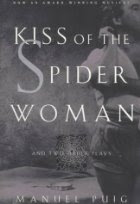
Kiss of the Spider Woman and Two Other Plays (1994)

This collection of plays by Argentinian author Michael Puig includes Kiss of the Spider Woman (El beso de la mujer araña) (1983), Under a Mantle of Stars (Bajo un manto de estrellas) (1983), and Mystery of the Rose Bouquet (El misterio del ramo de rosas) (1987). The totally awesome book club that I'm in (actually, it's a literary society) decided to read Kiss of the Spider Woman, together with Tennessee Williams' Orpheus Descending for our most recent discussion.

Actually, in addition to Puig's 1983 play of Kiss of the Spider Woman, there is also his 1976 novel of the same name, the 1985 film version staring Raúl Juliá and William Hurt, and a Tony-award winning musical from 1993. With so many versions, why hadn't I ever heard of it before?

Kiss of the Spider Woman is the story of two cell mates in a Latin American prison. Molina is gay and a few years into his eight year sentence for statutory rape. Valentin is a communist revolutionary. The play covers a short period in the middle of their time together -- they have settled into a routine where Molina helps pass the time by reciting the plots of old movies, they fight, make up, talk about Molina's mother and Valentin's girlfriends, and take care of one another within the boundaries of prison life. A shocking revelation at the end of the first act complicates things and brings the play to its moving climax and its really quite perfect and wonderful ending. I liked this one a lot.

I have dibs to read the novel soon, and I'm very interested to compare the two, but because I read the play first, I feel like none of the other media will be able to capture Puig's minimalist style and sense of character and timing. I watched some scenes from the musical on YouTube. Bleh. Granted it is based on the book and not the play, and I saw the scenes out of context, but still -- nothing at all like the vision of this story that I had in my head.

The other two plays in the collection were also very good -- particularly Mystery of the Rose Bouquet, the story of a sick old woman, her nurse, and their pasts. Like Kiss of the Spider Woman, a mixture of realism and theatre give the story its power. Highly recommended.

Thursday, October 15, 2009

The Promise of Murder (1959)

I picked up this copy of The Promise of Murder [also known as Melora] (1959) by the uniquely-named Mignon G. Eberhart from a used bookstore in Madison on our vacation. How could I resist? The cover is awesome and the author's name is Mignon. When I did a little searching on the author I discovered that 1) She is a woman; 2) She is from my hometown; 3) She went to the same undergraduate liberal arts college that I went to. I also found out that she was one of the most successful female mystery writers (known as "America's Agatha Christie") and that she has written over 60 books. And now I want to read more of them.

The set-up for The Promise of Murder is a lot like Daphne Du maurier's novel (and Alfred Hitchcock's film) Rebecca. A naive young second wife, Anne, comes into a wealthy household and is overwhelmed by the unspoken memory of the first wife, Melora. In this case, however, Melora isn't dead -- she just divorced Brent almost two years ago. No one ever talks about Melora, not even Anne's sister-in-law Cassie -- the widow of Brent's brother who, with her teenage son and daughter, has lived with Brent for the past fifteen years and ran every aspect of his household.

Brent gets called away to lawyery business in France the same day that the two kids head back to boarding school and Cassie goes to visit friends in the country. Anne sees them all off and goes up to the study only to find a piece of her letterhead in the typewriter with the words "I am going to kill you" typed on it. She gets a little nervous, but blows it off as a joke by one of the kids. After an un-nerving run-in with Melora, Anne finds another note, then another. The teenage daughter comes home unexpectedly with the flu and the two settle in for a suspenseful night full of creepy elevators, appearing and disappearing knives, cut phone lines, and a doctor who might not be a doctor at all.

Soon everyone returns and, after a physical confrontation, the police arrive. But then people start dying. And everything seems to revolve around the alluring Melora...

I think this essay does a nice job of illustrating the appeal of Eberhart's writing. A little romantic, a lot suspenseful, a tiny bit goofy, and entirely enjoyable.

[Wonderfully awesome back cover available here.]

Saturday, October 10, 2009

Gould's Book of Fish (2001)

Gould's Book of Fish (2001) by Richard Flanagan is indescribably weird and wonderful. The story of one forger told by another, Flanagan co-opts the life of real convict artist William Buelow Gould as the narrator of his book within a book that tells the story of a horrific Tasmanian penal colony in the 1830s, art, Australia, love, race, and fish. Lots and lots of fish.

In modern-day Tasmania, a man (who makes fake antiques for a living) finds an unusual book with detailed drawings of fish in the back of a junk store. He becomes obsessed with the scrawled narrative that surrounds the drawings -- bits and pieces of a story, written in different colored inks on found scraps of paper. He can't stop reading the book or talking about it. Every time he opens it, he finds a new passage he hadn't read before, or an unseen slip of paper slides out of the binding. And then one day he finishes it. And the whole thing turns into a salty puddle on the bar. So, after an intimate experience with a fish, he decides to re-create Gould's masterpiece. Which brings us to the book of fish.

Gould is possibly the most untrustworthy narrator ever created, but he is all we have, and he is so damn compelling, that we just make do. He has been exiled to Australia for at least one of a variety of real or mistaken crimes (including forgery, murder, sexing up the wrong people, and disrespecting the flag). And when he eventually is sentenced to the worst and most isolated prison on the rough west coast of Tasmania, he is mistaken by the prison surgeon as an artist, and commissioned to paint realistic drawings of the fish that are brought up in the colony nets for a scientific project in England. Even though he is not really an artist, he likes the small perks that come with the position, and goes with it. At first hating the fish, then loving them, and eventually merging with them completely.

This book has a Tristram Shandyness about it, mixed with a huge dose of colonialism and fishy philosophy. The narrative is at once loose and unconventional, and tightly constructed and satisfying. Absolutely worth checking out.

[Thanks, Corie!]

Thursday, October 01, 2009

interviewer interviewer interviewer

I love my husband because he will drop everything to watch Monty Python clips with me, even when I say all the jokes along with the skit.


Happy flanniversary, baby.

Monday, September 28, 2009

Sometimes We're Always Real Same-Same (2009)

It is books like Sometimes We're Always Real Same-Same by Mattox Roesch (2009) that really show the strength of the LibraryThing Early Reviewers program -- if they hadn't sent me an advance copy for review, the chances of me getting my hands on Roesch's debut novel (particularly considering my tendency to only buy books that are at least a decade old) would have been slim. And this book was great.

"Sometimes we're always real same-same" is one of the reasons that Go-boy, a young man in the small Alaskan town of Unalakleet, loves his girlfriend Valerie. Go-boy is the cousin of our protagonist, Cesar, a high school junior from LA who moves to Unalakleet with his mom (a Native who was born there but hadn't come back for 20 years) after his parents split up and his brother gets a life sentence for killing two people in a gang shooting. Go-boy is positive that Cesar will stay in Alaska (in fact, Go-boy is usually pretty positive about everything), although Cesar is sure he is going to head back to LA as soon as he can save up enough money for a plane ticket.

Then Cesar meets Kiana, Go-boy's adopted step-sister, and after a one-night stand he can't stop thinking about her.

Through a summer of romance, tragedy, and a job counting fish, Cesar becomes more and more tied to the community and his cousin, while Go-boy spins out of control with his unorthodox views of Christianity and philosophies of a world-wide conspiracy to make heaven on earth. Cesar, like most teenagers, is so caught up in his own internal dramas that he doesn't notice that Go-boy's mania is pushing him over the edge until it becomes unstoppable.

This book explores some heavy territory (including alcoholism, gang violence, mental illness, and suicide) without becoming too preachy in the process. The characters, the town, and the interplay between western and Native traditions are nicely drawn and the narrative is compelling and well-paced. I really enjoyed this book, and I think it would be a great read for both high school and adult readers.

Plus the title is sure always real fun to try-say.

Thursday, September 24, 2009

Yoshe Kalb (1933)

In my continued reverse-alphabetical-by-title exploration of Harold Bloom's western canon list, I recently read Israel Joshua Singer's Yoshe Kalb (1933). I am pretty sure I've read some short stories or something by I.J.'s better-known younger brother, Isaac Bashevis Singer, but this is the first Yiddish novel I've ever read.

Yoshe Kalb has the feel of a religious parable or mythic oration mixed with a political satire and a dash of romance novel, although the main character is, at least according to I.B.'s introduction, based on an actual man who lived in the Chassidic community in Galicia. This man, Nahum, who doesn't start out with the name of Yoshe, is married off to Serele, the youngest daughter of the charismatic Rabbi Melech, when he is only 14. He is delicate and scholarly and doesn't fit in well at all in the earthy and backstabbing court of the great Rabbi. Rabbi Melech was anxious to marry off his youngest daughter so that he could take a fourth wife (his third, and most beloved, wife having recently died). The Rabbi marries the young and headstrong Malkah, who also doesn't fit in at court or with her much older husband. Unfortunately for everyone, she and Nahum fall into an uncontrollable lust at first sight. Now it is a pretty big sin to lust after anyone who is not your wife, but it is an extra super big sin to lust after your step-mother-in-law, especially if you are very serious about your faith like Nahum.

As you might imagine, things don't end well. And they don't end well in a particularly spectacular way.

Nahum eventually leaves the Rabbi's city in the middle of the night, starts wandering and reciting the Psalms, and lives as a beggar. A series of events leads him to a place in the house of the Beadle in a town across the border in Russia where he is given the name of Yoshe the Loon. More things don't go well and Yoshe finds himself forced to marry the Beadle's daughter, who isn't playing with a full deck.

So after 15 years, Nahum/Yoshe, who is now so quiet and spiritual that no one can ignore him, goes back to Serele. And when a man from the other village recognizes him as the husband who ran out on the Beadle's daughter, someone's got some explaining to do.

I still do not completely understand the ending of this book, but I liked it quite a bit. You should read it too, so we can talk about it. Anyone? I feel like I simultaneously gave too much away and didn't say enough in my review here, but this is really a fun read with wonderfully written characters (none of whom are all that admirable).

[As an aside, Yoshe Kalb was adapted as a play for the Yiddish theatre, where it was a huge success, and I could really see it working in that format.]

Sunday, September 20, 2009

Time suck

Apparently I am going to spend all day playing this. The noise the skull guy makes when you reunite his head with his body is very addictive.