Friday, January 29, 2010

The Yeshiva, Volume II: Masters and Disciples by Chaim Grade (1968)

As I mentioned in my review of the preceding volume to Chaim Grade's The Yeshiva, Volume II: Masters and Disciples (1968), both volumes are out of print, rather expensive, and a bit hard to find the second volume particularly so. But good old Harold Bloom decided to put them on his western canon list, and I have vowed to purchase all those books, so it was worth the sacrifice.

The second volume of this epic Yiddish novel finds Tsemakh Atlas still the nominal head of his yeshiva, although he is increasingly isolating himself from the school and his students at the same time that the students and the different factions of the town are getting in more and more frequent conflicts. Chaikl, Tsemakh's former student (and the character who is most closely based on Grade himself), is now studying privately with a renowned Jewish scholar, but the more he tries to focus on studying the Torah, the more enraptured he becomes with the natural world.

After an unforgivable clash between Tsemakh and the town, he is asked to leave. His thoughts have turned back to his first fiancé, the one with whom he broke off his engagement before meeting and marrying his beautiful (and secular) merchant wife, Slava. After learning of his first fiancé's fate, he humbles himself before the town and becomes a wanderer, seeking repentance.

The second half of the book finds both Tsemakh and Chaikl back at Tsemakh's home yeshiva several years later. Although the outward fire seems to have left Tsemakh, his internal turmoil doesn't seem to have calmed down at all. Both Tsemakh and Chaikl struggle to make their separate, but parallel, life decisions from under the rubble of their theological upbringing.

In my summary I focus on Tsemakh and Chaikl since they are the core of the book, but Volume 2, much more so than Volume 1, spends lots of time on other members of the two yeshivas and the towns through which the story passes. There is not nearly as much Slava (or other women) in this volume as the first, which I found a little disappointing. The vignettes of other characters are well done, but not as engrossing as the tragic saga of Tsemakh Atlas.

Sunday, January 24, 2010

The Mysterious Affair at Styles by Agatha Christie (1916)

Agatha Christie's first novel, The Mysterious Affair at Styles (1916) was my latest read on dailylit.com, and a tight mystery novel like this really lends itself to the serialized format.

So much of what Agatha Christie writes has become the standard for detective fiction, and it is hard to imagine that her cast of scheming relatives and family friends (who all have something to gain from a murder), the location of a large English manor house in the countryside, and the mysterious poisoning of the matriarch of the family was a rather fresh set-up at the time. Even today, after almost a century of similar mysteries, Christie's clues and characters, and particularly her beloved Belgian detective Hercule Poirot and his friend and "Watson," Hastings, are fresh and engaging.

I always thought that Agatha Christie novels would be stuffy and old fashioned, but even as far back as 1916 she was writing clever, suspenseful, and often funny crime fiction that still entertains.

Wednesday, January 20, 2010

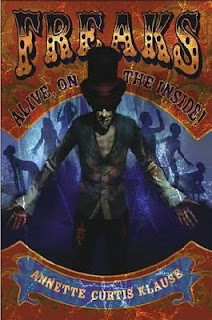
Freaks: Alive, on the Inside! by Annette Curtis Klause (2006)

A copy of Freaks: Alive, on the Inside! by Annette Curtis Klause (2006) fell into my hands after Dr. M got it as a door prize in one of his teaching classes, and it makes for an entertaining and unique young adult novel.

Our hero, Abel Dandy, is a 17 year old boy. It is 1899 and Abel has lived all his life in Faeryland, an amusement park / carnival type place where visitors are entertained by bearded ladies, midgets, Siamese twins and other "freaks." Abel's mom has no arms and his dad has no legs, so Faeryland was one of the only places they could make a living. Abel has good friends there, but increasingly feels out of place since he doesn't have any physical oddities. He gets pretty good at throwing knives, but no one will give him an act. After receiving an exotic ring as a going away present from one of the Siamese twins, Abel decides to run away from home and seek his fortune.

Almost immediately he begins having detailed dreams about a beautiful Egyptian dancer who promises him adventure. He dismisses the dreams as the product of a fortuneteller predicting that he would go off and fall in love with an older foreign woman. After joining another circus as the assistant to a knife thrower, Abel discovers that his young friend from Faeryland, Apollo the Dog-faced Boy has followed him and is hiding out in the elephant's train car. With the added responsibility of taking care of Apollo (and rescuing him from the circus owners who think all "freaks" should be in an institution), Abel breaks away from the circus and hooks up with a small traveling show featuring a midget bearded lady, an alligator-skinned woman, a worm man, a man with two heads, a real Egyptian mummy, and a bunch of cute little freaky-children, as well as one mean skeleton-man manager and his creepy henchmen. As Abel works to return Apollo to his parents and meet his dream woman, he has to fight his way through some pretty dark situations and learn more than a few things about himself and the way the world works.

This book was a really fulfilling adventure and coming of age novel -- I think older junior high or high school students (as well as adults!) would really like it. There is some sexual business (Abel is 17 after all) and some violence in it, but it isn't too explicit and fits nicely with the action of the story. Klause's characters, her descriptions of circus life, and the view of late-19th century America are all strong points of the book. There is a "twist" that I could spot right away, but I think younger readers will be surprised, and even though I figured out what was going on more quickly than it was revealed, the plot ultimately moved beyond the twist and kept me entertained and excited.

Friday, January 15, 2010

The Piano Lesson by August Wilson (1990)

My latest look at the random book generator brought up The Piano Lesson by August Wilson (1990), which Dr. M bought and read for an African American Literature class a couple of years ago.

The Piano Lesson takes place in 1930s Pittsburgh (and is actually the fourth play in Wilson's series The Pittsburgh Cycle) at the home of Doaker, his widowed niece Berniece, and her daughter Maretha. Berniece's brother Boy Willie is in need of some money so he and his friend Lymon come up from the south to sell a truckload of watermelons and negotiate the sale of a family heirloom, an intricately carved piano. Boy Willie has a chance to buy the land that their family had worked as slaves, if he can just get enough money together. But the piano has a history that makes it un-sellable in Berniece's eyes. The conflict between the brother and sister and the ghosts of the past and the present give this play a tension and presence that you can feel through the pages. It is pretty easy to see why The Piano Lesson won the Pulitzer Prize for Drama...

Of course, reading a play and seeing a play are two very different (although often equally enjoyable) things. I'd love to see The Piano Lesson someday, but for now I'll have to make do with the trailer from the 1995 film of the play, featuring most of the Broadway cast.

Sunday, January 10, 2010

Then Came the Evening by Brian Hart (2009)

My latest read from the LibraryThing Early Reviewers program is Brian Hart's debut novel, Then Came the Evening (2009), a tragic story of a family in small-town Idaho.

Then Came the Evening starts off strong, setting into motion the inevitable trajectories of three interesting characters. Bandy is a young man who has just come back from Vietnam and is living in a cabin on his parent's property with his girlfriend Iona. Bandy wakes up one morning to find himself in a crashed car on the ranch, still drunk, with the police and his father waiting for him outside. The cabin that he and Iona shared has burned to the ground, and everyone assumes Iona went with it. Bandy becomes violent and ends up shooting one of the officers and going to jail. Iona didn't die in the fire, though. She was fed up with Bandy's drinking and affairs and left him for another man and moved away. Eighteen years later, still in prison, Bandy gets a brief letter from Iona. She was pregnant when she left him, and his son, Tracy, wants to meet him.

First Tracy, then Iona, then Bandy end up back at Bandy's parents house on the family ranch. Bandy's parents died years ago, and the man Iona left Bandy for has also died. All three of them are raw and flawed and filled with their own resentments and regrets. Is being family enough to bring them redemption?

While the book started out strong (the prison scenes are particularly well written), the last half of the book falls apart a bit with some mis-steps in pacing and some dialogue and action that doesn't seem to fit with the characters as they were revealed to us at the start of the book. I feel like I'm being a little nit-picky with the flaws of Then Came the Evening but that is only because it could have been a great book and it ended up only being good. Hart has a real talent for describing the rural and small-town Idaho landscape, and for crafting his characters -- I really look forward to reading his next book.

Wednesday, January 06, 2010

The Savage Scalpel by Alain Rothstein (1968)

Perhaps an ordinary person would take a look at the goofy cover of Alain Rothstein's 1968 novel The Savage Scalpel and say: "That looks pretty bad. I'm not going to read it." I, on the other hand, said "That looks pretty bad! I'm going to read it!" Sometimes when I say that, the books end up being pretty good. Sometimes they are at least funny. This one was honestly one of the most poorly written books I have ever read. There was some entertainment in that, but that is about as far as it went. Here are some unconnected thoughts on the book:

1. The back of the book promises: "A brand-new dimension in reading experience -- for those who are willing to risk treading to the edge of appalling sensation!" I fear that might have been over-selling it...

2. Plot description: Frank Young, a big-shot psychiatrist, and his best friend Mel, a former attendant at the institution where Frank worked, band together to solve the murder of Frank's half-sister. She was brutally tortured by the mob and found murdered in her New York apartment after Frank and Mel returned from a two-year trip overseas to help Frank forget about the death of his fiance, who was killed in a car accident by two mobsters fleeing a robbery. These mob events are not related, except to highlight that Rothstein does not like the mob. In the end, Frank and Mel decide to take matters into their own hands and torture members of the mob to find out what happened to Frank's sister.

3. This will give you a sense of Rothstein's smooth exposition, when Frank first meets Mel: "I thank you my friend," he said. "And I admire your nonconformity. Do you know, I went to the University of Pennsylvania for four years for my M.D., after my undergraduate years. Then there were two years as an intern at Bellevue Hospital in New York. After that, two years as a resident in neuropsychiatry at the state mental hospital, followed by a chief residency in neurology at the best university hospital in Manhattan. Now I'm a fellow in neuropsychiatry here at the Retreat. But in all those years, nobody on the staff of any of those institutions -- but nobody -- ever called me 'Doc' before."

4. This will give you a sense of the uncomfortable sex scenes: They made love then, without bothering to remove all their clothes. Easily, almost lazily, at first, they embraced, exploring each other's body with caressing fingers and lips, then began the rhythm of the dance of life. Okay, reading this book was totally worth it for the phrase "the rhythm of the dance of life."

5. There are about 20 pages in the middle of the book that were definitely written for another purpose and possibly written by another author (Frank gets a call from a former lover who reads about his sister in the paper, then he reminisces about their affair in a coherent and decently-written fashion before returning to the incoherent and poorly written story).

6. The "Brutal, violent, slashing!" torture climax is.... boring. Frank tortures two of the mobsters by using his medical knowledge to dissect them in front of some other mobsters. That is admittedly pretty brutal, but instead of creating any tension or gore, Rothstein actually has Frank give us an anatomy lesson and basically just types a few paragraphs from a medical text book with the occasional groan thrown in.

I could go on and on (which, I suppose, is one reason to read the book), but overall this was an uncomfortable read with inconsistent characters and clunky writing. I guess you can't win them all....

Saturday, January 02, 2010

Microthrills by Wendy Spero (2006)

Once again the lovely St. Murse loaned me a book that he didn't like. To be fair, he wasn't really sure I would like it either, but he knew I would give it a shot: and he was right on both counts!

Wendy Spero's Microthrills: True Stories from a Life of Small Highs is a book of essays based on the stand-up comic's one woman show about her life. The back of the book compares Spero to David Sedaris -- to be honest, I like Sedaris but have never really gotten why people are so super excited about him -- Sedaris does, however, actually make me laugh. Spero, not really so much.

Not that this is a bad book. Actually it was a pretty good book to read in spurts over the holidays while I took refuge from the negative twenty degree windchill on my mother-in-law's couch. The stories of Spero growing up in Manhattan, her journeys through her first jobs, her neuroses, her mother's neuroses, and all the rest are all very nice and not poorly written. And yet, despite all that, they didn't really make me laugh or think or anything at all. Although Spero and I are about the same age, I didn't feel like I related to her or her problems or worries at all -- there just wasn't any connection there.

I am pretty sure that Wendy Spero is a fine stand-up comic, and that her one-woman show is pretty entertaining. But for me, at least, that entertainment just didn't come through in the print version of her memoir.

Thursday, December 31, 2009

The Aspern Papers by Henry James (1888)

Attention all archivists and historians: you should read this book! It gets 27 thumbs up from me.

Henry James' The Aspern Papers (1888) is a tightly constructed and satisfying novella that explores the ethical implications of biographical research through a pointed character study. In the book, our protagonist is a literary critic and historian who specializes in the life and work of Jeffrey Aspern, a prominent American poet. He learns that Aspern's lover, Juliana, is living in a dilapidated mansion in Venice with her spinster niece. Juliana is now an old woman, but the narrator is sure that she has some precious letters and other material relating to the great Aspern.

After his colleague inquires about the letters and is quickly dismissed, the narrator decides to take a different track -- approaching the two women as a fellow American interested in renting some rooms in their large house so that he can have access to their garden. They are in need of money and quickly take him up on his offer, and he attempts to ingratiate himself to Juliana and woo the niece to gain access to the precious documents.

The three main characters in this book are very nicely drawn, and the narrator is deliciously unreliable and self-serving. The implications of the narrator's actions and the awareness (or naivety) of the two women shift through the story and continue to change in your mind after you read it. The "at all costs" attitude of the narrator as well as the ending of the book (which I won't reveal here) remind me quite a bit of Julian Barnes' novel Flaubert's Parrot. In format and style the books are very different, but the themes and characters are sometimes interchangable.

An excellent read -- one of Henry James' best.

***
Sorry for the lack of posts lately -- I went up north for the holidays, and forgot to put a note up here. Never fear: I read plenty of books while I was keeping out of the winter weather.

Sunday, December 13, 2009

Doubleback by Libby Fischer Hellmann (2009)

I got a copy of Doubleback (2009), the second of Libby Fischer Hellmann's mystery/suspense books staring Chicago PI Georgia Davis (and the sixth featuring videographer Ellie Foreman) as part of the LibraryThing Early Reviewers program. I am generally pretty forgiving of mystery novels, and it is possible that Hellman's books need to be read as a series instead of plucking one out of the middle, but this book really did not work for me at all.

The plot is... confusing. Here are the basics: The neighbor of Ellie's friend's little girl Molly is kidnapped. She doesn't want to call the police, because the kidnappers threatened her daughter's life, so she goes to Ellie's friend who calls Ellie for some reason. In a previous book it seems the Ellie and Georgia solved some kind of mystery together, so Ellie calls Georgia. Georgia doesn't want to get involved but (as is repeated multiple times), she has a tender spot in her heart for little children, even though she is emotionally distant from everyone else. Still, she suggests that they go to the police, and then, oddly enough, the little girl is dropped off outside of her house three days later and no one will say what happened. Then the boss of Chris Messenger (the mother) at the bank (did I mention she is the IT director at a bank?) dies in a mysterious car accident and it appears his brake lines were cut. Then the same thing happens to Chris. Chris's ex-husband hires Georgia to figure this all out, which eventually leads to complicated discussions of bank transaction protocols, Blackwater-esque security firms, and drug trafficking on the Arizona/Mexico border. Throw in a couple weird side plots where Georgia gets all dolled up to investigate a high-end dating service that is potentially stealing people's identities and a preachy video-shooting excursion to an ethanol plant in Wisconsin and you have one seriously not-that-great mystery.

Surprisingly, in the midst of all the crappy characters and unbelievable action, there was one character that I really liked, and about 25 pages in the last third of the book that started to get exciting. Then that character died and everything got stupid again.

I appreciate the charms of a series, where characters build in complexity over a series of books, but I think (especially in the mystery genre) the books should be able to stand on their own. Doubleback doesn't.

Monday, December 07, 2009

The Yeshiva: Volume 1 by Chaim Grade (1967)

When I bought this copy of The Yeshiva by Chaim Grade (1967), which I'm reading because it is on Harold Bloom's Western Canon list, I knew that it was a two volume work, and I was pretty sure that the copy I bought had both volumes bound together. Not so. So, after Christmas I will work on getting the (out of print, rather expensive) Yeshiva, Volume 2: Masters and Disciples. Until then, you and I will have to make do with just one half of this epic Yiddish novel.

The Yeshiva draws on some of Chaim Grade's own experiences growing up in Lithuania and Poland between the wars in a story that crosses religious torment with vingettes of everyday life. The main character is Tsemakh Atlas, a scholar who fanatically follows the teachings of the Mussar movement (a Jewish ethical movement that focuses on removing all traces of sin from your thoughts and actions, rejecting comfort and pleasure, and [apparently] telling the truth to everyone even if they don't want to hear it). The problem, however, is that Tsemakh secretly doubts the existence of God and openly belittles close studying of the Torah, which is what pretty much everyone else thinks a good scholar should work on.

Tsemakh fights with his home yeshiva (a yeshiva is kind of an academy for studying the Torah -- as a side note, I am very thankful this book came with a glossary), and finds himself agreeing to an engagement with a pious unmarried woman in a far-off town. But, because Tsemakh is fiesty and often acts without thinking, he sours on the idea, breaks his engagement, and moves on, only to lustily fall for a freethinking, beautiful and wealthy woman from a merchant family. Slava is on the market because everyone knows she has been having an affair with a married man in the big city, but Tsemakh falls head-first into his passions and ignores all the reasons why he and Slava are not a good match. He shaves off his ear-locks and beard and attempts to be a shop-keeper with his brothers-in-law.

It naturally does not take Tsemakh long to work himself into a guilty fury for ignoring his Mussar teachings and falling for a non-observant beauty. After hurling himself back into his faith, he decides to take another scholar from the village and move somewhere else to start up his own yeshiva. He brings a few students from Slava's town with him, including Chaikl, who soon takes over the focus of the book as he walks a parallel path between piousness and temptation.

Grade paints a realistic and engrossing picture of Jewish life between the wars in the period where freethinking and secular movements were threatening the traditional way of life. In Tsemakh we have a man with horribly ordinary passions and doubts who takes pleasure in tormenting himself and generally alienates those around him. He is balanced by a whole host of scholars, villagers, families, and shopkeepers who spend their time just living their lives. This is only the second Yiddish novel I've read, but I liked it even better than the first (although, to be fair, they are pretty different) and I am very interested to read Volume II and see what kind of fervor Tsemakh works himself into next.

[Anyone know how to pronounce Tsemakh? (Professor Romance?) It has been driving me crazy to not be able to pronounce it in my head....]

Monday, November 30, 2009

Enter the Saint by Leslie Charteris (1931)

Enter the Saint (1931) was Leslie Charteris' second foray into the Saint universe, but he liked it so much better than the book in which our hero first appeared, that he liked to think of it as the start of the series (which eventually grew into dozens of books, movies, TV shows, and a 1997 film I never heard of starring Val Kilmer).

And it is easy to see why the character was so popular -- known as "the Robin Hood of Modern Crime," Simon Templar, aka The Saint, is a moral criminal who steals from immoral criminals and donates all their ill-gotten wealth to charity, minus a 10% collector's fee for him and his compatriots. He is stylish, witty, smart, and very good at driving fast cars in a dare-devil fashion through the countryside. He calls everyone baby, sweetheart, angel, or love. He is just and moral and righteous, but he also drinks a lot, has a sexy and smart girlfriend, and knows how to crack a joke.

In this book, Charteris gives us three novellas staring The Saint and his gang as they outwit criminals and simultaneously help and avoid the great Inspector Teal of Scotland Yard. I get the feeling that the same thing happens in all the other books too, but I can't imagine getting tired of it. I'd never read any Leslie Charteris before, but I'd love to read more. And make sure to check out his Wikipedia page -- his biography is almost as exciting as his books.

[Super exciting back cover available here!]

Saturday, November 28, 2009

Telling the truth can be dangerous business

All those idiots who say that Ishtar is a bad movie are sadly misinformed:


It does get a little sloppy and loses some momentum when they go to North Africa, but it picks back up, and the first half of the movie is one of the funniest things I've ever seen. Make sure to watch at least the first few minutes of this.

Sunday, November 22, 2009

Black and Blue by Anna Quindlen (1998)

Anna Quindlen's novel Black and Blue came out in 1998 and was immediately added to the illustrious ranks of Oprah's Book Club. Naturally it also shot right up the bestseller's list. At the time I was working at a Barnes and Noble and Oprah's Book Club was a Big Deal, and I didn't like it at all. I also had an immediate dislike for books on the bestseller's list since I had to stick 30% off stickers on every one of them, and then take them off all the ones that fell off the list at the end of the week. And yet, somehow, I ended up with a copy of Black and Blue that I have been moving around with me for the past 11 years. My copy even had one of those dreaded 30% off stickers stuck to the inside of the front cover. But: it came up on my random reading list generator, and I decided to finally give Black and Blue a chance.

This is the story of Fran Benedetto. She has been married to Bobby Benedetto, a New York police officer, for fifteen years. They have a son named Robert. She works as a nurse. And Bobby has been beating her since she was 19 years old.

As the book begins, Fran has started her journey away from Bobby with the help of a battered woman's organization that is run just like the witness protection program. She takes Robert and tries to settle down in an anonymous town in Florida, but all the time she is looking over her shoulder and waiting for her husband to find her. Gradually she starts to make friends and find work, Robert has a buddy in their apartment building and enjoys playing sports at school. Fran even finds a man who loves her, and who she thinks she can trust. But eventually, the inevitable has to happen.

Quindlen is a good writer, and the story is well-written with compelling (although sometimes a little clichéd) characters and a suspenseful ending. By the nature of the subject matter, the plot is pretty suffocating (everything is defined in terms of Fran's abuse by Bobby, and there is no doubt that he is going to find her and Robert eventually). I can't really hold the singular focus of the novel against Quindlen, since I'm sure that a woman in Fran's situation couldn't help but experience life just the way Quindlen writes it, but it does not make this an easy or really very enjoyable book to read.

Although it is occasionally a little overly Lifetime, I would say that Black and Blue has once again proven my distrust of Oprah's Book Club and the bestseller list wrong.

Wednesday, November 18, 2009

I'm a Winner!

I won a book giveaway from the always entertaining Forgotten Bookmarks site yesterday. If you haven't looked at it before, you should check it out -- finding things slipped into old books has always been one of my favorite surprises. Thanks FB!

Tuesday, November 17, 2009

Trouble Under Oz (2006)

The lovely Choo loaned me Trouble Under Oz (2006) by Sherwood Smith, an authorized modern addition to L. Frank Baum's Oz series. The book is actually a sequel to Smith's first journey into the Oz world, The Emerald Wand of Oz, which I haven't read, but she gives enough background about the characters that, much like Baum's original series, you can read the books independently.

Dori and Em are two sisters in Kansas who have already had one exciting adventure together in Oz, thanks to a wild tornado. While they were there, Glinda gave them a special snow globe that they can use to see what is going on in Oz while they are back in Kansas. The two look at it all the time, and one day Dori sees Tik-Tok holding a sign that Glinda needs their help. Lucky for them, a series of unusual coincidences (snow storm, sick grandmother, fighting parents) clear the way for Dori to journey to Oz while Em stays home and covers for her. Once in Oz, Dori hooks up with Prince Inga of Pingaree (who you might remember from Rinkitink in Oz) to find Prince Rikiki, the son of the deposed leader of the Nomes who Dori met up with in her last adventure, and help him get his throne back while avoiding a war with the neighboring kingdoms. Oh and there is also some kind of trouble with Dorothy and weird black clouds, which is pretty obviously thrown in there to give Dori and Em something to do in the next addition to the series...

The three young people have some nice adventures with plenty of nods back to the original series. While the book is well written, it doesn't have the looseness or creativity of the Baum originals, but that isn't really Smith's fault since adding to a classic series is naturally a less free and creative medium than starting something from scratch. The book is illustrated by William Stout, who did a great job except that all his drawings show Dori with short hair and in one scene Em makes a point of saying that Dori's hair is very long -- am I a nerd for being bothered by this? I did like that Smith makes a point of having Dori ask where all the female Nomes are, since you never see or hear anything about them in the original Oz books, and the answer is excellent.

I'm not sure that this is a book that needs to be read by anyone except those who have a love for the Oz world, but if you do, then Smith's new additions to the series seem to be worth checking out.

Saturday, November 14, 2009

Tennessee Williams: Four Plays (1976)

I bought this copy of Tennessee Williams: Four Plays (1976) because my bookclub was reading Orpheus Descending, and I was happy to get the chance to also check out Summer and Smoke, Suddenly Last Summer, and Period of Adjustment.

Orpheus Descending (1957) is a revised version of Williams' first play, Battle of Angels, which played briefly in 1940 to a poor reception. He couldn't let the story go, though, and revised and reworked it for 17 years until his star was bright enough to give the failed story another shot. The play is about Lady, an Italian woman who runs a confectionery in a small southern town with her sick (and cruel) husband, Jabe. One day a musician comes into town, trying to escape his previous life of partying and stealing. Lady gives him a job at the store and the two begin a love affair with her husband dying in the bedroom upstairs. Things don't end that well for anyone.

Summer and Smoke (1948) is the story of Alma, a preacher's daughter, and the boy next door, John, a doctor's son. Ever since she was a little girl, Alma has loved John, even though he moved from a little boy who teased her to a grown man that mostly ignores her. Alma grows into a high-strung and sensitive adult who gives piano lessons, sings awkwardly at public events, and giggles nervously just about all the time. When John returns home from college he is at loose ends and reconnects with Alma, raising her hopes that they will be together at last. As the year moves on, however, he spends more and more time at the Moon River Casino with the owner's sexy daughter Rosa. Things don't end that well for most of these characters, either. This one is probably my favorite of this batch.

In Suddenly Last Summer (1958) things don't even start all that well. A wealthy New Orleanian woman's doting middle-aged son died while on vacation with his pretty young cousin, Catherine, who has been hysterical since she returned and is being kept in a private mental institution by her wealthy aunt. Mrs. Venable has a Sister bring Catherine to her home from the institution to tell the real story of her son's death, since she does not believe the story that Catherine keeps telling everyone. And to make sure that Catherine doesn't tell anyone the story anymore, her aunt has hired Dr. Cukrowicz to force her niece into getting a lobotomy.

And, finally, in Period of Adjustment (1960) (subtitled High Point over a Cavern: A Serious Comedy) things start out pretty rough, get even rougher in the middle, but end up working out just fine. A newlywed couple, George and Isabel, drop in on George's old army buddy Ralph on their second day of marriage. Things didn't go well on their first night as a married couple, and they are both pretty riled up about it. Ralph isn't doing too much better since his wife packed up their young son and left him earlier that day. Oh, and it is also Christmas Eve. It turns out that both of the couples are just going through a period of adjustment.

I really like Tennessee Williams -- everything about his plays is heightened and tragic and romantic and sad, and that is just the kind of thing I like. I can understand why he doesn't appeal to everyone, but if you like Williams, this collection of some of his less well-known plays is worth checking out.

Thursday, November 12, 2009

Let the Right One In (2004)

I always enjoy seeing what the LibraryThing Early Reviewers program decides to send me, even though it usually isn't a book or author I had ever heard of. So when I got the notice that they were sending me a copy of John Ajvide Lindqvist's Let the Right One In (2004) -- the book upon which the recent vampire movie is based -- I got extra excited. I love good vampire stories, and from what I had heard about the movie this was a genuinely freaky horror story without all that teenage Twilight-y nonsense.

In the bleak winter of suburban 1980s Stockholm, 12-year-old Oskar holes himself up after school in his bedroom in the apartment he shares with his mother to avoid the constant bullying he is subjected to on the playground. His secret hobby is clipping out newspaper articles about murderers and serial killers and pasting them into his scrapbook. His bookshelves are filled with horror novels, and his daydreams often turn violently against the boys the bully him at school.

Then, one evening, a boy is killed, drained of blood, in the woods in a nearby town. The next night Oskar meets his new neighbor on the playground at the apartment complex. She is an odd young girl named Eli who simultaneously attracts and repulses Oskar, but he can't stop going out every night to see her again.

One of Oskar's neighbors is part of a group of friends who meet up at a nearby Chinese restaurant every night to drown their sorrows and pass the time. Then one of them disappears, and the only witness to his death is the saddest and drunkest of the group -- a man who lives with dozens and dozens of cats and hardly ever leaves the house. He saw his friend attacked by a child, but he doesn't think anyone would believe him and doesn't want to get involved.

Things escalate -- both between Oskar and Eli and between the victims and survivors. The characterization in this book is excellent -- the coming of age romance between the two children, the co-dependence of Eli and those around her, and the friendships and broken lives of all the adults. And there are also some kick ass horror scenes, excellent (and often disturbing) kills, and a nice interpretation of the traditional vampire mythology.

I am excited to watch the movie, and even though I've heard it's great, I can't imagine that it could hold up to the book. Very nicely done.

Sunday, November 08, 2009

Behind a Mask: Or, A Woman's Power (1866)

Little Women was one of my favorite books growing up, and since Louisa May Alcott and I share a birthday, I've always been a bit fascinated with her and her life. I'm not sure how I went all these years without checking out some of her pseudonymously published romantic potboilers, but thanks to the technological serialization of DailyLit, I just finished reading Behind a Mask: Or, A Woman's Power (1866) in 48 easy installments.

Alcott was much like her Little Women character Jo, and wrote Behind a Mask and her other A. M. Barnard stories to earn the money that her family needed but her idealistically transcendentalist father could not supply. The story is romantic and suspenseful, but skilfully written with underlying themes that make it something more than just a paycheck.

A young and lovely governess, Jean Muir, is recommended to the wealthy Coventry family as a companion for the teenage Bella. She is coldly received by the eldest son and heir, Gerald, and his betrothed, his cousin Lucia, but warmly welcomed by Mrs. Coventry and her younger son Edward. Ms. Muir quickly enchants most of the family with her quick wit and lovely singing voice, and earns their pity with a delicate constitution and sad back-story. In fact, one by one, even the hardest hearts of the family will fall madly in love with her. But at the end of the first chapter, when the new governess is left alone in her room, we see her remove her make-up, relax her guard, and show us that she is not at all what she seems.

This book worked particularly well being divided up into daily segments, and I'm keen to check out some of Alcott's other works for hire...

Friday, November 06, 2009

Brothers?

Don't you think that Carol from the Where the Wild Things Are movie looks like he could be a close relation of.....


...Coach McGuirk from Home Movies?

This point would be easier to prove had I access to a larger library of stills, but if you have seen them both, then do you know what I mean?

Thursday, November 05, 2009

The Kids are All Right (2009)

Our latest literary society discussion pick is The Kids Are All Right (2009) by Diana and Liz Welch, with the help of their brother Dan and their sister Amanda. This is a memoir of four siblings, each of whom experienced and remember the unsettling events of their youth in very different ways that all come together into a very engrossing and moving book.

When Amanda, the oldest sibling, was 16 and Diana, the youngest, was four, their father died in a car accident. He was driving back to their home in Bedford, New York form his father's funeral in Boston. Their mother, a soap opera actress, was left alone with the four children and a mountain of previously undisclosed financial problems. And then, one month later, she was diagnosed with cancer. When she died four years later, the siblings struggled to find families that could take them in, especially the two youngest -- Dan (14) and Diana (8) -- but no one would volunteer to take them all.

I am not always a fan of the "crazy childhood" memoir genre -- I think they are often played either too lightly or too tragically. But The Kids Are All Right, in part because of its four narrators, is moving because it is straightforward and has a natural delivery of both humor and sadness. And while much of the book is about the family tragedies, the memoir also gives us the same awkward and funny and isolating and embarrassing normal experiences of growing up. Very nicely done.

[There is also a lovely web site, if you want to find out more about the book and the Welch family.]