Wednesday, September 17, 2014

Foam of the Daze by Boris Vian (1947)

The lovely Bridget lent me her copy of Foam of the Daze by Boris Vian (1947) [L'Écume des jours originally and also translated as Froth on the Daydream]. I'd never heard of this book before the recent Michel Gondry adaptation (Mood Indigo -- which I really enjoyed), but apparently it is something like The Catcher in the Rye of French literature -- wildly popular among young people for generations and extremely influential.

I'd like to quote my own dear husband, Dr. Mystery, in his review of The Wanderer by Alain-Fournier: "In classic French tradition, this book is about nostalgia, idealized romance that turns tragic once it becomes real, the romanticism of adolescent desire and yearning and the painful loss of that desire when adulthood hits, and the impermanence of childhood idylls. The book is melancholy and concerned with loss, but it's not heavy-handed or oppressive and is often funny." In fact, I could just quote Dr. M and end this review right now, because in classic French tradition, this book hits all those same points.

Colin is rich and lives in a fantastical apartment. He is best friends with Chick, who is obsessed with Jean-Sol Partre. He also has a cook, Nicolas, who is extremely creative in the kitchen. He has mice that are his friends and a piano that makes cocktails as you play and everything is great except that Chick has recently fallen in love and Colin hasn't. He meets Chloe at a party, quickly decides he is in love with her, and they marry. Everything is great until, on their honeymoon, Chloe takes sick. Colin spares no expense in her treatment, but soon goes through all his money and has to sell his pianococktail and get a job, which nearly kills him. Chloe dies, they bury her in the saddest (but also funniest) funeral of all time, and that's just it.

As a girl who likes tragic endings, this book has a lot to recommend it. I am glad that I saw the film before the book, because Gondry puts a lot more life into Chloe and the other female characters, who are all pretty flat in Vian's novel. I was also able to really delve into the extensive (and helpful!) footnotes as I read and didn't have to worry too much about getting taken away from the plot or the characters, since I was already familiar with them from the film.

This was an interesting one, and definitely one of those rare cases where both the film and the book are worth experiencing, in either order.

Monday, September 01, 2014

The Liars' Club: A Memoir by Mary Karr (1995)

I had a mental block against reading The Liars' Club: A Memoir by Mary Karr (1995) since 1995 was right in the heart of my time working at Barnes and Noble and The Liars' Club was a runaway best seller. Anything that was a best seller in the late-1990s makes me wary after all the time I spent sticking on and taking off 30% and 20% off stickers and restocking the shelves at the front of the store. My DAFFODILS book club, however, decided to read something from the 1990s and when this was was suggested, the nearly 20 years since I had to deal with those discount stickers disappeared and I finally felt ready to dive in.

This, the first of Karr's three published memoirs (along with other essays and books of poetry) tells the story of her mother, her father, and the childhood she and her sister had in Southeast Texas and (for a short period) in Colorado. Karr grew up near Port Arthur, close to the gulf, and right in the middle of the oil industry. Her father worked for the oil company, as did most of the people in her town (fictionally called Leechfield, but actually the town of Groves, between Port Arthur and Beaumont). Her mother was an enigmatic artist and voracious reader from west Texas who lived for several years in New York City and did not mix well with the other women in the town. Her father was a favorite among his friends at the Legion and known for his ability as a storyteller and his propensity for fighting (and for undoubtedly winning those fights). Both of them drank and both of them had tempers, but what really made things unstable was the depression and mania of Mary's mother, Charlie.

The action of the book takes place mostly in the early sixties, when Mary is about 6-8 and her sister, Lecia, is about 8-10, although the hard things that happen to them and their resourcefulness and (particularly in the case of Lecia) stoicism, often make them seem older. While there are plenty of pleasant and often funny memories of their time together as a family, the burdens placed on Lecia and Mary to hold their mother together, Mary's sexual abuse by two men outside the family, and Charlie's several very real (and dangerous) mental breaks can sometimes make this a pretty rough read.

The storyteller, of course, is a grown up Mary Marlene Karr and she never really lets the reader forget that she is a grown woman looking back on her childhood. She also admits when she doesn't remember something, when she might be remembering something differently than how it happened, and when her sister would undoubtedly correct what she was saying -- this gets around one of my big problems with many memoirs: the adult writer's tendency to make things seem better (or worse) than they really were and the reliance on memory (particularly a child's memory) as if it were fact.

The last section of the book jumps forward to the 1980s and brings some adult context to the lives of Mary and Lecia and some explanation and mellowing of her mother and father. I'm interested to read Karr's other memoirs, one of which covers her adolescence and early adulthood and the other her recovery from alcoholism and conversion to Catholicism. If the straightforward, funny, and sometimes brutal narrative voice of The Liars' Club is any indication, the following memoirs should be just as piercing and full.

Wednesday, August 27, 2014

Fear is the Same by Carter Dickson (1956)

The pulpy cover of my copy of Fear is the Same by Carter Dickson (1956) along with the back cover copy that screams: "Many men held her body -- did any man hold her heart?" would make one think that this is a classic 1950s crime novel. Instead, it's an unusual time-travel / historical romance / murder mystery / adventure novel. While some readers of the genre might be upset about the bait and switch, I rather liked the unexpected story.

Jennifer has unexpectedly found herself living in a house in the Regency England of 1795. It is unexpected because, while she can't remember all the details, she knows she comes from far in the future (from the 1950s, in fact) and that she was fleeing some kind of danger when she was apparently sent back in time. A body must have been waiting for her because everyone knows who she is. She slowly starts piecing things together when she sees a familiar face, Phil, who she recognizes as her great love from the 1950s. Phil is also starting to realize that he has been plopped down into the past, in his case into the body of a Lord who is widely known as being a sickly wimp married to a headstrong and beautiful bitch named Chloris. As their memories slowly come back, Jennifer and Phil realize that they were lovers and that Phil had been running from a false murder charge that seemed impossible to beat. Unwittingly, they set off the same set of events in their new time zone when a murder takes place in Chloris's locked bedroom and every clue points to Phil as the murderer.

Interspersed with Jennifer and Phil's quest to prove his innocence is really quite a bit of boxing (apparently both old and new Phil have secret bare-knuckle boxing skills that they use to get out scrapes and earn money), some detailed history of the Whigs and the royal family, and some pretty great scenes where Jennifer and Phil are trying to find landmarks in a much more rural London based on their 20th century mental maps of the city. This book is occasionally more complicated than it needs to be and frequently reveals its author's delight in the details of the Regency period, but it pulls the reader along with the action sequences and has some unexpectedly great character development. I could have asked for a slightly less abrupt ending, but the book holds together well as a whole.

Carter Dickson is one of the multiple pen names of John Dickson Carr, a prolific writer of mid-century detective novels. Based on the twists and turns and energy of this one, I'd definitely take another one of his books out for a spin.

Saturday, August 16, 2014

A Farewell to Arms by Ernest Hemingway (1929)

My Debbie Downer book club decided to read something about World War I this year, which is the 100th anniversary of the start of the war, and since none of us had read Hemingway's Very Important Novel, A Farewell to Arms (1929) before, and we knew it had a sad ending, it seemed like a good pick.

I had never read any of Hemingway's novels before, although I had read quite a few short stories and I had an idea of what I thought about Hemingway and his writing style going into this (important, influential, but also super masculine and difficult for me to really grasp onto). I won't lie, I didn't love this book, and I guess I knew I wouldn't really love it going into the thing, but I do love having read it, since I think it's an important part of American literature and now I can say I don't really like Hemingway with the authority of someone who has actually read a whole novel.

A Farewell to Arms tells the story of Frederic Henry, an American man who is serving as a Lieutenant in the Italian army's ambulance corps, before the U.S. has entered the war. Henry meets Catherine Barkley, a British nurse serving in a hospital in Italy, and they soon fall in love. After Henry is wounded in the knee, he is transferred to Milan to convalesce and Catherine nurses him back to health and ends up pregnant. After a series of disillusioning adventures, Henry ends up going AWOL, reuniting with Catherine, and escaping to Switzerland. You probably already know how the book ends, and it is not happy. 

Someone asked me if this book was a romance and my answer is that I think Hemingway thought it was supposed to be, but I don't see how any woman could read the character of Catherine and think she was a) a realistic portrayal of a woman, b) that she actually loved Hemingway, or c) that anyone could actually love her. The classic brusque Hemingway dialogue means that the scenes between Frederic and Catherine are clipped and forced. She alternates between inexplicable moodiness at the beginning to an even more inexplicable complete surrender to anything Frederic wants to do at the end (with a brief bit of fire and irritability when she is actually in labor, but we see where that gets her). Frederic is apparently devoted to her but also seems just as devoted to drinking and (at first) the war effort and (later) avoiding any mention of the war.

It's easy to see why this was an important and popular book when it was released in 1929, ten years after the war. It would appeal to veterans, to their families, and to all the people who now felt the same disillusionment and fatalism as Frederic. I don't think the book ages well, and with the (lack of) character of Catherine, it doesn't hold much appeal for at least this 21st century American woman. 

And I'm not discounting Hemingway entirely -- I would totally give The Sun Also Rises a fair shot.

Monday, August 04, 2014

Today is Here by Don Blanding (1946)

I won this signed copy of Today is Here by Don Blanding (1946) in a raffle at an archives conference. I'd never heard of Blanding before, but this was a lovely little book of poems and drawings and I figured my reading it was meant to be.

Little did I know, Don Blanding (1894-1957) was quite a man. In fact, according to a fan's web site, he was "Author of such classics as Vagabond's House, Hula Moons and Drifter's Gold ~ Hawaiian Poet Laureate and Founder of Lei Day ~ Artist ~ Restless Vagabond ~ Designer of Vernon Kilns Dinnerware, Greeting Cards and Hawaiian Clothing ~ Songwriter ~ Theatrical Actor, Director and Producer of Musicals ~ Soldier ~ Lecturer ~ Radio, Film and Television Personality ~ Newspaper Columnist." That's a pretty amazing life! Blanding was born in Oklahoma and studied art in Chicago for a couple years before serving in WWI. After the war he studied art in Europe and then settled in Hawaii where he wrote poems for advertisers in a newspaper. His poems became very popular on the island and after locally publishing a few volumes of poems and art, he got a New York publisher and became famous, married a socialite, lived all over the world, got divorced, and never lost his passion for Hawaii (he is, indeed, known as the poet laureate of the island and founder of the holiday Lei Day).

The poetry in the book alternates between goofy and overly serious, and often has the plodding earnestness of something you might find in Reader's Digest. That being said, this was popular stuff in the mid-1940s and while it might not be super literary, there is a definite appeal to Blanding's writing style. Today is Here shows how deeply WWII affected Blanding and many of the poems are reactions to the atmosphere of war. The drawings, on the other hand, are more consistently enjoyable than the poetry to a modern eye. Beautiful, crisp, black ink drawings -- some are of people but many (and the best) are nature scenes, some of which move into pleasing repeating patterns. The drawings really make the book something you want to own and return to.

As a taste of one of my favorite non-serious poems in the book, here is the first verse of "Hollywood Boulevard" (and the verses just get better from here):

Hollywood Boulevard... Hollywood Boulevard
Quite unbelievable, gay-wild-and-woolyvard.
Overgrown Main Street, slightly inane street,
Frivolous, drivelous, frothy and vain street.
Not quite as bawdy and gaudy as Broadway
But far better known than that publicized Fraud-Way.
Simple, in some ways, as any small village street
And yet it's as hardboiled as New York's big thrillage street.
Diamonds and dungarees, barefoot and wedges,
Satin brocade that is frayed at the edges,
A funny fantasia, frantic and furious,
Blending of genuine, phony and spurious.
Hollywood's Super-Colossal production
Of pathos and beauty, of sin and seduction.

Friday, August 01, 2014

Gone Girl by Gillian Flynn (2012)

Unless you've been living under a rock somewhere, you have probably heard of Gillian Flynn's best selling novel, Gone Girl (2012), soon to be released as a David Fincher film. I'm always interested to know what all the fuss is about, so when I heard that my friend Corie had the book, I asked to borrow it.

And folks, there is a reason this book is so popular -- it's a damn compelling read with unpredictable twists and deliciously unreliable narrators. Those narrators are our protagonist/antagonists Nick and Amy Dunne, a couple who are celebrating the fifth anniversary of a rocky marriage when Amy suddenly disappears under suspicious circumstances and Nick becomes the center of a police investigation and media circus that have all but convicted him as his wife's murderer. The first half of the book alternates between Nick's experiences starting the day of Amy's disappearance, and Amy's diary entries going back to when the two of them first met in New York City. They were both writers at the time -- Nick for glossy popular culture magazines, and Amy doing quizzes for glossy women's magazines. Amy is the daughter of two extremely popular (and rich) children's book authors (the Amazing Amy series which is loosely based on her life) and has a trust fund that means she doesn't really have to work, but she does anyway. When the economy tanks, both Nick and Amy are laid off, Amy's parents need to borrow on her trust fund to stay afloat (Amazing Amy books aren't selling they way they used to) and since Nick's mother is dying of cancer, the two of them move to an isolated McMansion in Nick's small hometown in Missouri. Things were already going pretty poorly between them and the move and isolation from Amy's friends and family don't help things. In fact, Nick looks pretty suspicious from every angle, even his own. Until about halfway through the book when the first twist hits.

I'm not going to spoil what happens (although as a person who flips forward in a book to check out the structure, the chapter headings gave a bit of it away to me right away), but I will say that everyone is a little more complicated than they are originally presented and things just get muddier and muddier and more page turning as the book goes on. The ending is nice and ambiguous with no real comeuppance or tied up loose ends, which is just the way I like them. This isn't a work of great literature, but it is good at what it does -- sometimes all the buzz can really lead you in the right direction...

Tuesday, July 22, 2014

As Flies to Whatless Boys by Robert Antoni (2013)

One reason I like Robert Antoni's As Flies to Whatless Boys (2013) may be that it features some fictional correspondence with the Director of the Trinidad and Tobago National Archives. The reason that I loved the novel, though, is because the archivist has fictional sex with the "Robert Antoni" character, but still refuses to let him make photocopies of the diary he is using to write the story how his great-great grandfather came to Trinidad. PHOTOCOPIES ARE AGAINST THE RULES, DUDE! She will, however, gladly continue to have sex with him while he is in town.

Antoni's relatives came to Trinidad from England in 1845 as part of a group attached to the eccentric German inventor John Adolphus Etzler, who has taken their investments to begin a utopian commune in rural Trinidad where they can all make their fortunes. Fifteen-year-old Willy has come with his parents and three sisters. Also on the long boat ride to the island is Marguerite Whitechurch, a beautiful and mute girl a few years older than Willy with whom he is pretty seriously in love. As you might expect, things don't really work out with the utopian society, and they don't work out in a rather desperate way.

The narrative bounces back and forth between the 1845 boat trip, the year leading up to their departure, the first few months in Trinidad, a grown up Willy telling the story of his arrival in Trinidad to his son as he prepares for his first trip back to England, and the modern day author's research in the T&T National Archives (told for us through the Trinidadian email vernacular of Miss Ramsol, the archivist). We also get newspaper clippings, sketches from his father's journal, and other wide-ranging primary sources. This narrative bounciness takes a little bit of getting used to, but if you are a smart reader who likes something different, this will make you happy instead of sad. And it isn't totally out of control -- this isn't Cloud Atlas (although sometimes it does give you a bit of that feeling).

Uniquely, the book features an online appendix consisting of a couple of artistic short films and a series of recreated documents. Even if you never plan to read the book, the appendix is worth poking around in -- his historically accurate reproductions are impressive and don't really provide any spoilers if you think you'll read the book later. This is the kind of thing that I would ordinarily find really gimmicky, but in the context of this book it absolutely works. The pieces are perfectly crafted and really do add a depth and context to the narrative that is missing from the book alone. It was definitely a risk (like much of the narrative itself), but I'd say it paid off.

[I got my copy of this book through the LibraryThing Early Reviewers program.]

Friday, July 11, 2014

Austin Breakfast Tacos: The Story of the Most Important Taco of the Day by Mando Rayo and Jarod Neece (2013)

Oh hell yes. Just look at this cover. Don't you want to be eating a breakfast taco right now? If you are someone who has never had a breakfast taco, you should get this book and get inspired. If you love breakfast tacos as much as I do, you should get this book and expand your repertoire. I, in fact, borrowed my copy of Austin Breakfast Tacos: The Story of the Most Important Taco of the Day by Mando Rayo and Jarod Neece (2013) from the great Austin Public Library, but I could see myself buying my own copy for reference and inspiration.

This book was written by two of the guys behind the Taco Journalism blog (which is so great!). The book is divided into four sections: a history of the breakfast taco in general and in Austin; an overview of the parts of a breakfast taco; interviews with various Austinites about their relationship with breakfast tacos and their personal recipes; and a guided tour of some of the best places to get a breakfast taco in Austin (with a map). The whole book is nicely illustrated with full-color photographs and just generally well produced.

My favorite part (besides looking at pictures of tacos and drooling) is reading everyone's recipes for making breakfast tacos at home. I love breakfast tacos but I don't really like leaving the house, and my favorite weekend tradition is a lazy morning of breakfast tacos and coffee. Or breakfast tacos for dinner! I make mine in a million different combinations depending on what I have in the house, but here is my system for my favorite breakfast taco of them all, potato, egg and cheese:

1. Dice some potatoes into about 1/2 inch cubes, making sure to get them all the same size.
2. Heat up some olive oil in a skillet and add the potatoes when it gets hot. Let them hang out in there for longer than you think you should so they get all brown on one side, then do some flipping and waiting until they are brown all over. Add some salt and pepper.
3. Add a splash or two of water, turn down the heat, and cover so they can get nice and creamy on the inside.
4. Crack 3-4 eggs into a large bowl, splash in a splash of milk, add some cumin and cayenne pepper to taste and whisk it all up.
5. Heat some butter in another skillet over low heat and dump in those eggs. Add a little salt and pepper and scramble them up. Don't overcook them, because that is so sad!
6. Check on the potatoes -- if the water is soaked up and they taste done, add another dash of salt and pepper and stir them up.
7. Heat up flour tortillas in a dry cast iron skillet or over the gas burner.
8. Put some potatoes and eggs in a tortilla, top with shredded cheddar, and add some salsa.

To fancy it up, you can add sliced jalapenos or other peppers to the potatoes or fry up some bacon and cook the eggs in the bacon grease and then put bacon on your taco too.

Now eat your breakfast taco!

[And if you want something to brighten your day, watch author Mando Rayo present Austin Mayor Lee Leffingwell with an authentic and delicious breakfast taco as part of an intervention after the Mayor said that the Mexican fast food chain Taco Cabana had the best breakfast tacos in austin.]

Tuesday, July 08, 2014

Opal: A Life of Enchantment, Mystery, and Madness by Katherine Beck (2003)

I ran across this copy of Opal: A Life of Enchantment, Mystery, and Madness by Katherine Beck (2003) in a rambling used book store in New Orleans on a recent trip and although I'd never heard the bizarre story of Opal Whitely before, it really caught my eye and I decided to haul it home to Texas with me.

Opal Whitely grew up in small logging towns in late 19th-century Oregon, gained regional fame as a nature-lover and teacher of young children, and went on to reinvent herself as an orphan, a victim of child abuse, the secret daughter of daughter of Henri, Prince of Orléans, and the child bride of the Prince of Wales. During the course of her adventures she published two books, was kidnapped by a very weird group of rich theosophists, tried to seduce Amelia Earhart's husband, and had a steamy sex scandal with a swami who turned out to be a fellow con-artist.

The core of the Opal story is her second book, The Story of Opal, which was originally published as a serial in The Atlantic Monthly in 1920. Opal claimed that this was the text of a diary she kept when she was 6 and 7 that her mean younger sister had torn into pieces. She had carried the pieces around with her for years and painstakingly reassembled them when the editor of the magazine showed an interest. Hidden in the diary are all kinds of clues about her "real" parents, including French phrases that Opal claims she didn't know the meaning of. The diary was a huge hit upon its publication, although many readers thought that the diary was a hoax and could not have been written by a young girl. The Whitely family insisted that Opal (the oldest of four children) was a Whitely and not a member of the French aristocracy and pointed out that she looked remarkably like all her sisters. The investigations into the diary led to some negative publicity and stopped the publication of a second volume, but by that time Opal was on her way to India, then Italy and England.

Although she had (and still has) many true believers, I think it is pretty obvious that Opal was a mentally ill woman with the ability to talk her way into people's lives, and that her illness increased in severity as she aged. She, in fact, spent the last 40+ years of her life in an asylum in England, although she continued to receive money and visits from her friends and fans until her death in the early 1990s.

While the story of Opal is inherently fascinating, Beck's rendition of it could be a little better. The book reads relatively smoothly, but as an archivist I find a history book without citations, a bibliography, an index, or footnotes to be a little ridiculous. Still, Beck obviously did her research in this book, including in person interviews with Opal's descendents that provide an interesting coda to the Opal story.

[You seriously need to read all about Opal, even if you don't read this book.]

[The truly devoted can check out her irritating / inspiring diary for themselves on this amazing site!]

Wednesday, July 02, 2014

The Perry Bible Fellowship: The Trial of Colonel Sweeto and Other Stories by Nicholas Gurewitch (2007)

I was browsing around at my local library and saw this copy of The Perry Bible Fellowship: The Trial of Colonel Sweeto and Other Stories by Nicholas Gurewitch (2007). Even though there hasn't been much updating over the past several years, The Perry Bible Fellowship is still one of my favorite sites on the internet, and I was so happy to see its wonder captured in hard-cover book form.

Gurewitch published The Perry Bible Fellowship's amazing comics in various newspapers in the mid-2000s. I didn't find out about it until a few years ago when I quickly devoured the comics he has up on the PBF web site, linked above. If you haven't experienced them, spend a few minutes diving into the horrible wonder (like this, or this, or this).

The full-color book is nicely produced and contains a bunch of comics from the site mixed in with at least some that I had never seen before. At the end are some annotated outtakes and extras that provide a little insight into Gurewitch's comic-making system. The three-panel format is a perfect constraint for the rough chuckles in these tiny, harsh, universes.


You should probably just read all of these and then check out the book. Click here for a random one!

Saturday, June 21, 2014

Tarzan and the Ant Men by Edgar Rice Burroughs (1924)

I bought a copy of Edgar Rice Burroughs' amazingly-covered and titled Tarzan and the Ant Men (1924) at a thrift store in Omaha a couple years ago when I was home visiting family. Then last month while I was in New Orleans I bought another copy of the exact same edition at a used book store in the French Quarter. Apparently something about Tarzan, ant men, and the weird dudes on the cover of this book appeal to me... I was able to find a home for my second copy and quickly moved this one up to the top of my reading pile before I accidentally bought it yet again.

According to Wikipedia, this book represents Burroughs at the height of his writing powers and is one of the strongest in the Tarzan series. I'd half agree with that -- part of this book was a tight and interesting adventure with a well-developed sci-fi aspect, but the other half was a dragging and predictable trudge with some pretty ugly views on gender roles.

Our adventure starts when Tarzan (in full Lord Greystoke mode) insists on flying the small plane his son taught him how to pilot on a mega-solo adventure over the African plains. His son protests that he should at least bring a mechanic with him, but Tarzan is pretty stubborn and goes up by himself. He loses track of time and space and ends up crash-landing in an isolated part of the country that is surrounded by an impenetrable ring of thorn bushes (this set up really reminded me of the Oz books!).

Within this ring, two separate races had evolved: the Alali and the Minunians. Tarzan first meets with the Alali, a race of non-verbal Neanderthals where the women are strong and aggressive and the men are scared weaklings who hide alone in the jungle eating roots and waiting for a woman to capture them for some violent mating.

As Burroughs puts it: "The hideous life of the Alalus was the natural result of the unnatural reversal of sex dominance. It is the province of the male to initiate love and by his masterfulness to inspire first respect, then admiration in the breast of the female he seeks to attract. Love itself developed after these other emotions. The gradually increasing ascendency of the female Alalus over the male eventually prevented the emotions of respect and admiration for the male from being aroused, with the result that love never followed.

"Having no love for her mate and having become a more powerful brute, the savage Alalus woman soon came to treat the members of the opposite sex with contempt and brutality with the result that the power, or at least the desire, to initiate love ceased to exist in the heart of the male—he could not love a creature he feared and hated, he could not respect or admire the unsexed creatures that the Alali women had become, and so he fled into the forests and the jungles and there the dominant females hunted him lest their race perish from the earth." (Chapter 3)

Sigh.

Tarzan is captured by an Alali woman while he is unconscious from the plane crash, but ends up escaping from her cave with one of her sons, who he teaches to use a bow and arrow and generally stand up for himself around jungle animals.

One day, when wandering around and exploring on his own, Tarzan comes across an Alali woman attacking a small group of very small men (about 1/4 the size of a regular human) riding little antelopes. He saves the men, including Prince Komodoflorensal of the Trohanadalmakus (the names!) and is taken back to their city and treated as a hero. He gets to know and admire their structured and war-like (and ant-like) society and truly enjoys the company of the prince and the king.

One day, during a raid from a rival group of Minunians, Tarzan is overwhelmed by the small warriors, taken prisoner, and made into a slave back in their town. This second group of small people happen to have a scientist in their ranks who is trying to learn the secret of making small men big, but who so far has only succeeded in making big men small, which he proceeds to do to Tarzan. There are some pretty great adventure sequences as Tarzan and the prince (who was also captured) escape from slavery and take a sweet slave girl with them.


Sprinkled through the detailed descriptions of the Minunians and their society is some prohibition / WWI enhanced political debate:

"'In theory, but not in fact,' replied Gefasto. 'It is true that the rich pay the bulk of the taxes into the treasury of the king, but first they collect it from the poor in higher prices and other forms of extortion, in the proportion of two jetaks for every one that they pay to the tax collector. The cost of collecting this tax added to the loss in revenue to the government by the abolition of wine and the cost of preventing the unscrupulous from making and selling wine illicitly would, if turned back into the coffers of the government, reduce our taxes so materially that they would fall as a burden upon none.'

"'And that, you think, would solve our problems and restore happiness to Veltopismakus?' asked Gofoloso.

"'No,' replied his fellow prince. 'We must have war. As we have found that there is no enduring happiness in peace or virtue, let us have a little war and a little sin. A pudding that is all of one ingredient is nauseating —it must be seasoned, it must be spiced, and before we can enjoy the eating of it to the fullest we must be forced to strive for it. War and work, the two most distasteful things in the world, are, nevertheless, the most essential to the happiness and the existence of a people. Peace reduces the necessity for labor, and induces slothfulness. War compels labor, that her ravages may be effaced. Peace turns us into fat worms. War makes men of us.'" (Chapter 10)

Eventually, Tarzan heads back to the real world, but before he crosses the thorny barrier, he meets up with his Alalus friend. Things have really changed for their society since Tarzan entered the picture:

"Very proud, the son of The First Woman explained to Tarzan as best he could the great change that had come upon the Alali since the ape-man had given the men weapons and the son of The First Woman had discovered what a proper use of them would mean to the males of his kind. Now each male had a woman cooking for him—at least one, and some of them—the stronger—had more than one.

"To entertain Tarzan and to show him what great strides civilization had taken in the land of the Zertalacolols, the son of The First Woman seized a female by the hair and dragging her to him struck her heavily about the head and face with his clenched fist, and the woman fell upon her knees and fondled his legs, looking wistfully into his face, her own glowing with love and admiration." (Chapter 21)

Double sigh.

I love Burroughs and I can accept that my modern eyes are going to be stung a bit by the casual racism and sexism that trots through all his books (and particularly his Tarzan books), but the sub-plot of the Alali was a little too much, even for a mega-fan. Still, the good stuff is super good and if you can power through the cringeworthy parts, this is a pretty great example of the power of Burroughs.

[Want to read the whole thing but weren't the lucky friend who got my duplicate copy? No prob, Bob, check it out here for free.]

Wednesday, June 11, 2014

Joe by Larry Brown (1991)

I meant to read Dr. Mystery's copy of Joe by Larry Brown (1991) before we saw the recent David Gordon Green movie staring Nicholas Cage. Alas, the size of my reading pile bit me in the ass and I didn't end up reading it until a couple of months after we saw the movie. Lucky for me this is one of those rare cases where both the movie and the book are great, but in slightly different ways, so experiencing one before the other doesn't put you at a disadvantage.

Joe is almost fifty, divorced, a serious drinker, done hard time. He has hit an equilibrium in his life that involves working a crew of men in seasonal work to kill second growth forest and replace it with high dollar pine trees. It also involves a lot of gambling, drinking, driving around in his truck, and, occasionally, making really bad decisions.

Gary and his family walk into town carrying all their possessions and dragging along his mean drunk of a father. They come across a long-abandoned house in the country and decide to stay. To support his mother and mute sister, Gary picks up cans and tries to get odd jobs. He doesn't really know how old he is, but he says he's fifteen. He ends up working on Joe's tree-killing crew and Joe takes an interest in seeing that the kid is okay. That's pretty hard to do when a kid is in a situation like Gary's.

This is a rough book: a mix of almost poetic observations on the Mississippi countryside combined with sudden violence, harsh reality, and crushing, honestly rendered poverty. All the people in Joe are broken: some of them turned out to be made of mean pieces, others to be made of mostly good pieces. There are no real happy endings in this book. There are small victories and tiny pleasures, but there isn't any real salvation or redemption, no real way to dig yourself out of the hole you were born in (or that you dug yourself). This is a wonderfully written novel, filled with perfect dialogue and moving descriptions, and readers shouldn't let themselves be turned off by the sad storyline. This is the first Larry Brown novel I've read, and I can't wait to read more.

[p.s. The movie is great too!]

Monday, May 26, 2014

My Boys and Girls Are in There: The 1937 New London School Explosion by Ron Rozelle (2012)

My Debbie Downer book club picked a hell of a sad title this time around. My Boys and Girls Are in There: The 1937 New London School Explosion by Ron Rozelle (2012) tells the story of the 1937 explosion of the junior high / high school in New London, Texas -- still the largest death toll of any school disaster in the United States.

New London is in East Texas, near Tyler, about halfway between Dallas and Shreveport. In 1937, the depression was hitting the country hard, but the oil fields near New London made it a very prosperous part of the country. Single men and families moved there for work and they used some of that oil money to build one of the nicest new school buildings in the country.

Like many businesses and private residences in the area, the school decided to tap into the natural gas lines from the near-by oil wells to get free gas for the school. The oil companies used a little bit of the gas to run the wells, but most of it was just burned off and tapping into the lines was one of the benefits of living in an oil town. Towards the end of the day on March 18, 1937, gas from a leak built up in the large crawl space under the school and the building exploded when the industrial arts teacher turned on some equipment in the storage space. Over 295 people died, most of them children.

Rozelle's book starts with the feeling of a novel, giving us a look at the lives of the families, students, and teachers during the day before the explosion. While this technique doesn't always work for me, in this case I found it to be really effective and moving. As the narrative gets closer and closer to the explosion and its aftermath, I found myself having to put the book down to take a break and grab a kleenex.

The book goes on to give a more traditional historical view of the disaster and then moves us to present day New London to introduce some of the survivors who have collected material, created a museum with an archival collection, and raised a monument to a tragedy that for years was not spoken of by the people in the town who wanted to forget that day.

Living as an archivist involved with the history of Texas, I can't believe I'd never heard of this before. The book is a quick read and I'd recommend it to all Texans and anyone out there with an interest in history or crying.

You can read more about the disaster here and watch a fascinating contemporary newsreel of the event (which inflates the death toll) here.

Friday, May 23, 2014

Top 10: Brussels, Bruges, Antwerp, & Ghent by Anthony Mason (2014)

I got this copy of the DK Eyewitness Travel guide, Top 10: Brussels, Bruges, Antwerp, & Ghent by Anthony Mason (2014) in anticipation of a trip to Belgium (specifically Ghent) later this fall.

I've looked at DK travel guides before, and this one follows the same pattern (which is what one wants a travel series to do): surfacey, but relatively broad, small nuggets of information, lots of pictures. The size of this guide could make it a nice travel companion and it includes several types of maps, including a laminated pull-out map of the centers of all four cities that can be removed from the book.

I'm hoping to see a bunch of Belgium, but since our trip will be focused on Ghent, I was hoping for more detail on that city, which, perhaps because of its size or academic nature, is the least covered of the four. Still, this gave me a good overview of what is out there in lovely Belgium along with a portable size that will come in handy later!

Sunday, May 18, 2014

Woodcutters by Thomas Bernhard (1984)

"And as I went on running I thought: I'll write something at once, no matter what -- I'll write about this artistic dinner in the Gentzgasse at once, now. Now, I thought -- at once, I told myself over and over again as I ran through the Inner City -- at once, I told myself, now -- at once, at once, before it's too late."

My latest read from Harold Bloom's western canon list is the Austrian novel Woodcutters by Thomas Bernhard (1984). Our unnamed narrator has recently returned to Vienna after nearly 30 years of living as an expatriate in London. After learning that a former friend, Joana, has killed herself, he goes walking on a familiar street from his youth and runs into the Auersbergers, a couple that he was uncomforably close with in the 1950s and who he now vehemently hates. Yet, when they tell him about Joana's death he pretends he hadn't heard, and when they invite him to an artistic dinner at their house, he accepts, even though it's the last thing he wants to do.  And then, to his professed surprise, he actually shows up.

Our story starts there at the artistic dinner while the narrator and the other dinner guests wait interminably for the guest of honor, an actor from the Burgtheater, to arrive. The narrator's thoughts bounce back and forth between his current horrible predicament, the scene at Joana's funeral earlier that day, and his memories of his days as a young artist in Vienna and his history with the Auersbergers, Joana, and the rest of them.

The book is often funny, always acerbic, and occasionally, when the narrator gives us some unexpected awareness of his own flaws and faults, a little sad. The book is written in one continuous paragraph which gives the already racing and circular thoughts of the author a manic quality (and, incidentally, makes the book really hard to put down since there isn't anywhere to stop). After a session with this book I found myself sometimes exhausted and sometimes exhilarated, but never bored. Highly recommended. Especially if you enjoy poking fun at the Burgtheater and/or love mentioning wing chairs.

Wednesday, May 07, 2014

The Monuments Men by Robert M. Edsel (2009)

When I saw a trailer for George Clooney's recent movie version of the story told in The Monuments Men: Allied Heroes, Nazi Thieves, and the Greatest Treasure Hunt in History by Robert M. Edsel (2009), I was intrigued. This was a part of World War II that I didn't know much about, and the focus on cultural history and some non-traditional soldiers (plus George's dreamy eyes) made it seem rather appealing.

Shortly after I watched the trailer, a friend from college who has edited our alumni magazine for several years contacted me about writing an archives-related article for the magazine. It happened that Jesse Boell, a fellow alum of Nebraska Wesleyan University (class of 1925), was also a Monuments Man during and just after WWII, AND was also an influential archivist in Wisconsin. This piece was right up my alley, and I had lots of fun researching Boell's life, watching the Clooney movie and ordering a copy of Edsel's book.

Life being what it is, I didn't get a chance to read the book until after the deadline for the article, but it made a nice follow-up to all my research and a good cap to this project. The Monuments Men were a group of cultural professionals who were enlisted to document, protect, and preserve buildings, artwork, archives, and libraries that were being put at risk during the war. In the larger picture of battles, destruction, and a growing awareness of the victims of the Holocaust, resources for the scattered Monuments Men were few, but the soldiers did a lot with what they had and ultimately saved and returned innumerable works of art, personal libraries, and archival collections (including collections of Nazi archives used to persecute war criminals and to locate and return private property). Edsel focuses his story on a handful of the earliest and most charismatic of what would grow to be about 350 Monuments Men (and women), and centers his story on the work done in France and Germany during and just after the war.

As many people know, Hitler was a frustrated artist and he put a high importance on confiscating large collections of Europe's art and bringing it together under his control in Germany. Oddly enough, many works of art may have ultimately been saved from destruction by bombing or looting because Hitler's troops packed them up and hid them in isolated castles and deep mines. Still, the haste with which the treasures were stolen, the disregard for their well-being, and the ultimate urge to destroy everything as defeat crept closer undercuts the unintended altruism of the Nazi's actions.

Edsel (writing together with Bret Witter) is an engaging writer and goes to great lengths to make this history read like a novel. In some cases he is successful and his literary turns enhance the historical documentation, but more often than not he veers a little off course and distracts the reader who is interested in history with made-up dialogue and conjecture. The archivist in me really liked the inclusion of transcripts of complete letters from the soldiers home to their families, as well as orders from both the U.S. and German forces. An unexpected bonus was a look into the professionalization of conservation and the influence of the experiences these men had on their later work at prominent museums and other collections back in the states.

Not a perfect book, but an engaging read and worth exploring if you are interested in art history or World War II.

[If you are interested in my article, you can check it out here!]

Friday, April 11, 2014

Telegraph Avenue by Michael Chabon (2012)

My truly excellent DAFFODILS book club picked Telegraph Avenue by Michael Chabon (2012) as our latest read. Interestingly, this is the second Chabon book we've read for this book club -- we read The Yiddish Policemen's Union back in 2008 (!!!) when it was also just a year old.

One thing I like about Michael Chabon is that he is always willing to try things, even if they don't always work out. Here he made the two main characters of his novel (Archy and Gwen, a married couple, and Titus, Archy's recently discovered teenage son) African-Americans in north Oakland. Giving voice to a racial group and an urban cultural experience that is not his own was a bit of a risk. I'm not sure it paid off entirely (and sometimes feels a little problematic), but I can say that the black characters were a lot more interesting and fully drawn than the main white characters, Aviva and Natt, and their teenage son Julie.

Archy and Natt are business partners and best friends. They run Brokeland Records, a stereotypical cool guy record store (oh the record store stereotypes, and the never ending record geek talk, they are heavy here). It has never done that well, and with the advent of a new mega-store down the block, run by ex-fooball star and neighborhood success story, Gibson Goode, Brokeland looks like it will go broke for good pretty soon. On the lady side of things, Gwen and Aviva are midwives and partners who butt heads with the hospital system and, sometimes, each other. Gwen is also extremely pregnant with she and Archy's first child. To add in some more stress, Archy's teenage son from a brief youthful fling, Titus, is back in the picture after a childhood in Texas, Archy is cheating on Gwen, Julie is in love with Titus, and Archy's extremely estranged father (and former blaxplotation / kung fu star), Luther, is sticking his nose in where Archy doesn't want it stuck.

Whew. With so much happening, it is easy to see why this is a compelling read. What is hard to see (or explain) is why it is sometimes a pretty slow one. It doesn't seem to be tied to a character or section or plot point, but sometimes I just lost my momentum on this thing. Other times, though, I was really into it. I'm glad I read this one -- the good parts made up for the sloggy bits, and the parts that didn't work made the parts that do work even more interesting. I'm interested in seeing what my fellow DAFFODILS think of this one and if we can collectively figure out what on earth it's deal is.

Tuesday, April 01, 2014

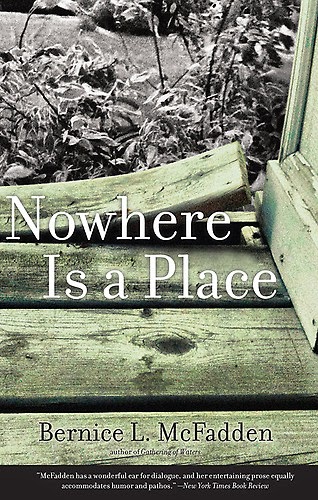
Nowhere is a Place by Bernice McFadden (2006)

About a year ago, I read a copy of Bernice McFadden's book Gathering of Waters (reviewed here) through the LibraryThing Early Reviewers program, and really loved it. Lo and behold, another McFadden book has come my way from the same source: Nowhere is a Place (2006).

The framing story here is a road trip with Sherry and her mother, Dumpling, from Dumpling's home in California to a family reunion in Georgia. Sherry is in her late-30s, secretly pregnant, coming out of a bad long-term relationship with a white man that her mother never liked, and living in Mexico after years of searching and globetrotting.

Sherry and Dumpling aren't that close, but at the start of the road trip, Sherry tells her mother that she wants to write a novel about their family history and the heart of the book are the words that Sherry writes each night after hearing her mother retell the family stories and that Dumpling reads and reacts to the next day.

The family story is rich, deep, and tragic. Starting from the massacre of an Indian village and the kidnapping and selling of the children into slavery, moving through rape, brutality, love, marriage, and heart break, heading north and cutting loose, and eventually ending right back in the car with Sherry and Dumpling. Much like Gathering of Waters, a simple plot description doesn't do this story justice. McFadden has a perfect sense of timing and description, and the hard-earned bursts of violence and revenge hit the reader just right.

This is a re-issue of a novel from several years ago, and it shares the same delicate balance between poetry and a harsh narrative that I found in the more recently published Gathering of Waters. While the framing narrative is a little clunky at first and the book took a bit to really click for me, the payoff is worth a little patience at the beginning. I'm definitely going to keep an eye out for more of McFadden's novels.

Sunday, March 23, 2014

Where the Moon Isn't by Nathan Filer (2013)

Our latest Debbie Downer book club read (for which, as you might remember, we only read depressing books) is Where the Moon Isn't by Nathan Filer (2013) [published as The Shock of the Fall in the UK].

Our narrator is Matthew, a schizophrenic young man in Bristol, England.When Matthew was a child, he and his older brother Simon, who had Down Syndrome, snuck out of their family's vacation rental late at night. Matthew deliberately scares his brother who ends up having a tragic accident and dying.

Fast-forward ten years and Matthew is under professional care. He is alternately committed to a mental hospital or living on his own but coming into a day program for therapy, activities, and his mandated medication. Before he was hospitalized he had moved out of his parents house into his own apartment and then quickly started hearing his brother Simon talking to him. This escalated into a full-blown obsessive crazy person scenario that ultimately resulted in Matthew's hospitalization.

The book we are reading is the book Matthew is writing from the computer at the hospital day center and, when he goes off his meds and holes up in his apartment, from the typewriter that his grandmother gave him. The book uses different fonts to indicate the different writing locales and intersperses handwritten letters from Matthew's social worker and drawings that he creates to illustrate his story. I can't quite decide if I liked the conceit of the different fonts or found it distracting -- it really rides the line -- but I did like the construct of the book and the way that Matthew's narrative voices changes as his mental health ebbs and flows. The movement between the present and the past and his slow movement to describing the accident with his brother and the aftermath of his psychotic break are well timed and effective.

Filer worked as a mental health nurse for ten years before writing this book, and that experience combined with the energy of the story resulted in a lot of excitement for this debut novel. Multiple publishing houses entered into a bidding war that increased publicity for the book before it even came out, and Filer went on to win awards a lot of favorable reviews for his work.

This is definitely a strong debut novel and Filer's decade-long experience as a mental health nurse has given him a unique perspective on his subject matter. That being said, I'm not sure it lives up to its bidding war / award winning hype. Still, this is a fast and unique read and worth your time.

Wednesday, March 19, 2014

Malice Matrimonial by Joan Fleming (1959)

When we were in New York for my sister's wedding last August, one of my favorite stops was at the Strand Book Store ("18 miles of books. Since 1927."). I'd recommend adding a stop at the Strand (and some extra room in your baggage) to anyone heading to NYC for a visit. I got this pretty brittle but barely read copy of Malice Matrimonial by Joan Fleming (1959) in the basement of the book store from a big table full of other ignored books of this type for only $1. That is my kind of table, folks.

Fleming was a British crime novelist who published over 30 novels from the 1940s through the 1970s. For those of you who care about this kind of thing (Dr. M), she didn't write her first one until she was 41 and she had a very successful career.

This is the first of Fleming's novels that I've read, and while I finished it over a week ago I still haven't been able to get my head around how I feel about it. Our hero, Henry Ormskirk, is a rather dull young man with interesting friends. He is dumped by his fiance, loses his job, and then goes to a party given by Venice, an exotic woman who owns an exclusive fashion boutique, with his roommate to cheer himself up. While there, Henry meets and quickly falls madly in love with Venice's daughter Pia, recently reunited with her mother in England after being raised by her father, a Count, in Italy. Things move at a brisk pace and before you know it Henry and Pia are married, and Henry has a new job drawing sketches of models in new dresses at Venice's store. The heat cools off soon after they start living together. Pia quickly learns that she is pregnant and a cooling marriage plus a baby that he doesn't feel much attachment too lead to a dull and wandering Henry who is soon back in the arms of his ex-fiance.

This is all a little weird but not that mysterious until Pia divulges that she was pregnant before she met Henry and then disappears after a big fight. Everyone is pretty sure Henry killed her, and his dopiness doesn't help matters much, but when the clues start slowly rolling in, they just don't add up.

This book is very dark and more than a little bitter with few likable characters or hopeful plot lines. That edge gives a color to the pretty pedestrian mystery that makes the book very readable, but also a little off-putting. Like I said, I still can't figure out what I thought of this. I'll need to mull this one over a little bit more, but if I run across any more Fleming bargains in the basement of a book store, I'd definitely scoop them up.