Friday, June 11, 2010

Good Wives (or Little Women, Volume 2) by Louisa May Alcott (1869)

After the success of Little Women in 1868, Louisa May Alcott penned a companion volume in 1869 that is sometimes bound separately as Good Wives and sometimes (like in the case of my grandmother's copy of the book that I'm reading), bound together as a second part of the story.

I had read this part of the book once before, but not nearly as many times as I read the first part of the book. Maybe it is because I'm grown up now, but I liked the "young womanhood" part of the collection even more than the childhood part.

In Good Wives the oldest March sister, Meg, marries her fiance John Brooke and starts a family. Jo, the second daughter (and the one modeled after Alcott), refuses the hand of their cute and wealthy and nice next door neighbor Laurie who has loved her since childhood. She breaks his heart and he heads to Europe while she goes to New York City to work as a governess and work on her writing. The third daughter, Beth, stays close to home and is still a little sickly from her battle with scarlet fever, but is just as kind and thoughtful as ever. Little Amy, the artistic one, hits the jackpot as a companion to her wealthy aunt on a trip to Europe where she stretches her artistic wings.

Although each of the "Little Women" are moving further and further from their childhood home, they are still just as close with their mother and one another. Each is sometimes tempted and starts down the wrong path, but their solid character and good upbringing always bring them back to the good life. This book deals with more grown up difficulties, tragedies, and blessings, but the core of the characters is just the same as when Alcott laid their foundations in the first volume of the book. And I challenge anyone on earth to write a better betrothal scene than Alcott. She has two in this book that got me a little weepy they were so perfect.

There is still some moralizing in this book (it was written in the late 1800s after all), but nothing that a patient reader can't handle. And if you give it a little time, you are rewarded by passages like the following (which I'm going to quote at length, because I can). This is particularly revealing since Alcott herself never married:

"An old maid, that's what I'm to be. A literary spinster, with a pen for a spouse, a family of stories for children, and twenty years hence a morsel of fame, perhaps; when, like poor Johnson, I'm old, and can't enjoy it, solitary, and can't share it, independent, and don't need it. Well, I needn't be a sour saint nor a selfish sinner; and, I dare say, old maids are very comfortable when they get used to it; but—" and there Jo sighed, as if the prospect was not inviting.

It seldom is, at first, and thirty seems the end of all things to five-and-twenty. But it's not as bad as it looks, and one can get on quite happily if one has something in one's self to fall back upon. At twenty-five, girls begin to talk about being old maids, but secretly resolve that they never will be. At thirty they say nothing about it, but quietly accept the fact, and if sensible, console themselves by remembering that they have twenty more useful, happy years, in which they may be learning to grow old gracefully. Don't laugh at the spinsters, dear girls, for often very tender, tragic romances are hidden away in the hearts that beat so quietly under the sober gowns, and many silent sacrifices of youth, health, ambition, love itself, make the faded faces beautiful in God's sight. Even the sad, sour sisters should be kindly dealt with, because they have missed the sweetest part of life, if for no other reason. And looking at them with compassion, not contempt, girls in their bloom should remember that they too may miss the blossom time. That rosy cheeks don't last forever, that silver threads will come in the bonnie brown hair, and that, by-and-by, kindness and respect will be as sweet as love and admiration now.

Gentlemen, which means boys, be courteous to the old maids, no matter how poor and plain and prim, for the only chivalry worth having is that which is the readiest to pay deference to the old, protect the feeble, and serve womankind, regardless of rank, age, or color. Just recollect the good aunts who have not only lectured and fussed, but nursed and petted, too often without thanks, the scrapes they have helped you out of, the tips they have given you from their small store, the stitches the patient old fingers have set for you, the steps the willing old feet have taken, and gratefully pay the dear old ladies the little attentions that women love to receive as long as they live. The bright-eyed girls are quick to see such traits, and will like you all the better for them, and if death, almost the only power that can part mother and son, should rob you of yours, you will be sure to find a tender welcome and maternal cherishing from some Aunt Priscilla, who has kept the warmest corner of her lonely old heart for 'the best nevvy in the world'.

Tuesday, June 08, 2010

Eeeeeeee!

In February 2008, I reported that I really wanted an Asus Eee netbook. And today, in June 2010, I am writing this post from my very own Asus Eee netbook. I still think the name is dumb, but the tinyness and funness are exactly as I anticpated. Netbooks!

It was still a stretch to my budget, but lets pretend that I have saved $8.00 a month for the past 29 months. That seems reasonable, right?

Monday, June 07, 2010

The Swiss Family Robinson (1812)

I recently finished reading The Swiss Family Robinson by Johann D. Wyss (1812) in 134 delightful serialized chunks delivered to me via e-mail by dailylit.com. I had never read this classic novel as a child, and I figured it would work well in a serialized format.

As you might remember from the dozens of movies and television shows based on this plucky and ingenious Swiss Family, the book begins with our heroes (a mother, father, and four young boys) getting in a shipwreck on their way to Australia. Everyone else on the ship is lost, but the family eventually makes their way to an island that is bereft of human beings but conveniently filled with almost every plant and animal life the father and sons have ever read about in their natural history, engineering, history, and adventure reading.

The first half of the book is very procedural: how they built their first shelter, how they got food, how they built a better shelter, how they moved around the island, how they built an awesome shelter in a tree, how they built another awesome shelter in a grotto, how they cultivated food and livestock, and the list goes on and on. Liberally sprinkled around these lessons of survival and ingenuity are moral lessons on how to be a good man, how to treat your wife and family, and how to frequently bow down and thank the lord. The moral lessons get a bit trying, but this book was written in 1812 by a Swiss pastor, so I think we can let him have his morality.

In the second half of the book things suddenly get very exciting when, after returning from a two day trip exploring the unexplored parts of their island, the father and three of the sons come back home to find their canoe missing and the wife and youngest son taken from the island. They quickly give chase in their small boat, making it to another island and getting into quite a bit more trouble before their prayers are answered and (as you might expect) the family is reunited. The story of their reunion and the nice way things work out for the family's future on their island paradise is a satisfying and well earned ending to this enduring story.

Fun fact: The family is not actually named Robinson -- Robinson comes from Robinson Crusoe and the title lets us know that this is the Swiss family version of that famous castaway story.

Wednesday, June 02, 2010

Elysiana by Chris Knopf (2010)

My latest selection from the LibraryThing Early Reviewers program is Elysiana (2010), a stand-alone novel from established suspense writer Chris Knopf.

Elysiana is a fictional barrier island off the coast of New Jersey. It is one mile wide, twenty-five miles long, and sees a huge population increase every summer when the tourists descend upon the elongated coast line. In the summer of 1969 a whole hoard of interesting characters find themselves on Elysiana, crossing paths with one another, working through painful pasts, and making up our story:
  • Gwen ends up on the island after coming down from a three day drug trip that started in Chicago and on the tail end of some major daddy issues.
  • Jack has lived on Elysiana for years, the only resident of a giant hotel built by his grandfather. He works as a lifeguard on the beach patrol and mostly lives inside his head, partly as a product of surviving a four year coma after a teenage accident.
  • Avery Volpe is the militaristic head of the beach patrol, and possibly the most powerful person on Elysiana in the summertime.
  • Norm Harlan is the city manager with ambitions to oust Volpe and the mayor. He also has a distractable wife and a precocious daughter named Sweetie who is constantly getting lost.
  • Sylvia Buente fails to kill herself when she is rescued by Mike Ditzler, one of the life guards with his own complicated life story, and who is now holed up in his apartment.
  • Petey Amato is a small-time crook and surfer who is pretty big-time on this little island.
And the list goes on and on and on. Add in an island-wide super party on the heels of the biggest storm in the century, and you have a recipe for lots of plots, sub-plots, romance, violence, and quirkiness.

The novel is solid overall, although with so many characters no single story line really draws the reader in. And with so much action, there isn't much time for characterization, which leaves some of these potentially very interesting people feeling rather thin. However, Knopf wrangles his sub-plots well and everything is tied together in a satisfying way, and with a very nice climax. This would be a nice summer read that wouldn't disappoint, as long as you didn't expect too much from it.

Saturday, May 29, 2010

Büchner: The Complete Plays, edited by Michael Patterson (1987)

As I mentioned in my post on Woyzeck, I also read the rest of the works in Büchner: The Complete Plays, edited by Michael Patterson (1987), with the exception of Danton's Death, which is also on the western canon list and which I will probably get to in about 2045.

Georg Büchner
(1813-1837) managed to squeeze quite a bit into his 23 years of life, and this collection documents his many facets -- political revolutionary, dramatist, biographer, scientist, son, and fiancée:

The Hessian Courier (1834)
This was a revolutionary and really quite illegal pamphlet that Büchner wrote with a radical clergyman. Inspired by the French revolution, Büchner called for the German peasantry to rise up against the Grand Duchy of Hesse-Darmstadt. He argues logically (including lots of facts and statistics) that the rich were living off of the work of the poor and not giving the poor anything in return. Over Büchner's objections, his partner added religious language that he thought would appeal more to the rural poor. The pamphlet was printed and distributed twice, but in both cases the revolutionary nature of the work scared everyone who was meant to read it, and anyone who did get their hands on a copy immediately turned it over to the local police. Several conspirators were arrested and tortured, but Büchner managed to escape the country and live out the rest of his short life in exile in Strasbourg (where he had previously lived as a student) and Zurich. His experience with The Hessian Courier proved to him that revolutionary action was ineffectual, and while there are some political themes that run through his literary works and letters, he never returned to the political stage.

Lenz (1835)
This novella, based on the life of Jakob Michael Reinhold Lenz (a literary contemporary and romantic rival of Goethe) was one of my favorite pieces in the collection. Büchner focuses on the period in Lenz's life when he has been exiled from the court of Weimar and subsequently suffers an attack of paranoid schizophrenia. He goes to the mountains of Alsace to stay with the clergyman J. F. Oberlin and regain his sanity, but his mental state goes downhill and he ends up returning to Eastern Europe with his brother. Büchner paints a convincing and sympathetic portrait of paranoia and depression, a state that he had some familiarity with himself.

Leonce and Lena (1836)
This comedic play was written for a literary contest, but submitted past the deadline and returned to Büchner unopened. It was not published or produced until after his death. This is a romantic comedy of mistaken identity, filled with word play, with an obviously Shakespearean influence. When the prince of the kingdom, an unrepentant playboy who is bored with his affluent life of leisure, is forced into an arranged marriage, he and his sidekick take off on a road trip to avoid being tied down. Little does he know that his fiancée, who he has never met, had the same idea and also escaped the castle with her governess. It is pretty easy to guess what happens next, and everything coalesces into a very satisfying play. I, of course, can't read the original German, but the translation is crisp and the playfulness and puns in the dialogue all seem to come through.

On Cranial Nerves (1836)
The opening remarks of this scientific lecture given by Büchner as part of becoming a member of the teaching staff at Zurich University show his humanism and his philosophical rather than mechanical view of science.

The book also includes excerpts from Büchner's letters to his family, fiancée, and friends, as well as descriptions of Büchner from his contemporaries, which were all very revealing and fun to read. Each piece in the collection, as well as the book as a whole, is given an insightful introduction by the editor, Michael Patterson. I don't always enjoy introductions in a book, but Patterson gives just the right amount of context and interpretation and his clear prose is a pleasure to read. If you are looking to insert a little 19th century German literature into your life, you can't go wrong with this extensive collection of the works of Georg Büchner.

Tuesday, May 25, 2010

Pickled Beets?

I was shopping at HEB today on my lunch break and I bought a jar of pickled beets. I really don't know why, since I have never really liked beets (they taste like dirt), but I had an undeniable urge to eat pickled ones. Since they only cost $1.40, I figured it was worth the splurge.

So I ate several pickled beets when I got home from work. They still taste like dirt, but somehow I don't mind that anymore. I actually kind of like it. I think I am officially a beet fan!

And click here to watch the credits of the Care Bears Adventure in Wonderland movie that my sisters and I watched 100000000 times as kids. Give it until about 3:15 and you can hear exactly what I hear in my head every time someone says pickled beets.

[photo credit: stu_spivack]

Sunday, May 23, 2010

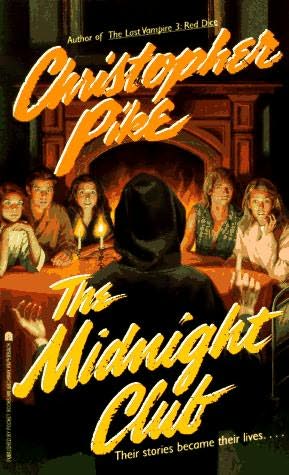
The Midnight Club by Christopher Pike (1994)

The Midnight Club (1994) is another one of those Christopher Pike books that came out a little too late for me to enjoy it in my junior high Pike heyday, but I picked it up a free copy when I worked at a bookstore in college and have been carrying it around with me for the past ten years. Now seemed like the perfect time to give it a read.

This book has one of the most somber settings of any Christopher Pike novel -- an old seaside mansion that has been converted into a hospice for terminally ill teenagers, most of whom are poor and/or alone and would be lonely and dying in some gross state hospital if they weren't rescued by the avuncular owner of the hospice.

Our hero is one of the dying teenagers, Ilonka, who has formed The Midnight Club with her roommate Anya, the sexy and dying Kevin (who Ilonka is secretly in love with), his roommate Spence, and the quiet and modest Sandra. Every night at midnight the five teens meet in the basement of the mansion to tell each other stories -- some of the stories are scary, some romantic, and all a little supernatural. After one meeting they start talking about ghosts and what happens when you die, and make the pact that whichever one of them dies first will do everything in his or her power to contact the rest of the group from the other side. And then one of them dies in the night!

At least that is what the back of the book wants you to think this story is about. And all of that does actually happen, but instead of being a freaky tale of ghosts and death, this is actually a rather sweet love story about growing up and forgiveness. I'm not sure how Pike did this (and maybe I was just feeling emotional this week), but this book is nicely written, engaging, and often very moving. I know! From Christopher Pike! I think part of the difference in this book is that he gave himself a structure for filling the novel with nicely told mini-stories (the ones the teens tell in The Midnight Club), which puts a little less pressure on his main characters, and allows their characters to develop and their relationships to evolve with out the full crush of Pike's usually rather ham-handed descriptions.

If you are looking for the usual Pike novel, this probably isn't for you, but I really found it worthwhile. Go Team Pike!

[Also, the one hilarious part of this novel is the guy sitting second from the right on the cover. It is hard to see in this picture, but he is wearing the most amazing green plaid shirt with the sleeves cut off, unbuttoned to his mid-chest. Hospice wear!]

Thursday, May 20, 2010

Woyzeck by Georg Büchner (1837)

The next stop on my journey through Harold Bloom's western canon is the play Woyzeck by Georg Büchner (written in 1837, unfinished because Büchner died [at the age of 23!], and not published until 1875 or staged until 1913).

I had some familiarity with Woyzeck through Werner Herzog's 1979 movie starring Klaus Kinski and Eva Mattes (trailer here -- no English subtitles, but you don't really need them). It's been quite awhile since I've seen the film, and now that I've read the play I'm excited to see it again. From what I can remember, Herzog follows Büchner's script pretty well. However, since Büchner never finished the script, several different versions of the play have been edited together and performed over the years, and each director or editor has been able to put his or her own mark on the sequencing and staging of the play.

In the play, Woyzeck is a soldier. He has a son with his common-law wife Marie, but they don't have enough money to get the proper papers to get married. There doesn't seem to be any war going on, so most of Woyzeck's soldiering involves digging ditches and shaving the commanding officers. He is a haunted man and doesn't seem to be particularly at ease with life, possibly in part because he is eating nothing but peas as part of a medical experiment to earn extra money for Marie and the baby. A handsome and fancy Drum Major catches Marie's eye and seduces her, and when Woyzeck finds out, he goes mad and kills her.

It may seem like I've given away the whole thing, but what is really interesting about the play doesn't have anything to do with the plot. The plot, in fact, was taken from a real life "true crime" case of a man (named Woyzeck) who killed his wife in a jealous rage. Rather than carrying the reader with its plot, Woyzeck brings us in through its episodic structure, the humanity and suffering of the characters, and the buffoonery of the authority figures. It is because of the strong characters and episodic plot that each director of the play can mold it to his or her own vision without losing Büchner.

I got Woyzeck as part of a larger book of Büchner's complete plays and other writings, and read all of them except Danton's Death (which is also on the western canon list). I'll do a second post for the other plays and works in the larger book because I am too excited about Büchner to put it all in one post!

[Awesome Woyzeck poster found here.]

Thursday, May 13, 2010

Renegade!

I feel like I've been beating this to death in other venues, but in case you haven't heard:

1. The Renegade Craft Fair is this weekend in Austin.
2. The awesome Mary P. from Pretty Good Things will have a booth there filled with wonderful things for you to buy.
3. I will be helping Mary P. sell those awesome things.
4. You should come say hi to us and experience all the awesomeness!

See you there!

Monday, May 10, 2010

The Quiet American by Graham Greene (1955)

Our latest book club read (Go DAFFODILS!) is The Quiet American by Graham Greene (1955). I had only read one other Greene book (The Man Within, Greene's first novel, which I reviewed here) -- but from what I heard it wasn't really representative of Greene's other work, so I was very interested to read some more.

I was, however, pretty familiar with the plot of The Quiet American, having seen both the Joseph L. Mankiewicz version from 1958 (starring Audie Murphy and Michael Redgrave), and the Phillip Noyce version from 2002 (starring Michael Caine and Brendan Fraser). I thought both versions of the movie were pretty good -- I liked the 50s one better, but Brendan Fraser gave a great performance as the American in the recent film.

The basic plot has our narrator, cynical British journalist Thomas Fowler living with his mistress of two years, Phuong, in an apartment in Saigon as he covers the French war and smokes his nightly opium. Fowler loves (or at least believes he loves) Phuong and would marry her except that his estranged wife back in England is a Catholic and won't give him a divorce. One night at a hotel bar, Fowler meets a naive young American government worker named Alden Pyle who just arrived in Vietnam from his college days at Harvard. Fowler enjoys playing the wise and experienced Englishman to Pyle's fresh-faced and straight-talking American. Or at least he does until Pyle falls in love in Phuong.

I won't get into too many of my thoughts on the book (since I want to try and remember those for book club), but I will say that I really enjoyed this. The book is expertly constructed and I could pull out dozens of sentences from the novel that couldn't be more perfect. Neither Fowler nor Pyle are admirable men, but the ways in which they fool themselves and each other make for an exciting psychological thriller, with a good dose of philosophy and politics on the side.

Thursday, May 06, 2010

The Gone-Away World by Nick Harkaway (2008)

The always-awesome Corie recently lent me a copy of Nick Harkaway's 2008 debut novel The Gone-Away World. This book is gigantic (532 pages), but that didn't daunt me much since one thing Corie and I share is a love for really long novels. I jumped right in without knowing much about the book and I thought it was... Okay. Not bad at all, but not particularly great. A blurb on the book compares Harkaway's writing to Catch-22 or Kurt Vonnegut, and I could see that, but mostly I got a big whiff of Tom Robbins -- who I loved in my youth and whose quirky humor, obvious politics and need to philosophize I am now a rather lukewarm about. So I was into this book but not loving it when I got about 350 pages in and all of a sudden the whole thing became really quite awesome.

Here's the set up: We start the book in a post-apocalyptic future. Everything is all Mad Max and the only thing resembling civilization as we know it exists right along the Jorgmund Pipe, which emits some kind of gas that keeps the bad things away. What the bad things are and how everything got like this won't be revealed for awhile. Our hero and his friends are a group of ex-military who specialize in putting out fires and containing hazardous situations. When the Jorgmund Pipe bursts into flames, the uber-corporate government gives them a call and they spring into action.

Then we go back in time to the narrator's pre-apocalypse youth, and learn of his close friendship with Gonzo Lubitsch and his family, his school days, his work with a master of an ancient Chinese martial art, his college days, his entry into the military, and his marriage. This is all sometimes funny, sometimes interesting, and sometimes has a lot of holes in it, goes on a little long, and is less humorous than the author thinks. Then we get back to the "present," and everything changes for our narrator.

I'm not going to reveal the catalytic event and subsequent twist, but I will say that I didn't see the twist coming until just a couple pages before it happened. And this twist did what twists almost never do: It didn't make me feel cheated and it made me re-evaluate the first two-thirds of the gigantic novel and really like what before I had thought was just okay. If you have some patience in you and like long sort of sci-fi / sort of political satire / sort of humorous novels, then give this one a try. I swear it is worth it just for flipping that switch in the narrative.

[Also, I just now found out that Nick Harkaway is John le Carré's son. Weird beard.]

Saturday, May 01, 2010

Little Women by Louisa May Alcott (1868)

I read Little Women by Louisa May Alcott (1868) about a billion times when I was a girl. I loved the relationships between the sisters, the rebelliousness of Jo, and the way that everyone took care of each other even when they were fighting over some little thing. And since Alcott and I share a birthday, I wrote numerous elementary school English papers on her life and times and the history of her books.

Recently my aunt loaned me a new biography of Alcott, which I'm very interested to read, but she suggested I re-read Little Women and its sequels -- Alcott published a second volume in 1869 after the success of the first volume (often titled Good Wives, but sometimes bound in together with Little Women), then Little Men in 1871 and Jo's Boys in 1886. I've read both volumes of Little Women before, but not any of the others, so I am keen to check them out.

In case you are one of the sad people on earth who has never read Little Women or seen any of the film adaptations, let me fill you in on the plot: The March family has four daughters (Meg, Jo, Beth, and Amy), and they live in a house somewhere in New England with their mother, who they all call Marmie. Their father is serving in the Civil War, even though he is a bit too old to be doing so. The family used to be quite wealthy but, for an unexplained reason, they have lost their fortune and both Meg and Jo have to go out and work to help bring some money into the household (Meg as a nanny and Jo as a companion to their rich and crotchety Aunt March).

Each of the daughters has a strong personality that guides the action of the book: Meg is the oldest, sometimes a little vain, and remembers when the family had money and misses that lifestyle; Jo is an impetuous tomboy who loves to read and write and make up stories and direct plays staring her sisters (Alcott modeled Jo on herself, and she is a pretty obvious favorite character for most readers); Beth is sweet and shy and giving, and loves to play the piano; Amy is the youngest, tries to act more worldly than she is, mispronounces words, is caught up in conventions, and wants to be a great artists.

The best thing about Little Women is that everything that happens is pretty ordinary, but because the characters are drawn so well and the reader has such sympathy for the family, the small victories and tragedies of everyday life are heightened and the book is really a fun read.

The one downside to modern readers (or perhaps adult readers, since it didn't really bother me as a kid) is the moralizing -- around every bend our little women are learning important lessons in being kind and understanding and not saying mean things or being selfish or rude, and each of those lessons is spelled out for the reader and rubbed in maybe just a little too much. Still, it is forgivable considering the time the book was written and its audience, and it definitely isn't a deal breaker.

Check this space for more Alcott updates in the near future!

[Also: My copy of Little Women (printed in 1926) was actually my grandmother's copy. I'm not sure if it is a copy she had from when she was a girl or if she bought it later in life, but it has great illustrations by C.M. Burd and an introduction by Albert Lindsay Rowland (Superintendent of Schools, Cheltenham Township, PA) that gives this advice to modern readers of 1926: "A superficial opinion would call it a far cry from the long dresses, the veiled faces, and the prim speech of the March sisters to the scanty frocks, the bobbed hair and the vigorous actions of a group of modern school girls. Yet all are little women and the tremendously interesting and important problem of growing up is essentially the same in both cases."]

Saturday, April 24, 2010

McSweeney's, No. 33: The San Francisco Panorama (2010)

I'm not usually much of a McSweeney's reader, but my cousin loaned me a copy of McSweeney's, No. 33: The San Francisco Panorama (2010), edited by Dave Eggers and his gang. In this experiment, the McSweeney's crew decided to celebrate everything that was great about traditional print journalism and the large canvas provided by newsprint -- kind of a eulogy to the dying format, as well as a call for its rebirth. What they ended up creating is an overwhelming thing of beauty -- beautiful because of the full-color printing and the striking layouts, and overwhelming because it is over 300 pages long. This is a seriously intense newspaper.

So here is a thing about me: I don't really like newspapers. Physically, I mean. They are hard to hold, make a lot of noise, and are practically impossible to read while laying down (which is my favorite way to read). I read most of my day-to-day news online, and for longer pieces of journalism I prefer magazines (shout out to Harpers, the best magazine on earth!). That being said, the Panorama really does take advantage of the large format and prints some gorgeous photographs and very smart infographics that wouldn't have worked in a smaller medium. So there could be something in this embrace of the newsprint medium for certain tasks.

It might be my reading preferences talking, but my favorite parts of the Panorama were the magazine enclosures (one for books and another more general magazine). And of course the comics -- comics are the exception to the rule in my dislike of big newspapers. The bigger the better for the comics pages. There is some first rate journalism in the Panorama, and the short story by George Saunders in the books section ("Fox 8") was worth the cost of admission alone.

While I initially balked at the size and "newspaperyness" of the whole thing, I'm very glad I stuck with the Panorama. Thanks McSweenoids! And thanks, cuz!

[There is a nice description of the project here, including some lovely pictures]

Sunday, April 18, 2010

Land of The Lost Souls: My Life on the Streets by Cadillac Man (2009)

Cadillac Man is a homeless guy from Hell's Kitchen, and Land of the Lost Souls: My Life on the Streets (2009) is a memoir distilled from the journals that he has been keeping for the past thirteen years. In his book, Cadillac Man introduces us to his friends and his enemies, memorializes other street people who died on the street or just disappeared, and takes us back into his childhood and his "outsider" life with his wife and children and job and explains how he got to where he is today.

His book is moving, often funny, sometimes scary, and always filled with his personality. After reading it, I felt like he had been talking in my ear for a few days, and after I was done I missed that voice. The writing is at its best when reflecting on his past and current life, or when giving the reader a look at the procedures of homelessness (how to set up camp, strategies for canning, how to win a fight, where to get food), and at its worst when he peppers his stories with lots of dialogue, which is often written in the stilted way dialogue gets when you tell it later as a story. And since Cadillac Man is a storyteller, I guess I can't fault him for that.

At the end of the book I found out that some guys made a documentary about Cadillac Man [trailer here], and I think I'd like to see it. Most of all, I'd like an update on his life -- has he been in touch with his children at all? Did he ever hear anything else from Penny (a runaway that he fell in love with and then helped get back to her family)? Is he still living under the same viaduct?

This book gives an interesting perspective on a prevalent way of life and tells it in a compelling way. Definitely recommended.

[I got this book through the highly recommended LibraryThing Early Reviewers program.]

Monday, April 12, 2010

The Immortal by Christopher Pike (1993)

Christopher Pike's The Immortal (1993) came out a little too late to be included in my youthful Pike party, but I got a discarded copy of it when I worked at a bookstore in college and have moved it around for so many years that I'm glad I've finally read it. And now I can give it away!

We all know that Christopher Pike doesn't age as well as we might like. The Immortal, on the other hand, seems like it wouldn't have set that well with me even at a tender age. The plot has Josie going for a week-long vacation in Greece with her best friend, Helen; her father, a Hollywood screenwriter; and his girlfriend Silk, a wannabe actress. Helen and Josie have just graduated from high school (although you would hardly guess it since they never talk at all about work, college, or what they plan to do with themselves). They also don't get along with each other very well, which is odd for best friends, but maybe not quite so odd when one learns that Josie dated Helen's boyfriend after he broke up with her. And then Helen tried to kill herself. And Josie was struck by a sudden and inexplicable heart problem. And they were both in the hospital and near death for awhile. But now everything is fine. So they are going to Greece!

Helen had been to the island of Mykonos the summer before (her parents took her there after she got out of the hospital), so she shows Josie around. Josie quickly falls in love with the island, feeling an inexplicable closeness to everything there, including Tom, an English summer worker who Helen had a fling with the summer before. So Josie, being Helen's best friend, naturally makes quick work of getting Tom to fall in love with her.

All pretty pedestrian, right?

But wait!: Josie and the gang take a tour boat out to the sacred island of Delos. She feels totally connected to the island, and begins having weird dreams about a goddess when she gets back. Later she spends an illicit night on the island after falling out of a boat and wakes up to find a statue of the goddess from her dreams next to her. Her dreams get more and more vivid, Helen acts more and more distant, and then she and Tom get really sick. But what can it all mean?

Even though this book was pretty dumb, I don't want to spoil it for other Pike enthusiasts, so I'll just say that the twist is hidden relatively well, but feels kind of underwhelming once it is revealed.

Half of this book is written like a vacation guide to the Greek island of Mykonos, there is a very tacked on sub plot where Josie and her dad discuss the plot of his science fiction screen play for pages and pages, none of the teenagers act very teenagery, and none of the adults act very adult.

I love you Christopher Pike!

Friday, April 09, 2010

The Stuff that Dreams are Made of

Don't freak out. This post is not about a book!

When I was growing up, there was a department store in Lincoln named Richman Gordman. In the center of this department store was an animal-themed indoor playground that parents could use to entertain their children while they got some shopping done. In the center of that playground was this amazing (and, in retrospect, extremely disturbing) elephant slide. And now, thanks to the power of Ebay, you can purchase that slide for a minimum bid of $521.00 as of this posting! Well not the exact same one, since the one that is for sale is apparently from Omaha, but you get the idea.

I still sometimes have weird dreams about this bizarre indoor playground filled with giant animal equipment. I was actually pretty scared to go on the elephant slide (with its blood red nose!) for quite awhile as a young girl. Thanks to Allison for posting a link to this on Facebook!

[Also, if you aren't familiar with this awesome slide, please note that you enter the slide from underneath the trunk, between the elephant's legs, then crawl up through the inside of the elephant and slide down his weirdly opened up trunk. Scary!]

Wednesday, April 07, 2010

Murder of a Medici Princess by Caroline P. Murphy (2008)

The always lovely Choo lent me this copy of Murder of a Medici Princess by Caroline P. Murphy (2008) awhile ago and it languished at the bottom of my ever-growing book reading pile for way too long. I have a thing for biographies of female nobles from the past, and this exploration of the life of Isabella de Medici in 16th century Italy totally fits in that category.

Isabella was the daughter of Cosimo de Medici, a savvy politician and strong businessman who strengthened the Medici family's grip on Florence and eventually worked his way up to being named Grand Duke of Tuscany. Cosimo was extremely dedicated to his family, particularly the women in it, and of all his children Isabella seems to have been his favorite. She was raised in style in a close-knit family, and educated every bit as much as her brothers. When she was married to Paolo Orsini, the playboy son of a powerful Roman family, Cosimo saw to it that Isabella remained the female anchor of the Medici family and made it possible for her to stay in Florence instead of joining her spendthrift husband in Rome or at his isolated country estate.

Isabella was able to lead a life that few Italian women in her era could -- educated and respected by her family, freed from any obligations as a wife, and funded by the deep pockets of her father, Isabella was the ultimate intellectual society party girl of her day. She sponsored musicians, artists and writers, mentored her beautiful cousin Leonora (who was married to her youngest brother), threw the best parties in Florence, and had some not-so-secret lovers -- all while deftly avoiding her husband's pleas for her to join him in Rome.

Everything was going pretty well for Isabella until the man who made it all possible, her father, died. After Cosimo's death, the leadership of Florence fell to his oldest son, Francesco. Isabella and Francesco had never really gotten along that well, and he never approved of her lifestyle. Francesco was not nearly the leader that his father was and the delicate balance of Florence society quickly began to fall apart. Francesco eventually took swift action to silence the dissenters and remove any obstacles to his power, which ultimately led to a very sad end for both Isabella and Leonora (one you could probably guess from the title of the book).

Murphy's book is nicely researched and illustrated, and reads almost like a novel -- she gives the reader enough context to understand what is going on, but doesn't dwell overly long on arcane details, names and dates. Highly recommended if you too have a thing for those crazy high-born ladies from history.

[Note: When I read The Agony and the Ecstasy (a historical novel about the life of Michelangelo that I didn't like that much), I vowed to read more about the Medici family. And I just did! I'd just like to congratulate myself on the follow through.]

Thursday, March 25, 2010

The Night Gardener by George Pelecanos (2006)

After Dr. M read The Night Gardener by George Pelecanos (2006) and liked it so much, I moved it up near the top of my reading pile, and I'm very glad I did.

The Night Gardener focuses on the life and career of Gus Ramone, a DC homicide detective. Early in his career, when he was still a regular cop, a serial killer took the lives of three young people and left their bodies in various community gardens in the city. Each of the victims had a first name that was a palindrome, and the media dubbed the murderer The Palindrome Killer, but inside the department everyone called him the Night Gardener. Gus was harnessed with a partner that he didn't get along with (Dan "Doc" Holiday) and the two of them admired the work of an older homicide detective on the case, T.C. Cook.

Twenty years later, Gus is a detective, Holiday is off the force (due to an investigation that Gus headed in his time at Internal Affairs), and Cook is long retired. And then another boy is found dead in a community garden. And his name is Asa.

The mystery part of the book revolves around this killing, but the core of the book is Gus and his family, Holiday and his solitude, and the city itself. More than just a "whodunnit," The Night Gardener gets deep into its characters, paints a three-dimensional world, gives us a police procedural that rings very true, and explores issues of race with a subtlety and depth that is unusual in a genre novel.

Occasionally Pelecanos falters and has one of his characters spout a diatribe or get up on a soapbox for awhile, but if you can set these rare missteps aside, you will have a very nice reading experience ahead of you when you pick up The Night Gardener.

You may know Pelecanos as a writer and producer on that little TV show that everyone was so ape shit over a few years ago called The Wire. I swear we are going to watch it sometime, but we tend to run 5-10 years behind the mainstream when it comes to television watching. We haven't even watched any of The Sopranos yet. But, I know there are tons of you out there that love The Wire in a serious way, and all of you should go out and get yourself some George Pelecanos novels.

Saturday, March 20, 2010

Sudden Fiction Latino: Short-short Stories from The United States and Latin America edited by Robert Shapard, James Thomas, and Ray Gonzalez (2010)

I got this copy of the anthology Sudden Fiction Latino: Short-short Stories from The United States and Latin America edited by Robert Shapard, James Thomas, and Ray Gonzalez (2010) from the always fabulous LibraryThing Early Reviewers program. This is part of a series of anthologies featuring "short-short" or "flash" fiction -- that is, short stories that are at the most a few pages long, and often even shorter than that.

In this anthology, the editors bring together stories from Latin American authors (in translation) and Latino authors in the United States. There are plenty of recognizable names (in fact, possibly every major Latin American or Latino author that I can think of is here: Junot Díaz, Gabriel García Márquez, Jorge Luis Borges, Sandra Císneros, Isabel Allende, Rudolfo Anaya, Roberto Bolaño, Julio Ortega, and the list goes on), as well as a whole slew of authors that I have never heard of before, but whom I now really want to check out. The stories are sometimes metaphorical, sometimes straightforward, sometimes experimental, sometimes comedic, and sometimes bitingly tragic. I love reading short stories, and the compressed nature of this "sudden" fiction highlights everything that makes the short story format great.

This is an astutely edited, wonderfully written book. And, as an aside, it is possibly the perfect thing to read in a crowded airport and a boring flight.

Saturday, March 13, 2010

The Complete Persepolis by Marjane Satrapi (2007)

This time around the DAFFODILS (Devilishly Affable Friendly Friends Optional-Drinking Invitational Literary Society) decided to bust out into the wonderful world of graphic novels with The Complete Persepolis by Marjane Satrapi (2007).

Persepolis is a graphic memoir about Satrapi's girlhood in Tehran during the Iranian revolution and later the Iran/Iraq war. Her parents are liberal and secular, and big supporters of the revolution who find themselves and their friends increasingly persecuted by the fundamentalist leadership. Satrapi is young, but smart, and her parents treat her with respect, give her her freedom, and don't hide much of the stark and repressive world outside of their apartment doors.

As she gets older and more headstrong, and as the dangers of the war and the threats of the conservative government increase, her parents decide to send her to high school in Austria. In this second part of the memoir, Satrapi relishes the freedom and variety of the west, but feels increasingly isolated and cut off from her family and homeland. Her coming-of-age journey leads her to some dark places, an eventual return to Iran, and into her life as a young married woman.

I really enjoyed this book -- Satrapi's crisp black and white drawings complement the straightforward and unsentimental story of her life. Parts of the book are very dark, but they are tempered by the obvious love and humor of Satrapi's family and friends. I haven't seen the film version yet (which was co-directed by Satrapi), but it is on my list. And I can't wait to hear what the other DAFFODILS have to say about this book.

Go DAFFODILS!

[And, to clarify the publication history (since I am a library nerd): Satrapi wrote four volumes of Persepolis in French between 2000 and 2003. They were translated into English and published in two volumes in 2004, and then made into a movie and collected into one English-language volume in 2007.]

Monday, March 08, 2010

Wuthering Heights by Emily Brontë (1847)

The next stop on my reverse alphabetical by title journey through Harold Bloom's Western Canon is Emily Brontë's first and only published novel, Wuthering Heights (1847). If I had to pick a favorite novel of all time, this one might be it. This is the third time I've read it (in fact I even wrote vaugely about it here the last time I read it, for the late, great Smarter Than You book club), and I like it better every time I work my way through it.

Wuthering Heights tells the story of two families living on the isolated moors in northern England. The Earnshaw's live at Wuthering Heights -- they have a son named Hindley, a daughter named Catherine, and an adopted son that the father found starving on the streets in London named Heathcliff. After the father and mother die, Hindley and his wife become the head of the family and he unleashes his pent up hate and jealousy of Heathcliff on the young boy. Heathcliff and Catherine, who have been inseparable, constantly feel the wrath of her brother, and the only stabilizing influence in their life is Nelly, their servant who grew up with them at the Heights and who is almost part of the family.

The nearest house to the Heights is Thrushcross Grange, the family home of the wealthy Linton's. They also have a son and a daughter, Edgar and Isabella, and their sheltered and well-mannered existence couldn't be more different from the outdoor wildness of Heathcliff and Catherine.

And yet, Catherine can't help but be intrigued by the bookish and fragile Edgar. And Edgar can't resist the beautiful and tempestuous Catherine. So much so that he asks her to marry him, and when she agrees Heathcliff runs away from Wuthering Heights and no one hears anything from him for three years.

What follows is a complicated, romantic, harrowing, and very human story of revenge, love and redemption. It crosses two generations, a whole host of Catherines and Earnshaws and Lintons, and it doesn't end until almost all the characters are finally at peace and in their graves. Instead of playing the story out in real time, Brontë bounces back and forth between the present day existence of her narrator, Mr. Lockwood, a tenant at the now empty Thrushcross Grange, and the past history of the Grange and the Heights as told to Lockwood by Nelly.

This book is so wonderfully dark and brooding and filled with comeuppance and revenge and hurt feelings and oppressive nature and horrible and wonderful humanity that I think everyone in the entire world should grab a copy and read it right away. Have you read your copy yet?

Thursday, February 25, 2010

The Stolen Child by Keith Donohue (2006)

The lovely Corie often loans me books I'm not familiar with by authors I've never heard of and every time they end up being really really good. This is the perfect book borrowing set-up, and The Stolen Child by Keith Donohue (2006) is no exception.

One day, seven-year-old Henry Day runs away from his home on the edge of the woods and hides in the hollow trunk of an old tree. Late that night he is found by a search party and brought home to his grateful parents, but after that day he is never the same again. That is because Henry Day isn't Henry Day anymore -- he has been replaced by a changeling.

The changeling who is now Henry Day was stolen from his German immigrant parents over a hundred years ago. Since then he had been living in the woods with a band of other stolen children -- stealing food and causing mischief in the town, sleeping in burrows and eating berries and roots in the forest, nearly hibernating in the winter, not aging a day on the outside, and waiting his turn to become the senior changeling and the next one to return to the world of humans. The real Henry Day, named Aniday by the changelings, now joins the band of children in the woods and begins forgetting his family and transforming into a fairy child.

The book alternates chapters between the new Henry Day and Aniday as both boy-men grow into their new lives. Each of them is obsessed with their real past: Henry dreams in snatches of German and has an instant musical virtuosity, especially on the piano (a talent the real Henry Day didn't possess). Aniday remembers glimpses of his mother and twin sisters, and one day, years after he was stolen, he accidentally wanders too close to a house at the edge of the woods at dawn, and comes face to face with his unremembered father. Neither of them are ever quite the same after that. Both Henry and Aniday fall in love and embrace their new lives, but neither can stop yearning for the unremembered past.

I wasn't sure about this book at first, since I'm not much of a fantasy fan (fairies? hobgoblins? No thank you.), but Donohue weaves the myth of the changeling into a strong modern-day novel about identity, family, and trust. His descriptions of the day-to-day lives and traditions of the changelings (both in the tribe and after returning to the human world) are imaginative and engrossing, and his characters are complex and nicely written. An excellent book all around -- thanks Corie!

Wednesday, February 17, 2010

Family Resemblances by Lowry Pei (1986)

I'm not sure where or why I picked up this used copy of Family Resemblances by Lowry Pei (1986), but I found it in a big box of books at my parent's house when I was home last Christmas and I decided it was about time to read it.

This is a coming-of-age novel written from the perspective of Karen Moss, a fifteen year old girl from Chicago who spends a summer with her aunt Augusta in small-town Missouri. Augusta is beautiful and proud, 35, unmarried, and a teacher who has summers off and lots of time to spend with her niece. Her straightforwardness and her laid back attitude contrast greatly with her sister, Karen's mom, and Karen finds the atmosphere at her aunt's house to be both frightening and liberating. Augusta lets Karen drink wine with dinner and talks to her like she was a grown up -- confessing past loves, sexual exploits, and current romantic entanglements. And then Karen starts up some romantic entanglements of her own with George, a 17 year old in town to visit his grandparents that she meets at the pool. Although they often disagree and sometimes fight, the two women grow closer and closer over the long summer, but like all summers, it eventually comes to an end.

Pei nicely captures the stillness and anguish of that last summer before you get a car and a job, and the tension and exhilaration of a first real romance. The book has a subtle style to it that tricks you into thinking that nothing much is happening right before the emotions and personalities of the characters crash or connect. Occasionally the voice of Karen or Augusta hits a wrong note, but overall Pei gives us two well-written characters and an ambiguous but satisfying ending.

Finally, I'd like to point out that there is lots of nice information about Lowry Pei on his web site, including downloadable PDF files of several of his short stories and this entire novel. I really applaud when authors make their work so easily and freely accessible. Way to go, Mr. Pei!

Friday, February 12, 2010

Geek Love by Katherine Dunn (1989)

After talking about Freaks: Alive, on the Inside! with some of my friends, the lovely Joolie suggested that I read Geek Love by Katherine Dunn (1989). And she even had a copy to loan to me, so how could I resist?

Geek Love is the story of the Binewski family's traveling carnival. When Al Binewski inherits the carnival from his father, he notices that the troupe is becoming less and less popular. In an effort to drum up some business, he and his wife Crystal Lil decide to breed their own freak show by dosing the pregnant Lil up with drugs, radiation, and anything else they can think of. Their first experiment yields Art the Aqua Boy, born with no arms and legs, just little flippers coming out of his torso. The next successful experiment gives us Ely and Iphy, the Siamese twins. Third out of the hatch is our narrator, Oly, an albino hunchback dwarf (who was always pitied by the rest of the family since she really wasn't that unique), and finally Chick, the youngest son who looked perfectly normal but had a hidden psychic talent.

The book is split between present-day Portland where Oly works in the radio industry and her past youth and young adulthood working with her family in the carnival. In Portland Oly owns a run down apartment building and has her drug-addled and senile mother, Lil, installed in the first floor as the building manager, and her daughter, Miranda in an upstairs apartment. The thing is, Lil is too out of it to know who Oly is, and Miranda was given up for adoption when she was one year old and doesn't know anything about her family. Oly acts as a secret guardian of the stories of her family's past and the trajectory of her daughter's future (and the future of the subdued freakishness that connects the otherwise normal-looking Miranda to her family).

As she prepares for the climax that will set Miranda on the right path, Oly goes through the papers and artifacts from her past and writes out the history of the Binewski family for her daughter. In addition to regular family dramas and coming-of-age heartaches, the Binewski's have to deal with a son whose sideshow act turns into a amputational cult, pregnant Siamese twins, a child whose freak-gift removes all boundaries of physics, an emasculated father, and a mother with a very tenuous grasp on reality. Whew. No wonder things don't work out very well...

I liked this book a lot -- particularly the present-day parts. The carnival family was great, but the whole thing lost a little momentum about three quarters of the way through. And even though his gift is pretty important to the plot, I spent a lot of time wishing that Chick had a more realistic freakishness to him, and not a deus ex machina talent that quickly moved the plot from the weirdly possible to the unbelievable.

Sunday, February 07, 2010

Apparition & Late Fictions: A Novella and Stories by Thomas Lynch (2010)

I got a copy of Apparition & Late Fictions (2010), the debut fiction collection of essayist and poet Thomas Lynch, through the LibraryThing Early Reviewers program. After I started reading it, I realized that I had actually read one of the stories ("Hunter's Moon") when it appeared in Granta a few years ago, and really liked it at the time.

In addition to being a published author, Lynch has run the funeral home that he inherited from his father since the mid-1970s. [And he wrote a collection of essays about the business, The Undertaking: Life Studies from the Dismal Trade that was nominated for a National Book Award in the 1990s, and which I'd really like to read.] The theme of death and loss runs through all the short stories and the novella in this collection -- sometimes overtly (a young funeral home director who tends to a widow's dead husband and later her dead daughter; a coffin salesman who is mourning the death of his third wife and the long-ago loss of his daughter; a young man who takes his father fishing for the last time), and sometimes more subtly (a wealthy and respected professor, the widow of a famous poet, who isolates herself at a Michigan resort and becomes obsessed with a beautiful young Jamaican waitress; a former Methodist minister who finds success on the lecture circuit after writing a self-help book about prospering after a divorce, but who can't resist touring himself around the resort island where his ex-wife had her first affair).

All the stories are written with a light touch, and Lynch gives us a fleshed out and lived-with description of the landscape and characters of the Upper Midwest. I really enjoyed this solid collection of fiction, and I look forward to reading Lynch in some of his other genres.

Wednesday, February 03, 2010

Chain Letter by Christopher Pike (1986)

So, we can all agree that Christopher Pike is kind of a goofy writer. His brand of young adult fiction, while extremely appealing to the pre-driving set, is often melodramatic, stilted, and involves inconsistent characters, plots that don't make sense, and oddly detailed descriptions of the characters' hair. Chain Letter (1986) is no different, but maybe because it was one of the first Christoper Pike books I read in my youth, I feel it has a certain charm and consistency lacking in some of his later books.

In Chain Letter seven high school friends are piled into a car heading home after a rocking Beach Boys concert. [Note: I have been assured that in the early 80s, the pre-Kokomo Beach Boys would not have been a very cool band for a bunch of teenagers, including the "punk rock"/sex-crazed girl, to want to go see, but that is part of the charm of Christopher Pike]. They have all been drinking a little (you know how crazy those Beach Boys concerts get), and they get lost somewhere out in the country. Tony, the driver, loses control of the car and they go off the side of the road and into the brush. Oddly they hit a man with their car, even though they are in the middle of nowhere, and they find him dead by the side of the road. Freaking out, they hastily bury him in a shallow grave and vow never to tell anyone about it.

And then, one year later, they get the chain letter from "The Caretaker." Someone knows what they did and wants them to pay for it. One by one they receive tasks from The Caretaker, coded in the personal ads of the local newspaper. The tasks move from embarrassing to illegal, but if they refuse to do them, they are threatened with punishment. And then members of the group begin disappearing. Then dying.

The ending is a little goofy, and it doesn't make any sense at all that the grown-ups and parents would react to everything the way that they do, but there is a very nice climatic chase/attack scene and some good twists along the way. If you are feeling the need to re-visit some Christopher Pike, you won't be disappointed by Chain Letter.

And because I know you want it, here is a little hair-description for you:
Her clear-skinned oval face and wide generous mouth gave her the foundation for an above-average appearance. Plus her light brown hair had a natural sheen that none of them could duplicate with expensive shampoos and rinses.

Friday, January 29, 2010

The Yeshiva, Volume II: Masters and Disciples by Chaim Grade (1968)

As I mentioned in my review of the preceding volume to Chaim Grade's The Yeshiva, Volume II: Masters and Disciples (1968), both volumes are out of print, rather expensive, and a bit hard to find the second volume particularly so. But good old Harold Bloom decided to put them on his western canon list, and I have vowed to purchase all those books, so it was worth the sacrifice.

The second volume of this epic Yiddish novel finds Tsemakh Atlas still the nominal head of his yeshiva, although he is increasingly isolating himself from the school and his students at the same time that the students and the different factions of the town are getting in more and more frequent conflicts. Chaikl, Tsemakh's former student (and the character who is most closely based on Grade himself), is now studying privately with a renowned Jewish scholar, but the more he tries to focus on studying the Torah, the more enraptured he becomes with the natural world.

After an unforgivable clash between Tsemakh and the town, he is asked to leave. His thoughts have turned back to his first fiancé, the one with whom he broke off his engagement before meeting and marrying his beautiful (and secular) merchant wife, Slava. After learning of his first fiancé's fate, he humbles himself before the town and becomes a wanderer, seeking repentance.

The second half of the book finds both Tsemakh and Chaikl back at Tsemakh's home yeshiva several years later. Although the outward fire seems to have left Tsemakh, his internal turmoil doesn't seem to have calmed down at all. Both Tsemakh and Chaikl struggle to make their separate, but parallel, life decisions from under the rubble of their theological upbringing.

In my summary I focus on Tsemakh and Chaikl since they are the core of the book, but Volume 2, much more so than Volume 1, spends lots of time on other members of the two yeshivas and the towns through which the story passes. There is not nearly as much Slava (or other women) in this volume as the first, which I found a little disappointing. The vignettes of other characters are well done, but not as engrossing as the tragic saga of Tsemakh Atlas.

Sunday, January 24, 2010

The Mysterious Affair at Styles by Agatha Christie (1916)

Agatha Christie's first novel, The Mysterious Affair at Styles (1916) was my latest read on dailylit.com, and a tight mystery novel like this really lends itself to the serialized format.

So much of what Agatha Christie writes has become the standard for detective fiction, and it is hard to imagine that her cast of scheming relatives and family friends (who all have something to gain from a murder), the location of a large English manor house in the countryside, and the mysterious poisoning of the matriarch of the family was a rather fresh set-up at the time. Even today, after almost a century of similar mysteries, Christie's clues and characters, and particularly her beloved Belgian detective Hercule Poirot and his friend and "Watson," Hastings, are fresh and engaging.

I always thought that Agatha Christie novels would be stuffy and old fashioned, but even as far back as 1916 she was writing clever, suspenseful, and often funny crime fiction that still entertains.

Wednesday, January 20, 2010

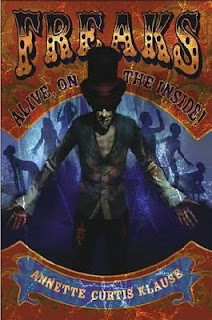
Freaks: Alive, on the Inside! by Annette Curtis Klause (2006)

A copy of Freaks: Alive, on the Inside! by Annette Curtis Klause (2006) fell into my hands after Dr. M got it as a door prize in one of his teaching classes, and it makes for an entertaining and unique young adult novel.

Our hero, Abel Dandy, is a 17 year old boy. It is 1899 and Abel has lived all his life in Faeryland, an amusement park / carnival type place where visitors are entertained by bearded ladies, midgets, Siamese twins and other "freaks." Abel's mom has no arms and his dad has no legs, so Faeryland was one of the only places they could make a living. Abel has good friends there, but increasingly feels out of place since he doesn't have any physical oddities. He gets pretty good at throwing knives, but no one will give him an act. After receiving an exotic ring as a going away present from one of the Siamese twins, Abel decides to run away from home and seek his fortune.

Almost immediately he begins having detailed dreams about a beautiful Egyptian dancer who promises him adventure. He dismisses the dreams as the product of a fortuneteller predicting that he would go off and fall in love with an older foreign woman. After joining another circus as the assistant to a knife thrower, Abel discovers that his young friend from Faeryland, Apollo the Dog-faced Boy has followed him and is hiding out in the elephant's train car. With the added responsibility of taking care of Apollo (and rescuing him from the circus owners who think all "freaks" should be in an institution), Abel breaks away from the circus and hooks up with a small traveling show featuring a midget bearded lady, an alligator-skinned woman, a worm man, a man with two heads, a real Egyptian mummy, and a bunch of cute little freaky-children, as well as one mean skeleton-man manager and his creepy henchmen. As Abel works to return Apollo to his parents and meet his dream woman, he has to fight his way through some pretty dark situations and learn more than a few things about himself and the way the world works.

This book was a really fulfilling adventure and coming of age novel -- I think older junior high or high school students (as well as adults!) would really like it. There is some sexual business (Abel is 17 after all) and some violence in it, but it isn't too explicit and fits nicely with the action of the story. Klause's characters, her descriptions of circus life, and the view of late-19th century America are all strong points of the book. There is a "twist" that I could spot right away, but I think younger readers will be surprised, and even though I figured out what was going on more quickly than it was revealed, the plot ultimately moved beyond the twist and kept me entertained and excited.

Friday, January 15, 2010

The Piano Lesson by August Wilson (1990)

My latest look at the random book generator brought up The Piano Lesson by August Wilson (1990), which Dr. M bought and read for an African American Literature class a couple of years ago.

The Piano Lesson takes place in 1930s Pittsburgh (and is actually the fourth play in Wilson's series The Pittsburgh Cycle) at the home of Doaker, his widowed niece Berniece, and her daughter Maretha. Berniece's brother Boy Willie is in need of some money so he and his friend Lymon come up from the south to sell a truckload of watermelons and negotiate the sale of a family heirloom, an intricately carved piano. Boy Willie has a chance to buy the land that their family had worked as slaves, if he can just get enough money together. But the piano has a history that makes it un-sellable in Berniece's eyes. The conflict between the brother and sister and the ghosts of the past and the present give this play a tension and presence that you can feel through the pages. It is pretty easy to see why The Piano Lesson won the Pulitzer Prize for Drama...

Of course, reading a play and seeing a play are two very different (although often equally enjoyable) things. I'd love to see The Piano Lesson someday, but for now I'll have to make do with the trailer from the 1995 film of the play, featuring most of the Broadway cast.

Sunday, January 10, 2010

Then Came the Evening by Brian Hart (2009)

My latest read from the LibraryThing Early Reviewers program is Brian Hart's debut novel, Then Came the Evening (2009), a tragic story of a family in small-town Idaho.

Then Came the Evening starts off strong, setting into motion the inevitable trajectories of three interesting characters. Bandy is a young man who has just come back from Vietnam and is living in a cabin on his parent's property with his girlfriend Iona. Bandy wakes up one morning to find himself in a crashed car on the ranch, still drunk, with the police and his father waiting for him outside. The cabin that he and Iona shared has burned to the ground, and everyone assumes Iona went with it. Bandy becomes violent and ends up shooting one of the officers and going to jail. Iona didn't die in the fire, though. She was fed up with Bandy's drinking and affairs and left him for another man and moved away. Eighteen years later, still in prison, Bandy gets a brief letter from Iona. She was pregnant when she left him, and his son, Tracy, wants to meet him.

First Tracy, then Iona, then Bandy end up back at Bandy's parents house on the family ranch. Bandy's parents died years ago, and the man Iona left Bandy for has also died. All three of them are raw and flawed and filled with their own resentments and regrets. Is being family enough to bring them redemption?

While the book started out strong (the prison scenes are particularly well written), the last half of the book falls apart a bit with some mis-steps in pacing and some dialogue and action that doesn't seem to fit with the characters as they were revealed to us at the start of the book. I feel like I'm being a little nit-picky with the flaws of Then Came the Evening but that is only because it could have been a great book and it ended up only being good. Hart has a real talent for describing the rural and small-town Idaho landscape, and for crafting his characters -- I really look forward to reading his next book.

Wednesday, January 06, 2010

The Savage Scalpel by Alain Rothstein (1968)

Perhaps an ordinary person would take a look at the goofy cover of Alain Rothstein's 1968 novel The Savage Scalpel and say: "That looks pretty bad. I'm not going to read it." I, on the other hand, said "That looks pretty bad! I'm going to read it!" Sometimes when I say that, the books end up being pretty good. Sometimes they are at least funny. This one was honestly one of the most poorly written books I have ever read. There was some entertainment in that, but that is about as far as it went. Here are some unconnected thoughts on the book:

1. The back of the book promises: "A brand-new dimension in reading experience -- for those who are willing to risk treading to the edge of appalling sensation!" I fear that might have been over-selling it...

2. Plot description: Frank Young, a big-shot psychiatrist, and his best friend Mel, a former attendant at the institution where Frank worked, band together to solve the murder of Frank's half-sister. She was brutally tortured by the mob and found murdered in her New York apartment after Frank and Mel returned from a two-year trip overseas to help Frank forget about the death of his fiance, who was killed in a car accident by two mobsters fleeing a robbery. These mob events are not related, except to highlight that Rothstein does not like the mob. In the end, Frank and Mel decide to take matters into their own hands and torture members of the mob to find out what happened to Frank's sister.

3. This will give you a sense of Rothstein's smooth exposition, when Frank first meets Mel: "I thank you my friend," he said. "And I admire your nonconformity. Do you know, I went to the University of Pennsylvania for four years for my M.D., after my undergraduate years. Then there were two years as an intern at Bellevue Hospital in New York. After that, two years as a resident in neuropsychiatry at the state mental hospital, followed by a chief residency in neurology at the best university hospital in Manhattan. Now I'm a fellow in neuropsychiatry here at the Retreat. But in all those years, nobody on the staff of any of those institutions -- but nobody -- ever called me 'Doc' before."

4. This will give you a sense of the uncomfortable sex scenes: They made love then, without bothering to remove all their clothes. Easily, almost lazily, at first, they embraced, exploring each other's body with caressing fingers and lips, then began the rhythm of the dance of life. Okay, reading this book was totally worth it for the phrase "the rhythm of the dance of life."

5. There are about 20 pages in the middle of the book that were definitely written for another purpose and possibly written by another author (Frank gets a call from a former lover who reads about his sister in the paper, then he reminisces about their affair in a coherent and decently-written fashion before returning to the incoherent and poorly written story).

6. The "Brutal, violent, slashing!" torture climax is.... boring. Frank tortures two of the mobsters by using his medical knowledge to dissect them in front of some other mobsters. That is admittedly pretty brutal, but instead of creating any tension or gore, Rothstein actually has Frank give us an anatomy lesson and basically just types a few paragraphs from a medical text book with the occasional groan thrown in.

I could go on and on (which, I suppose, is one reason to read the book), but overall this was an uncomfortable read with inconsistent characters and clunky writing. I guess you can't win them all....

Saturday, January 02, 2010

Microthrills by Wendy Spero (2006)

Once again the lovely St. Murse loaned me a book that he didn't like. To be fair, he wasn't really sure I would like it either, but he knew I would give it a shot: and he was right on both counts!

Wendy Spero's Microthrills: True Stories from a Life of Small Highs is a book of essays based on the stand-up comic's one woman show about her life. The back of the book compares Spero to David Sedaris -- to be honest, I like Sedaris but have never really gotten why people are so super excited about him -- Sedaris does, however, actually make me laugh. Spero, not really so much.

Not that this is a bad book. Actually it was a pretty good book to read in spurts over the holidays while I took refuge from the negative twenty degree windchill on my mother-in-law's couch. The stories of Spero growing up in Manhattan, her journeys through her first jobs, her neuroses, her mother's neuroses, and all the rest are all very nice and not poorly written. And yet, despite all that, they didn't really make me laugh or think or anything at all. Although Spero and I are about the same age, I didn't feel like I related to her or her problems or worries at all -- there just wasn't any connection there.

I am pretty sure that Wendy Spero is a fine stand-up comic, and that her one-woman show is pretty entertaining. But for me, at least, that entertainment just didn't come through in the print version of her memoir.