Saturday, September 24, 2011

Ready Player One by Ernest Cline (2011)

My bookclub (go DAFFODILS!) decided to read Ready Player One by Ernest Cline (2011) after reading the glowing review of the book on Boing Boing. We had been talking about reading something genre-y, and Cline is from Austin, so it seemed like a nice idea to support a first-time local author. I can't say I loved it as much as Boing Boing did, but although it has a few flaws, this is overall a solid piece of science fiction with nicely drawn characters and a fast-moving plot.

Ready Player One is set in a mid-century America (the 2050s not the 1950s) that is feeling the dire effects of a failing economy, environment, and social structure. Unemployment is off the charts, there is hardly any fuel, and crime and drugs are everywhere. No one seems to mind all that much, though, because everyone is plugged into the OASIS, an immersive virtual reality / Internet / gaming world that was invented by James Halliday. When Halliday dies in 2044, he surprises everyone by leaving his entire fortune and the control of the OASIS to whomever can solve the game he created (filled with references to the 1980s, the decade he grew up in) and find the Easter Egg he has hidden in the OASIS. People go crazy trying to solve his first riddle and find the first of the three keys, but years pass and soon most people lose interest or start to think that the whole thing is unsolvable. A sub-set of super nerd egg hunters (or "gunters") obsess over the puzzle and fill endless message boards with their research. And a giant evil corporation, Innovative Online Industries, puts together its own team of ringers to try and win the contest so it can subvert Halliday's intentions and use the OASIS for its own evil purposes. Then our hero, the 18-year-old orphan, Wade Watts, finds the first key.

Wade is a classic underdog: he has no parents, no money, lives with a mean aunt in a giant slum of stacked trailers outside of Oklahoma City, was beat up at school until he got hooked up with one of Halliday's projects to provide public education in the OASIS (and got free equipment to access his account), and spends most of his time in his hideout (a van deep inside a giant pile of abandoned cars). Wade focuses as little of his energy as possible on the real world and spends all of his time watching 80s movies, playing 80s video games, and reading about everything that James Halliday was ever interested in. He has one friend, Aech, who is a fellow gunter, and an unrequited crush on a girl gunter/blogger named Art3mis. When he finds the first key, his avatar becomes famous, and things really start rolling.

Cline does a good job of giving his reader enough context that even a non-geek can read through the reams of 1980s geek culture references in Ready Player One and keep up, but I think I would have gotten a lot more out of this book if I had that video game experience in my past, and if I had some kind of World of Warcraft-esque contemporary multi-player questing experience. I have a little bit of geekiness in my background -- my dad was always into computers and we had a VIC-20 while I was growing up that I would type programs into from a little book. As our computers got better, I got really into freeware games that I could order through the mail, especially text-based adventure games, and I spent many high school evenings logging into a local BBS (shout out to Cyperspace in Lincoln, NE!) that could host 20 people at a time on its message boards, chat rooms, and extremely popular trivia contests. No pictures back in those days, kiddies, just words! The local modemers would have midnight coffee meet-ups once a week, and once I was 16 with a job and a car, I would join the group. I was easily 10 years younger than everyone else there, and one of only a few women, but the modemers were always gentlemen and I got some more exposure to the world of the geek while watching them play Magic, prepare for Renaissance Faires, and have exhaustive debates about Star Trek. But while I was sitting right next to the ultra geek culture, I never really embraced it. I haven't really watched the shows and movies, I never played Dungeons and Dragons, and while I have sci-fi inclinations, they are rather unfocused. The big hole in my geek experience is video games -- beyond the text-based adventure games, I really have never played any video games seriously at any point in my life.

Beyond the slew of references, I don't always like Cline's writing style which sometimes seems to simple for his subject matter and can get a little ham-fisted when addressing larger social issues -- a friend mentioned that this might have worked better as a young adult novel, and I really agree with that. Cline also suffers from what I like to call Cory Doctorow-itis. I like Boing Boing too, but there is a certain holier-than-thou / know-it-all geekiness factor that oozes from those guys, and I can draw some parallels between the things that irked me about Cline's books with the things that irk me about the Doctorow I've read.

Style issues aside, Cline sets up a classic good vs. evil plot with a dash of young romance, coming of age, and rags to riches, that all builds to a satisfying conclusion. His vision of the future is inventive and smart, and as a reader I was never bored. Definitely recommended for science fiction fans, and fans of Cory Doctorow.

Saturday, September 17, 2011

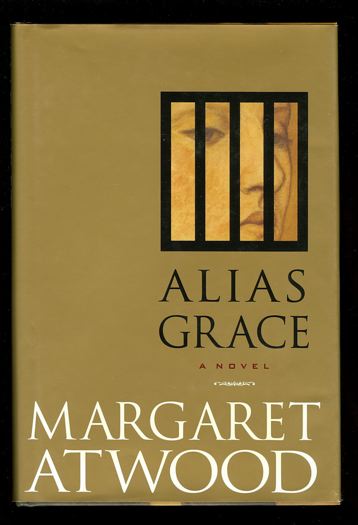
Alias Grace by Margaret Atwood (1996)

The always amazing Corie lent me this copy of Alias Grace by Margaret Atwood (1996) quite some time ago, but even though I'd read it back in college, I decided I wanted to read it again. And I'm glad I did, because it is awesome and I didn't remember all that much about it. Atwood is an author that I read so much of in high school and college but not that much of for the past dozen or so years. I think I might need to rectify that...

In Alias Grace, Atwood gives us a literary true crime novel based on the real story of Grace Marks [archives connection: check out the neat interface on a digitized copy of their "true confessions" from the Toronto Public Library]. Marks was an Irish immigrant who came to Canada with her family when she was 12. Her mother died on the ocean voyage over, and her drunk father wasn't much of a provider for her and her many brothers and sisters. When she was almost 13 she took a job as a servant, her father and siblings eventually left Toronto for the west, and she was on her own. She worked through several positions, accepting an offer to serve as a maid at Mr. Thomas Kinnear's country home when she was almost 16. Mr. Kinnear was a wealthy bachelor, and something of a dark sheep in the neighborhood. His staff was very small, just Grace, the housekeeper, Nancy Montgomery (who was suspiciously close to Mr. Kinnear), and a recently hired man named James McDermott who saw to the horses and other outdoorsy chores.

Some facts are unarguable: in 1843 both Nancy Montgomery and Thomas Kinnear were murdered and their bodies hidden in the cellar. James McDermott and Grace Marks took valuables from the home and went to Toronto where they caught a ferry over to the United States. They were arrested the morning after they arrived, tried, and sentenced to death. McDermott was hanged, but Grace Marks had her sentence commuted to life in the Kingston Penitentiary. She also spent some time in the asylum.

In Atwood's book, we learn Grace's story through a mixture of contemporary newspaper clippings, the published confession, letters from the main characters, and Grace's own narrative, both inside her head and what she decides to say to Simon Jordon, a young psychiatrist who is studying her case. Grace claims that she has no memory of what happened during the time of the murders, and Simon hopes to cure her memory and find out the truth. Really, though, Simon is kind of a dilettante. He is an American who comes from money, and instead of taking over his father's company, he has decided to dabble in the emerging science of psychology. He spends some time in Europe, and then returns to North America but still can't face his clinging mother and her solitary goal of getting him to marry and settle down.

Grace is hard to figure out. By this time she has been in prison for 16 years and has learned how to read people and how to keep things to herself. She manages to seem both very innocent and straightforward and extremely dangerous and duplicitous. Atwood pitches Grace's voice just right so that even the reader (who is often inside her head) can't really tell what she has done and what she knows:

I am sitting in the sewing room, at the head of the stairs in the Governor's wife's house, in the usual chair at the usual table with the sewing things in the basket as usual, except for the scissors. They insist on removing those from within my reach, so if I want to cut a thread or trim a seam I have to ask Dr. Jordon, who takes them out of his vest pocket and returns them to it when I have finished. He says he does not feel any such rigmarole is necessary, as he considers me to be entirely harmless and in control of myself. He appears to be a trusting man.

Although sometimes I just bite the thread off with my teeth.
(p. 62)

Alias Grace is a satisfying fictionalization of a true crime and a well-researched piece of historical fiction, but it also engages issues of gender and class in meaningful ways, dips its toes into psychology, sex, the penitentiary system, mesmerism, quilting, journalism, immigration, and the occult. All that and it also manages to be a fascinating read that is hard to put down. Definitely one of my favorite of Atwood's novels, and a great place to start if you haven't read any of her books.

Sunday, September 11, 2011

Baby Cat-Face by Barry Gifford (1995)

I bought this copy of Baby Cat-Face by Barry Gifford (1995) right after I finished an omnibus collection of Gifford's seven Sailor and Lula novels and read that this one also had some Sailor and Lula in it, even though it wasn't included in the collection. The wonderful Sailor and Lula are indeed in this novel, but more as a side show than the main attraction, so I can see why Gifford and his publishers don't include this one with the rest of the Sailor and Lula canon. But never fear: Baby Cat-Face is just as wild and weird and funny and awesome as the Sailor and Lula novels -- in fact, it might even be weirder.

Baby Cat-Face is a woman who has a cat-like face and who was nicknamed "Baby" since she was the baby of the family. Her real name is Esquerita Reyna, and she ends up in New Orleans hooked up with Jimbo Deal. One night while Jimbo is at work, Baby goes down to the Evening in Seville Bar on Lesseps Street to have a drink (rum and oj, which the bartender calls a "Rat Tango, as in 'I don't need no rat to do no tango at my funeral'") and ends up witnessing a murder. This freaks her out so much that she catches the first bus to North Carolina to get away from things for awhile and visit her aunt.

Things quickly veer out of control when Baby's bus is hijacked by a woman named Daylight DuRapeau who forces the passengers to watch an interpretive dance / poem performance put on by DuRapeau's spiritual leader. Baby and the friends she meets on the bus are rescued by a deus ex machina in the form of teenage Sailor and Lula out for a joy ride while Lula's mama is out of town. But it's when Baby goes back to New Orleans, sanctifies herself, and joins Mother Bizco's Temple of the Few Washed Pure by her Blood that things start getting really weird.

I won't give much more of the plot away since, in true Gifford fashion, the plot is a bit of a chaotic roller coaster and the meat of the story is the characters, the names, the one-sentence back stories, and the dialogue. Anyone who liked Wild at Heart or the other Sailor and Lula stories, who likes Southern literature and greasy gritty New Orleans, or who just likes to have a tornado of messy creativity bowl them over, should check out Baby Cat-Face and the rest of Gifford's novels.

[Gifford is apparently also an extensively published poet and non-fiction writer. I might have to get me some of those as well...]

Tuesday, September 06, 2011

The World's One Hundred Best Short Stories, Volume 3: Mystery, edited by Grant Overton (1927)

I recently won this exciting pile of old books through a giveaway on the Forgotten Bookmarks blog (and if you don't follow that blog, you should, because it is awesome). And rather than just put them on my shelf and gaze at their pretty spines, I thought I'd read them. I know that is unusual behavior for me, but just bear with it.

Starting off the pile is one volume of a multi-volume collection of short stories edited by Grant Overton: The World's One Hundred Best Short Stories, Volume 3: Mystery (1927). The title page doesn't do this adorable 4"X6" book justice -- it was physically fun to hold and in great shape, with clear type and a nice binding. Oh, and the stories were pretty great too.

Overton's definition of mystery is broad and includes some authors who are still very well known today, and others that I'd never heard of. A very worthwhile collection, and most of the stories are available in full-text online since they were published before 1923 -- just Google them, fools!

Here's the line up:

"The Doomdorf Mystery," by Melville Davisson Post (1918)
A brain twister where two friends try to figure out how the town meanie was shot when he was locked in a room by himself that could only be opened from the inside. Everyone wanted him dead, but no one could actually have done it!

"The Three Strangers," by Thomas Hardy (1883)
During a christening celebration in an isolated cottage in rural England, a stranger comes knocking on the door to get out of the rain. A few minutes later, another stranger does the same. And while he entertains the company with a song about his profession, a third man comes to the door asking for directions, takes one look inside, and runs away as if his life depended on it.

"The Gold Bug," by Edgar Allan Poe (1843)
Probably the most famous story in this collection -- William Legrand and his former slave Jupiter live alone together on an island off the coast of South Carolina. While walking one day, they find an unusual gold colored bug that bites Legrand as he tries to catch it. Legrand soon starts acting very peculiarly, and sends Jupiter for his good friend, our unnamed narrator, who joins the pair on what turns out to be an extremely profitable expedition.

"The Guilty Secret," by Paul de Kock (1910)
A funny mystery of romantic misunderstandings, tobacco, and protective uncles who like to play backgammon.

"Out of Exile," by Wilbur Daniel Steele (1919)
Possibly my favorite story in the anthology -- a moody story of two brothers in love with the same young woman. When she makes a flippant comment at a party that the first to sail to the mainland and come back with a golden ring will be the one she marries, both brothers head out in a violent storm but only one returns. She refuses to believe that the missing brother has died, and won't marry until he can attend the wedding. Told through the eyes of a teenager in the village, and its the distanced but character-based narration that make this one so great. [Read it here -- do it!]

"The Knightsbridge Mystery," by Charles Reade (1896)
This is the most detective-y of all the stories in this collection. Tells the story of a British boarding house whose tenants include a down-on-his-luck retired Captain and a substantial business man. On a night when the Captain's fortunes have fallen further and the businessman has a bag full of all his collected rents, the businessman ends up murdered in his bed and all his money stolen. The murder is pinned on the drunken horsemaster, but a police detective finds too many doubts in the story and tests all the honest tenants with another irresistible set-up.

"Silence," by Leonid Andreyev (1910)
A heartbreaking story of a stern minister whose daughter kills herself without an explanation, and whose wife then has a stroke that leaves her unable to speak or move. Beautifully written, lonely, and harsh.

"The Doll's House," by Katherine Mansfield (1923)
Three young sisters receive a marvelously huge dollhouse from their aunt and savor the attention it brings them at school, hand selecting no more than two girls a day to come and see it. Everyone gets a turn except the little Kelveys, whose mother takes in laundry, and whose father is out of the picture. No respectable family will let their children play with the Kelveys! A wonderful balance between the open-minded excitement of the youngest sister (who really really loves the tiny lamp in the dollhouse) and the hilariously biting asides and descriptions of the "proper" adult society.

"A Terribly Strange Bed," by Wilkie Collins (1852)
An Englishman who has amazing luck at a seedy French casino soon finds himself exceptionally drunk and checked into a room at the gambling house for the night. But then he runs up against a terribly strange bed, and his night takes a turn for the worse. This one was great fun.

"The Bamboozling of Mr. Gascoigne," by E. Phillips Oppenheim (1925)
This one wins the award for most exciting title -- an American swindler in Monte Carlo hooks up with a local man and his niece when they try to swindle him out of the cost of their lunch. Together the three team up to bamboozle the titular Mr. Gascoigne.

Saturday, September 03, 2011

The Double Life of Alfred Buber by David Schmahmann (2011)

The latest pick for me from the algorithms of the LibraryThing Early Reviewer program was The Double Life of Alfred Buber by David Schmahmann (2011).

Alfred Buber does indeed live a double life, but he lives each half of his life at such a distance from himself, that even his double life doesn't seem to equal a whole person. Buber was born in Rhodesia, the son of a Jewish Communist and a British woman. He was sent to the U.S. for college, first living with his uncle, then in a boarding house while he completed law school. He never wanted to be a lawyer, but found that he was pretty good at it, and got a position with a prestigious firm. He spent almost no money on anything except the dream house that he was building in a commuter town outside of the city. He fills the house with artwork, and has the grounds impeccably landscaped. Then he moves into it alone.

Buber is a lonely guy. He had a brief fling in law school, but the only other time he spends with members of the opposite sex are the lawyers and secretaries at work, who mostly respect but ignore him, and the prostitutes that he visits habitually. It is that second interest that leads Buber to tell his boss and uncle that he is going on a trip to Paris while he really boards a plane for an un-named city in Southeast Asia, well known for its prostitutes. Once he is there, however, he is disgusted with the whole procedure, locks himself in his hotel room, and books a flight for home. But not before venturing down an ally off the main street and making his way into a small bar filled with beautiful young women in open robes. There he "meets" Nok, a young girl from the country, as she gives him a perfunctory blow job. He buys her a book to help her learn English and promises he will come back to her. Then he heads back home, but he can't stop thinking about Nok.

Buber is a liar. He lies when it is important that no one find out the truth about his secret life, and he lies when it is of no importance at all. He lies to himself, and he lies quite a bit to his reader (who is us, obviously, but also someone quite specific in Buber's life). Many reviews have called The Double Life of Alfred Buber Nabakovian, and the combination of self-delusion, self-awareness, and isolation definitely owe a debt to Humbert Humbert. But where Humbert's obsession has a strength and power to it, Buber's seems to result in half-hearted actions, eternal doubt, and more inconsequential lies. Schmahmann brings it all together in a well-earned exhale of an ending that is satisfying for its utter Buberness. This slim character study is worth reading if you like you unreliable narrators mixed with a little humor and a lot of discomfort.

Tuesday, August 30, 2011

The Works and Days by Hesiod, Translated by Richmond Lattimore (circa 700 BC)

My latest dip into Harold Bloom's Western Canon is the Ancient Greek poem The Works and Days by Hesiod (circa 700 BC). As Bloom suggests, I read Richmond Lattimore's translation (published together with Theogony and The Shield of Herakles, which I'm saving for later).

Hesiod was from a region in Greece called Boetia and may have been a younger contemporary of Homer. In The Works and Days, instead of getting the narrative journey of past warriors that we see in Homer's the Iliad or the Odyssey, we have a contemporary piece of writing addressed to Hesiod's brother, Perses. Hesiod and Perses' father was a farmer, and when he died his land and estate was distributed between the two brothers, but Perses used the influence of some local judges to take more than his fair share (at least that is Hesiod's story).

In this poem to his brother, Hesiod responds to Perses by evoking the Gods and their justice, the story of Pandora's box, and the punishment in store for an unjust humanity that has strayed from its godly beginnings. He then goes on to list some practical advice: What time of year to plant your corn, what you should be doing in the winter (hint, it involves a lot of work preparing your equipment for the summer), what kind of woman you should marry, when you should harvest your grapevines, and the very small chunk of the year when you can relax. He also briefly touches on the best seasons for starting a sea voyage, and then ends the poetic advice with a listing of the lucky and unlucky days of the year for various pursuits.

If this sounds a little dull compared to the battles and characters of Homer, well, it kind of is, but there is a certain beauty in Hesiod's lists and advice, as well as some well placed jabs at his ne'er-do-well brother:

I mean you well, Perses, you great idiot, and I will tell you. Look, badness is easy to have, you can take it by handfuls without effort. The road that way is smooth and starts here beside you. But between us and virtue the immortals have put what will make us sweat. The road to virtue is long and goes steep up hill, hard climbing at first, but the last of it, when you get to the summit (if you get there) is easy going after the hard part.

Classics can be pretty fun, and The Works and Days only takes an hour or so to read, so embrace the listy advice and learn a thing or two from Hesiod!

Friday, August 26, 2011

4 for the Future, edited by Groff Conklin (1959)

In this science fiction anthology, 4 for the Future (1959), Groff Conklin, the prolific sci-fi editor (and possessor of an excellent name) brings together strong stories by Poul Anderson ("Enough Rope," 1953), Theodore Sturgeon ("The Claustrophile," 1956), Henry Kuttner ("The Children's Hour," 1944), and Eric Frank Russell ("Plus X," 1956).

While the stories run the gamut from an alien-filled space opera to a quiet story of love in a separate dimension, all four of the stories focus less on technology or exploration, and more on the humanness of the characters and the power of thinking your way out of a tight spot.

All four of these stories were very strong, but I particularly liked the family drama of personalities at the core of Sturgeon's "The Claustrophile," and the light touch of Henry Kuttner's very literary "The Children's Hour." The 1940s and 1950s are my favorite era of science fiction, and this collection doesn't disappoint. Also includes adorable anachronisms like an ink well tipping over in a futuristic office. If you like science fiction, you will like this.

[Equally awesome back cover available here if you are into that kind of thing.]

Friday, August 19, 2011

The Book of Negroes by Lawerence Hill (2007)

My lovely Aunt Charlotte loaned me a copy of Canadian author Lawrence Hill's The Book of Negroes [published in the US as Someone Knows My Name] (2007) an embarrassingly long time ago, and it just recently floated up to the top of my pile. Even though I had heard so many good things about the book, it was hard to make myself pick up what I imagined had to be a very sad and upsetting story of slavery. I was right that Hill's novel is sad and upsetting, but it is also moving, occasionally uplifting, and a surprisingly energetic read.

Hill gives us the first-person story of Aminata Diallo, who at the start of the book (in 1802) is an older woman, without any family, who was brought to London by abolitionists who want her to testify before Parliament in their fight to outlaw the slave trade. As part of her work with the abolitionists, Aminata decides to write her own life story, and that is the book we are holding in our hands.

Aminata starts with her life in a small African village with her parents. When she is 11 and walking home with her mother, a midwife, from assisting with a birth in another village, the two of them are attacked and Aminata is taken by the slave traders. The novel takes us through Aminata's brutal three month march to the sea, chained to other captured Africans, the putrid and deadly sea voyage, and her eventual purchase as a "refuse slave" by the owner of a South Carolina indigo plantation.

Through a series of coincidences, providence, and her own strong personality and aptitude for languages, Aminata survives these ordeals, learns both black and white English, and learns how to read and write. She also, at the age of 15, has a baby boy with a young man named Chekura who had been her companion since the long march in Africa. Chekura ends up on a nearby plantation and is able to sneak away once a month to visit Aminata. As with many slaves, their family is broken up.

I don't want to give away too much of the book, so I'll just say that through more coincidence and bravery, Aminata ends up with her freedom in New York City, and ultimately works with the British Loyalists during the Revolutionary War. The British promised freedom to any slaves that worked for them, and after the end of the war, Aminata is asked by the British to help them register all the blacks that served the Loyalist cause in "The Book of Negroes" so that they can be transported to Nova Scotia.

As you might imagine, things are not much better in Canada. The land promised to the former slaves is never given. They are forced to live in a separate town miles from the white settlement where they work, and when jobs become scarce, lynch mobs and arsonists attack the black settlement. A group of British abolitionists organize an exodus of former slaves to settle back in Africa in Sierra Leone, and Aminata Diallo, who by this point feels she has nothing to lose and who wants to see her home village again, decides to go.

This is obviously an epic and sweeping book that covers a lot of time, a lot of events, and a lot of countries. Keeping the entire narrative tied to the first person experiences of Aminata and allowing us to view these unimaginable actions on an individual scale allows the book to sink deeper than a birds-eye view of the topic. And Hill does a wonderful job with Aminata. Her narrative is straight forward and unflinching, very physical, pragmatic, and intelligent. She is a character that you admire much more than you pity.

The Canadian section of the book and the move to Sierra Leone was the part of the slave story that I wasn't that familiar with. The Book of Negroes is a real document (actually one of the most detailed and comprehensive archival records of individual slaves), and Hill definitely did his research -- there are dozens of recommended books for further reading at the end of the novel. Reading a story about slavery, showing all the horribleness of humanity, is never a fun endeavor, but Hill gives us something new in The Book of Negroes and something that we shouldn't look away from.

Saturday, August 13, 2011

The Wicked Heart by Christopher Pike (1993)

Hey, guess what, guys! I found another Christopher Pike book from my secret stash, and this one pretty much tops all the other ones in bad descriptions, far-fetched plots, and disturbing violence. I'm talking about The Wicked Heart (1993), the story of a teenage serial killer named Dusty Shame and his chemistry lab partner, Sheila, who helps solve the mystery and bring his story to an end. Let me say that again: Dusty Shame.

I'll just let Pike describe Dusty for you:

He was a handsome young man. His hair was light brown, soft and fine like that of an angel, his eyes green as grass in evening twilight. He was five ten, fit and muscular, but plagued by repeated heartburn. He had a tendency, when in social situations, to be jerky in his movements. But when he was alone, especially when he killed, he moved smoothly and gracefully as a dancer. Always, though, he was quiet. Had he been more talkative, he certainly could have had plenty of dates. And maybe if he had spoken to more girls and listened to their voices instead of the one [in] his head, he wouldn't have become a murderer....

Dusty was in many ways like his nickname, Dust, and viewed everything from the ground level, where the insects that crawled through the mud were the best friends of the flowers that scented the air with their perfume.

Here we go (spoilers follow, but I don't know that it matters much):

As the book begins, Dusty has killed two teenage girls and is about to kill a third. A voice in his head tells him he needs to kill six girls and bury them in an isolated cave in the California desert, where six other old graves already lie. The other girls Dusty killed lived in other towns, but for this third murder he picks Nancy, a girl from his chemistry class, who was talking about how her parents were going to be out of town for a couple days.

When Nancy doesn't show up for class the next day, her best friend (and Dusty's lab partner) Sheila, is worried. Sheila is also upset because her boyfriend Matt recently broke up with her. She runs into Matt after school and starts crying so hard that he offers to drive her home, but she insists that they stop at Nancy's house to check on her. When there is no answer, Matt breaks into the house and they notice nothing out of place except that Nancy and her purse are gone, and there is a white card with a hand-drawn swastika on the bed. They call Nancy's parents and then the police. Eventually they get put in touch with Lieutenant Black who has been tracking the other murders.

The ridiculousness level amps up as Lt. Black entrusts Sheila with details of the ongoing investigation and asks her for help in understanding how the Einstein computer network works (an adorably described Prodigy-like creation), since it appears that the killer finds his victims using the message boards. Sheila doesn't know much about Einstein, but her lab partner Dusty does! Uh oh! Dusty and Shelia go to Lt. Black's house and meet his cute teenage daughter Dixie. Uh oh!

Then things get really improbable:

Lt. Black sends Sheila out to another city to talk to a retired police officer named Gossick who has a theory about this case. She decides to take Matt with her and they hear the guy out. Here is the outline: Back in Nazi Germany, Heinrich Himmler had a girlfriend named Frau Scheimer. They were both empty evil beings without humanity that fed off of the suffering of others. Gossick was present when Himmler and Scheimer were caught and Himmler killed himself before being interrogated. Frau Scheimer and her young daughter (uh oh!) were released and ended up going to California. A similar set of murders of young women started up and Gossick started investigating. Through a deep meditation regimen, he connected in with the mysteries of the universe and realized that Frau Scheimer was responsible for the killings. Things happen, Gossick ends up shooting Scheimer, burying her in a secret grave, fostering her daughter for awhile, and then getting fired from the force, and losing custody of the daughter, who he had grown to love. The daughter's adopted parents end up dying and she changes her name and has a son of her own. She loses her mind to Alzheimer's when her son is a young man, but the evil voice of her mother is still able to talk to him and tell him to commit horrible acts. That's right: Dusty Shame is the grandson of Himmler!

And now he has Dixie and is driving her out to the desert with Sheila hot on their trail. Gossick and Matt are trying to find them! So is Lt. Black! What will happen!

So, this one was satisfyingly ridiculous, but also one of the worst written of all of Pike's books. The dialogue is horrible, the descriptions clunky, and the plot ridiculous. This was written in the heyday of Pike's career (it was the fourth book he published in 1993) and it reads like a poorly edited first draft. It is much much darker than other Pike books, but the ridiculous plot and poor writing do little to help the violence and tragedy to coalesce into anything suspenseful or engaging. If you love to hate Pike books, this is the one for you. If you are looking for a good murder mystery, then you should probably stay away.

Saturday, August 06, 2011

The Tragedy of Arthur by Arthur Phillips (2011)

The next LibraryThing Early Reviewers book in my pile is The Tragedy of Arthur (2011) by Arthur Phillips. Spacebeer readers who pay even more attention than I do will remember that I read Phillips' first book, Prague way back in 2006 for the first meeting of the awesome, but now defunct/transmogrified Smarter Than You Book Club. I remember liking Prague but having some reservations, and I feel similarly towards The Tragedy of Arthur, although Phillips gets way more ambition points with the conceit of his most recent novel.

"The Tragedy of Arthur" in The Tragedy of Arthur is an undiscovered Shakespeare play that our narrator's father discovered and liberated from a wealthy manor house over thirty years ago. Of course, our narrator's father is a talented forger who has spent most of the intervening years in prison. And our narrator happens to be a novelist named Arthur Phillips who has written several books, including a debut novel titled Prague.

Although he is suspicious at first, all the experts agree that the 1597 edition of "The Tragedy of Shakespeare" that his father found are authentic, and Arthur enters into a contract with his publisher, Random House, to publish this unseen play. Arthur secures the right to write the introduction and annotate the play for modern audiences himself. But when his doubts of the play's authenticity increase and Random House refuses to stop publication, he bulks his introduction to the play up into a 250 page memoir / explanation of his life, his father, his twin sister, his failed relationships, and everything else.

And then, just in case you didn't think Phillips was the smartest guy in the room, we have the text of "The Tragedy of Arthur": a five-act, straight-faced, iambic pentameter-ed, credibly Shakespearean tragedy. Complete with annotations by Arthur and co/cross-annotations by a Shakespearean expert.

Setting the novel's weaknesses aside, you have to admire Phillips' ambition and dedication to pull this off. It's awfully, awfully, clever, and he does it well. The meditations on forgery and reality are well thought out, and the comments on the legacy of Shakespeare are all pretty accurate and difficult to argue with, whether you love or hate the Bard.

While the introduction is well written, I was often put off by Phillips' distancing word play ("disparate desperate adventures," "disoriented in the JFK holding area where counterterrorism shades into countertourism") and meta-ness (it's a character, with the name of the author, writing an introduction, to a fake play, that really exists, and the introduction's like a memoir, and he tells us it's like a memoir! And why he hates memoirs!). I don't think that the revelations of the narrator's intentions end up being as emotionally connecting as Phillips' hopes they will be, and the unsatisfying twist that leads to those revelations is an out of character reaction to Arthur on the behalf of every other character of the novel.

Arthur Phillips' "Arthur Phillips" owes some literary debt to Phillip Roth's "Phillip Roth," and like Roth's novels that I've read, the narrator of The Tragedy of Arthur is very self centered, has ridiculous relationships with women, and kind of turns me off with his overly dude-centered ways. And although Phillips is a good writer, he doesn't have the dark, neurotic, over-the-topness that keeps me reading Roth even though I find most of his characters pretty despicable. I think that both Roth and Phillips want their narrators to be unlikable, but Roth pulls it off in a way that Phillips does not.

Either way, this book obviously gave me a lot to think about, and although when I just re-read what I wrote about it I realize I had a lot of criticisms, I really did like the novel overall. Anyone with a sense of literary playfulness, and particularly any English nerds who have read a lot of Shakespeare, will get a lot of enjoyment from this book.

Saturday, July 30, 2011

The Lotus Eaters by Tatjana Soli (2010)

When my excellent friend Corie loaned me Tatjana Soli's debut novel, The Lotus Eaters (2010), I wasn't entirely sure I'd get into this story of a female American photojournalist in Vietnam. Of course, I should have remembered Corie's track record of book recommendations -- I was quickly engrossed in this one and was carried away by it until the end.

In 1965, after Helen Adams' brother is killed in Vietnam, she drops out of college and with a high school photography class under her belt, decides to travel to Vietnam and cover the war as a freelance photojournalist. A tall blond woman is a unique sight in Saigon, and particularly unusual in the boys club of foreign journalism. Helen makes her share of newbie mistakes, one of which initially appears to be falling into bed with the handsome Pulitzer prize winning bad boy of the bunch, Sam Darrow. After getting brushed off by Darrow, Helen regroups and quickly (honestly maybe a little too quickly) makes a name for herself as a natural photographer who is willing to take risks to bring in the shot. She gets a job as a Life staff photographer and is once again in the orbit of Darrow and his Vietnamese assistant, Linh.

Linh, like many of the Vietnamese assisting the Americans, has had a complicated and tragic life because of the complicated and tragic series of wars in his country. He keeps his feelings and history to himself, for the most part, but his story is slowly revealed over the course of the book, as is his hidden love for Helen that grows even as she and Darrow become inseparable.

Soli starts the book with the American evacuation of Saigon in 1975 as Helen and Linh struggle to escape with their lives and Helen's film, and then drops us back a decade. This structure gives us a unique perspective as we watch the characters move forward to the action at the beginning of the book, and deepens our understanding of their actions. In fact, throughout the book, Soli's biggest strength is her structuring of the plot and her hints and revelations of the past.

Helen Adams, Sam Darrow, and Linh are no cynical Thomas Fowlers, but there is a lot from this expatriate community of journalists that hearkens back to Graham Greene's The Quiet American (in fact, in an early scene, Helen throws her copy of Greene's book in the trash and then decides to read it one more time after it is rescued by her room boy). While Helen and the other characters do lose their idealism and optimism, they also become more a part of the Vietnamese culture than Fowler ever did and never entirely distance themselves from the events surrounding them -- to the extent that they are ultimately nearly destroyed by their inability to isolate themselves.

Soli is a beautiful writer, and this is a well researched and accurate-feeling novel about a country and a war that have been written about many times before. The characters, the romance, and the action are all believable and moving, but her descriptions of the environment and her compassion for all the components of her novel, even the smallest characters or briefest scenes, are part of what really make The Lotus Eaters stand out. Definitely worth reading.

Wednesday, July 27, 2011

Huntington, West Virginia "On the Fly" by Harvey Pekar (2011)

I haven't read everything that Harvey Pekar (author of the American Splendor comics) has written, but what I've read I've really liked. So when Dr. M picked up the copy of his most recent (and final, since he sadly died about a year ago) book, the posthumously published and awesomely punctuated Huntington, West Virginia "On the Fly" (2011), I was happy to take a look.

Like his other work, this book consists of vignettes of Pekar's everyday life and some of the stories of people that Pekar has met. In this collection we have the story of "Hollywood Bob" (my favorite) who went from being a small time hood to the successful owner and driver of a limo business; the separate and then together stories of Tunc and Eileen (plus Eileen is a comic book archivist!); the drama behind a local toy store owner's purchase and renovation of a old timey diner; and Pekar's trip to the titular Huntington, West Virginia for a book festival.

Pekar's voice and presence melds with his subject in each story, and the perfectly ordinary events of regular life become a little more interesting through his eyes. This collection is beautifully illustrated by Summer McClinton. Definitely recommended for Pekar fans, and if you aren't a Pekar fan, then what have you been doing with your life?

Thursday, July 21, 2011

The Blind Assassin by Margaret Atwood (2000)

The always amazing Joolie lent me this copy of Margaret Atwood's The Blind Assassin (2000) after I raved so much about liking books with interesting structures like The Cloud Atlas. As always, Joolie was right on target with what I might like.

"The Blind Assassin" in The Blind Assassin is the title of a posthumously published novel by Laura Chase -- a woman who drives off a bridge and dies at the age of 25 on the first page of our book. Our narrator, Iris Chase, is Laura's older sister, and she had the book published after Laura's death. This book follows a young upper-class woman who is having an affair with a fascinatingly poor writer who is wanted by the police for his work with the labor unions. As they lay in bed together, the man spins a science fiction story about the blind assassins for his lover. The Blind Assassin alternates between sections of Laura Chase's novel, the current musings of the elderly Iris, and Iris's memoir of she and Laura's parallel lives.

The structure is obviously the star here, and Atwood expertly intertwines the different facets of the story, perfectly wrapping up all the loose strings by the end. The ending is a little predictable, but it hid itself long enough to be satisfying when it occurred to me. Beyond the structure we have Atwood's cold, distancing, unknowable, and fragile characters (and I mean all that in a good way). Our narrator, the character through whom we see everyone else, is tragically disconnected from everyone else in her life, and because of this distance, we can't ever know the other characters very well. And most of them come off as people I would prefer not to know anyway.

Part of the reason I think I responded so much to this book is that at its core it's about sisters -- I have two sisters (and no brothers) and sister stories have always gotten to me. The relationship between Iris and Laura is an exaggerated version of that combination of closeness and distance that any sisters share -- they are the people that are most like you and that you know better than anyone in the world, while at the same time being even more unknowable than a perfect stranger. This simultaneous closeness and distance between Iris and Laura drives the action of the book to its inevitably tragic (but ultimately satisfying) conclusion.

Wednesday, July 13, 2011

Just Kids by Patti Smith (2010)

The next book for the best book club in the U.S.A. (Go DAFFODILS!) is Patti Smith's memoir Just Kids (2010). I'm not the most informed on Patti Smith's musical career, and while I like Horses quite a bit, I find some of her music is a little too poetic and overtly political for my taste. This book, however, hardly gets into Smith's music at all. Instead it is a kind of dual coming of age story of Patti Smith and photographer Robert Mapplethorpe in late-1960s / early-1970s New York City. It's a story of a foundational friendship and young artists finding their voice. But most of all, its a love story.

Smith and Mapplethorpe were both born in 1946 and moved to New York City in the late 1960s. Once they found each other, they quickly formed a life together that supported the two of them both personally and artistically, and which didn't end until Mapplethorpe's death in 1989.

I'm not the hugest fan of the memoir as a genre (they can occasionally be wonderful, but usually either try to out do other memoirists in a horrible experiences contest or fall into the the rose-colored nostalgia trap), but Smith has written a beautiful and readable book about her experience in New York City and her relationship with Mapplethorpe, both hard subjects to approach without falling into cliches or glossing over rough edges.

Smith's background as a poet sometimes bleeds too heavily into her prose for my taste (particularly when describing herself), but for the most part she maintains a straightforward style that works well with her subject matter. The large chapter of the book that covers the couple's time in the Hotel Chelsea gets a little namedroppy (does Smith really remember every person that was at Max's Kansas City or some party or poetry reading every time?), but I imagine many readers are coming to the book for that 1970s New York experience and will appreciate knowing all the details.

I'll save some of my comments for the book club, but be prepared for the final chapter to melt even the coldest of hearts. Worth reading regardless of your musical tastes.

Friday, July 08, 2011

The War Prayer by Mark Twain (1916)

I got this copy of The War Prayer by Mark Twain (1916) at the seminary library book sale this past year -- it just called out to me from in between all the theological tomes and philosophy books.

Twain wrote this poetic protest in response to the Spanish-American war but wouldn't let it be published during his lifetime out of respect for his family, who thought the sentiments too harsh. It was first published in Harper's in 1916, in the heart of World War I, and has been a perennial favorite whenever the nation goes to war.

The copy I have was published during Vietnam, in 1971. Here Twain's words are accompanied by the powerful and chaotic line drawings of John Groth. The combination of the words and images really help to twist Twain's knife. Definitely worth a read.

[And if you want to read it (without Groth's wonderful illustrations) it is all right here.]

Monday, July 04, 2011

The Anatomy of a Moment: Thirty-five Minutes in History and Imagination by Javier Cercas (2011)

I got a copy of The Anatomy of a Moment: Thirty-five Minutes in History and Imagination by Javier Cercas (published in Spain in 2009, and in an English translation in 2011) through the Library Thing EarlyReviewers program. I have to admit that even though I requested it and I do have some interest in modern Spanish politics, it took me awhile to bring this book about a failed 1981 coup d'etat up to the top of my list. And while it was slow going at first, this book really exceeded my expectations and turned into something very unique and exciting.

My first clue that this was no ordinary history or political science book should have been the first two blurbs on the back of the book: "The best history book of the year" and "A masterpiece of twenty-first century European literature." Cercas is an established novelist in Spain, and found himself moved by the half an hour of video footage of the attempted February 23, 1981 takeover of the government by a faction of the military (commonly referred to as 23-F). Although the vote of a new Prime Minister that was going on at the time was being broadcast live on the radio, a couple of cameras were in the room recording when the soldiers entered. They recorded, unmanned, for about half an hour before they were both shut off. This footage is played often in Spain on the anniversary of the coup, and the reactions of the participants, particularly the recently disgraced Prime Minister Adolfo Suarez, inspired Cercas to write a novel. After the novel was done, it just didn't work for him, so he translated his extensive research and endless thoughts into this non-fiction novel of the events of the coup and the men on either side of the standoff.

During the coup, when the soldiers, led by Lieutenant-Colonel Antonio Tejero, entered the parliament floor and took the legislators hostage, three men refused to get down on the floor, even when the bullets started flying. I think wikipedia describes their reactions pretty well: "During the shooting of several machine gun rounds, whilst almost all deputies dropped terrified on the floor, three kept standing defiantly: acting Minister of Defense General Manuel Gutiérrez Mellado, who stood up and ordered Tejero to desist; acting President of the Government Adolfo Suárez, who remained sitting down instead of crouching on the floor; and Communist leader Santiago Carrillo, who, sitting down, calmly lit a cigarette and did not seem to be disturbed by the events." [You can get a hint of the coup here (and there is a lot more on You Tube -- search for "23 Febrero golpe de estado")]

But let's back up for a very tiny bit of Spanish history (feel free to skip the next two paragraphs if this is not your thing): In 1936, Francisco Franco led an unsuccessful coup against the left-wing Popular Front government. The coup started the Spanish Civil War, which pitted left against right and ended with Franco declaring himself the leader of Spain for life. And he lived for another 40 years. Knowing that he would need to take steps to carry on Francoism after his death, Franco allowed the heir of the Spanish monarchy, Juan Carlos, to return to Spain from Italy and be educated there. Franco was secure that Juan Carlos would continue his policies after his death and named him his official successor. He wasn't aware, however, that Juan Carlos had been meeting with political dissidents behind Franco's back, and when he came to power in 1975, he masterminded the transition of Spain from a dictatorship to a democracy.

The major creator of the new Spanish state was the first Prime Minister (who was initially appointed by the King but later elected democratically), Adolfo Suarez. Cercas describes Suarez as a "pure politician" and he did what seemed almost impossible -- got the Francoist legislature to vote their system out and a democratic one in, legalized political parties, including Communism, and extended autonomy to distinct regions of Spain. It was all going pretty great until Suarez leaned a little too far to the left from his centrist foundation, while international politics leaned heavily to the right (Thatcher, Reagan). Add in the oil crisis and increased terrorist activity from the ETA and you have a bunch of Spaniards who think that Franco wasn't so bad and another coup and a return to the right might not be a bad idea.

The background details and results of the coup (which are covered extensively in the book) are way too complicated to get into here, but I'll just say that Cercas does an amazing job of combining historical research with his novelist's eye for human psychology and emotion. The book has a wonderful structure -- each section starts with a detailed analysis of the existing video from inside the legislative chamber and ends with a step-by-step move through the action of the coup itself. In between we get the histories of all the major players, the cultural and political climate leading up to the coup, and the ultimate consequences of the military action.

Cercas' writing style takes a little getting used to, but as a lover of long sentences and multiple asides, I got into it pretty quickly. Here's a representative example: "I insist: I'm not saying that this was the only possible result of the coup for the monarchy if the King opposed it; what I'm saying is that, like any of the rest of the plotters, before joining the coup Cortina might have arrived at the conclusion that the risks the coup entailed for the monarchy were much fewer than the benefits it might bring in its wake, and that in consequence the coup was a good coup because it would triumph whether it triumphed or failed: the triumph of the coup would strengthen the Crown (that's at least what Cortina might have thought and what Armada and Milans were thinking); its failure would likewise do so."

Whew.

Obviously this isn't the book for everyone, and I have a little background in this kind of thing, so I might be a special audience (I was a Spanish minor in college and took a class all in Spanish about modern Spain), but if you have a little patience and some interest in Spanish politics, try picking this one up. I've never read anything else like it.

Friday, July 01, 2011

The Maeander Project

Do you remember watching Indiana Jones as a kid? And how cool being an archaeologist seemed? Obviously real archaeologists don't (always) act like Mr. Jones (Dr. Jones?), but they are still pretty cool. [Also, as an aside, I can see how constantly being reminded of Indiana Jones could get irritating for an archaeologist, but I sort of wish archivists had a parallel film hero.]

Two of my cool archaeologist friends (Colleen and John) are participating in a very interesting sounding project this August in the Maeander River area of Southwestern Turkey. When their funding stumbled, the group didn't give up, instead they started a Kickstarter page to raise $5,000 for the trip.

If you aren't familiar with Kickstarter, it is a neat system where people can pledge money to a project in exchange for a graduated level of thank you gifts (like when you contribute to PBS). If the project doesn't meet its funding goal within the designated time frame, no one pays anything. If it reaches its funding level, everyone contributes the bit they've pledged and project goes forward. I love the idea of crowdsourcing funding for good people to do interesting things. Some projects are never going to be attractive enough to big corporations, governments, or universities to support them, for whatever reason, but that doesn't mean they shouldn't get funding. Guys, we can fund them! With as little as $1!

The Maeander Project is up to 48 backers and $3,098 as of this posting, with two weeks to go. If they hit the $5,000 goal, they have a donor who has pledged to match it. Do me a favor and read their proposal and then contribute if you can. And even if you can't contribute, spread the word about this worthwhile project.

[Photo credit: Rol1000 on Flickr. Also I don't know much about Turkey or archaeology, but this is tagged as being in the Maeander River region with a Creative Commons license and I thought it was a nice illustration. So there.]

Thursday, June 23, 2011

The Haunting of Hill House by Shirley Jackson (1959)

No human eye can isolate the unhappy coincidence of line and place which suggests evil in the face of a house, and yet somehow a maniac juxtaposition, a badly turned angle, some chance meeting of roof and sky, turned Hill House into a place of despair, more frightening because the face of Hill House seemed awake, with a watchfulness from the blank windows and a touch of glee in the eyebrow of a cornice. Almost any house, caught unexpectedly or at an odd angle, can turn a deeply humorous look on a watching person; even a mischievous little chimney, or a dormer like a dimple, can catch up a beholder with a sense of fellowship; but a house arrogant and hating, never off guard, can only be evil. This house, which seemed somehow to have formed itself, flying together into its own powerful pattern under the hands of its builders, fitting itself into its own construction of lines and angles, reared its great head back against the sky without concession to humanity. It was a house without kindness, never meant to be lived in, not a fit place for people or for love or for hope. Exorcism cannot alter the countenance of a house; Hill House would stay as it was until it was destroyed.

My super awesome friend Dan loaned me a copy of one of his favorite books, The Haunting of Hill House by Shirley Jackson (1959). This book was made into a movie called The Haunting in 1963 (which I have seen and which is awesome) [and remade in 1999 into a movie I haven't seen, but have heard kind of sucks]. And since I liked the old movie so much, I was very excited to check out the book. As you might expect, it was wonderfully great.

Dr. Montague is a supernatural researcher who has finally found the perfect haunted house -- Hill House -- so he rents it out (naturally no one was living there at the time) and writes letters to dozens of people who, for one reason or another, seem like they may be receptive to ghosts and hauntings. Only two people respond: the shy and inexperienced Eleanor, who spent the past decade caring for her sick and recently deceased mother, and who experienced a three day storm of stones on her house after her father died when she was a young girl; and the cynical and urbane and somewhat psychic Theodora who comes out to Hill House from the city on a whim after a big fight with her partner. The doctor and the two women are joined by Luke, the nephew of the woman who currently owns Hill House.

The two women have an instant rapport, and Eleanor is fascinated by all her companions and amazed that they find her interesting and worth talking to. Even when the house starts acting up at night, Eleanor is more happy to be away from her family and out in the world than scared of the supernatural presence. The group spends most of their days joking with each other, exploring the grounds, and making fun of the dour housekeeper. Their nights are spent drinking brandy, playing chess, and eventually going to bed only to be woken up by strange noises in the hallways. Things escalate when Eleanor's name is written on the walls in chalk and blood. Eventually the tight-knit group blows apart -- but is it the fault of the ghosts or the fault of the humans?

Jackson's book is not only genuinely creepy, it is a masterful psychological thriller and a wonderful piece of literature. Our look at this group is through the eyes of Eleanor, a completely sympathetic (and yet also unreliable) narrator who journeys farther than any of the other characters in the book, even though she is only a few hours from her home in the city. And the ending is just perfect. I lovedlovedloved this book and I can't wait to read more of Shirley Jackson's work.

Thanks Dan!

[back cover available here, for all you book cover nerds.]

Friday, June 17, 2011

Abigail Adams by Woody Holton (2009)

My lovely aunt Charlotte lent me her copy of Woody Holton's recent biography of our second First Lady, Abigail Adams (2009).

I will be the first to admit that my geographical knowledge of New England and my ready knowledge about the Revolution is a little muddied. In fact, I always thought pre-Civil War US history was the most boring of the required history classes in high school and college. Sneaking up on the Boston Tea Party, the Battles of Lexington and Concord, the Declaration of Independence, George Washington, the Constitution and all that through the lens of Abigail Adams' life was a nice way to ingest some of the timelines and politics that usually zip right past me.

Abigail was the daughter of a Congregationalist minister in Weymouth, Massachusetts, not far from Boston. As a young woman she met the young lawyer John Adams, who lived in Braintree, Massachusetts, a nearby town. He was initially put off by her outspoken and "giddy" nature, but later praised her for her being "saucy." And throughout their long marriage, the revolution, and John's political career, Abigail never lost the saucyness that she was known for.

Because John was frequently sent to political posts that kept him away from Abigail for months (or years) at a time, the two had a deep and extensive correspondence. There is, in fact, more surviving documentary evidence of Abigail Adams than almost any other 18th century American woman. And that correspondence shows a woman who never shied from decrying the lack of educational opportunities for women; shrewdly invested money that she managed to set aside as her own, often against the wishes of John (even though by law all her property and money belonged to her husband); and closely followed and offered her strong opinion on all the politics of the day.

This was actually a nice companion to World Enough and Time, since it pre-dates and then overlaps with the action of that novel. Of course, the furthest south Abigail goes most of the time is New York (with a few months in the newly constructed White House as its first occupant), and she holds a strong New England prejudice against the southern states (and the French, the English, blacks, foreigners, Catholics, Calvinists, the very rich, and the poor -- with exceptions made in all categories for people she knows personally).

This book is nicely researched and well written. A family tree might have been a nice addition, since the Adams family reproduces widely and everyone seems to have the same names. Holton pushes the feminist angle pretty strongly (Adams is well known for her "Remember the Ladies!" letter to her husband), and while Adams certainly displayed a lifelong interest in the rights and education of women, I think he sometimes holds her relationship with John up as more unusually egalitarian than it really was. Most of all, you get a real sense for the every day life of the period -- the problems that distance (even what now seems like a small distance) put on communication; the parallels between the federalists / anti-federalists and today's politicians; the economy crippling speculation and real estate bubbles after the war; and a truly moving exchange when Abigail's daughter finds a lump in her breast and has to be convinced to get a mastectomy. I'm very glad I had a chance to read this book.

[And if you'd like a taste of Abigail's "saucy" and extensive correspondence with her husband, you are in luck because the Massachusetts Historical Society has put 1160 of them online. And yesterday, while I was finishing this book, I saw a link to this news story of a newly uncovered letter from Abigail!]

Sunday, June 12, 2011

Hate Annual #9 by Peter Bagge (2011)

In his latest installment in the Buddy and Lisa saga, Peter Bagge takes us back to Lisa's estranged homestead when her mom calls to tell her that her dad has Alzheimers. Lisa hasn't seen her parents in over a decade, and they've never met Buddy or Harold, so the whole family comes along and while they are there, more than one skeleton comes out of the closet. Best of all, though, are Bagge's expressive and exaggerated drawings and the goofy niceness of the Buddy that we've gotten to know over decades of comics. This one in particular made me want to go back and re-read our other anthologies. Go Buddy!

Wednesday, June 08, 2011

World Enough and Time by Robert Penn Warren (1950)

"Therefore I searched my books for what truth might be beyond the bustle of the hour and the empty lusts of time."

My next stop on the western canon caravan is Robert Penn Warren's delightfully melodramatic and engagingly uneven World Enough and Time (1950). Warren is best known for his novel about Louisiana politics, All the King's Men, and while I haven't read that one (although I will because it is also on this list, along with Warren's Selected Poems), I can only imagine that World Enough and Time does for 1820s Kentucky politics what All the King's Men did for 1930s Louisiana.

I mentioned that the book is uneven and melodramatic, and usually I'd view that as a negative, but in this case, the uneven and melodramatic narrative perfectly matches the uneven and melodramatic nature of the two main characters, Jeremiah Beaumont and his infatuation, and later wife, Rachael Jordon.

Jeremiah grows up in rural eastern Kentucky in the late 18th / early 19th century. It was a time when the state had just recently stopped being the wild frontier, where memories of wars with the Indians (and the British) were still fresh, and every tavern had an old uncivilized hunter sitting in the corner and spinning tales. It was a land of people who, for whatever reason, had to leave and strike west to make their fortune, which leads to a lot of dissatisfied wives clinging to their good family names and wishing they were back in Virginia. It was also, of course, a time of slavery, although Warren doesn't let that enter much into the story.

A learned neighbor of Jeremiah's sets up a school, and he proves to be a quick student. When he becomes a young man, his teacher introduces Jeremiah to one of his good friends, Colonel Cassius Fort, a lawyer and politician who invites Jeremiah to Frankfort to study law under Fort's instruction and mentorship. Jeremiah does just that, staying in Frankfort with the carefree Wilkie Barron and his widowed mother, and getting involved in some heated politics. When Wilkie gets into a passion over a girl named Rachael Jordon who has been taken advantage of and impregnated by Fort, Jeremiah drops everything to insinuate himself into her life and avenge her name.

The story is closely based on the almost too tragically romantic to be true "Kentucky Tragedy." If you want to keep the bulk of the plot a secret, you obviously shouldn't read the Wikipedia article about it, but I would argue that the strength of this book comes from its layered build-up and relentless punishment of its characters, and not from the actions of the crime or the findings of the trial. And if you agree with me, or if you don't think you'll ever read this book, then you should definitely read about the tragedy. The one part I'm unsure about liking in the novel is towards the end where it drastically swings away from the true story, but the more I think about it the more I like where Warren took me.

And even better than where he takes you, is how you get there. Just sample some of this, and try to resist reading it out loud:

"He belonged to that old race of Devil-breakers who were a terror and a blessing across the land, men who had been born to be the stomp-and-gouge bully of a tavern, the Indian fighter with warm scalps at his belt, the ice-eyed tubercular duelist of a county courthouse, the half-horse, half-alligator abomination of a keelboat, or a raper of women by the cow pen, but who got their hot prides and cold lusts short-circuited into obsessed hosannas and a ferocious striving for God's sake."

"'Ah, gentlemen,' [Lancaster] said, 'I trust that I do not intrude.' He spoke in a slow, very musical voice, which caressed the ear. But no one answered a word, and those lips which apparently were designed for 'An expression of melancholy, almost female sweetness, drew back as from long practice into a twisted, thinning smile which made you think of new silk being ripped by a careless blade for wantonness or in hatred and contempt.... 'And I'll remember what you said to me when we met,' Lancaster said, and smiled again, but this time a smile of pitying friendliness, so sweet and sincere that you took that face to be the face of your dearest other self.

It should come as no surprise that Warren is the only person that has won the Pulitzer Prize for both fiction and poetry.

This one takes some slogging, but it is necessary and so worth it. If you have any love for tragic romance, psychological drama, or Kentucky, then you should give it a shot.

[p.s. I can't believe I forgot to mention this above, but the whole book is narrated by a contemporary historian telling the story of Jeremiah and Rachael through archival documents and Jeremiah's prison narrative justifying his actions. That's right: Archives!]

Thursday, May 26, 2011

Grasses of a Thousand Colors by Wallace Shawn (2009)

Our lovely friend Ike lent Dr. M a copy of Wallace Shawn's play "Grasses of a Thousand Colors" (2009) recently, and since it was readable and in my house, I decided to read it. I really like Wallace Shawn as an actor, and I enjoyed My Dinner with Andre (which Shawn wrote and costarred in with Andre Gregory, who happened to direct the stage version of "Grasses of a Thousand Colors"), so I was interested to read one of his plays. And I think I liked it! Or rather, I know I liked it, although I'm not always sure why.

In "Grasses of a Thousand Colors," our protagonist, Ben (who was played by Wallace Shawn), is a sexually obsessed scientist who made great breakthroughs in genetic modification of food. He is addressing the audience as the author of a memoir, looking back over his successes and failures, and criss-crossing it all with the females of his life: his wife, Cerise; his lovers Robin and Rose; and one very mysterious white cat named Blanche.

In the end, the play, and Ben's life, come down to two things: eating and sex. Eating is no good anymore because the genetic trick that solved the food crisis by letting animals survive on the dead corpses of other animals has poisoned the food supply and resulted in excessive vomiting, an inability to eat potatoes, and death. Sex is no good anymore because as soon as our hero finds a new woman to satisfy his often-described penis, things change and the sexual relationship drifts apart. In fact, the only consistent lover he has is the beautiful long-haired Blanche, but even she becomes standoffish and bored after Robin cuts her head off.

So you see: it is a confusing play. And it involves a lot of barfing, penis describing, and cat sex. And yet it is extremely enjoyable! There is, as you might expect, a lot of humor hidden in the psychological symbolism of this play, and it is impossible to read it without hearing Shawn's unique voice speaking all of Ben's lines. Three hours might seem a little long for live theatre, but I wish I could have seen Gregory's staging of the play -- I feel like even more of the humor and playfulness would come out in a live performance.

Thanks, Ike!

Wednesday, May 18, 2011

A Game of Thrones by George R.R. Martin (1996)

I've always considered myself a science fiction reader and not a fantasy reader. Give me robots, aliens, and dystopian futures -- no dragons, elves, fairies, or magic for me, please! So, much like with the Harry Potter series, it took a huge number of my friends reading and loving A Game of Thrones by George R.R. Martin (1996) for me to dip my toe into the A Song of Ice and Fire series. And now that I have, I'm lucky that I'm a fast reader, because I can't believe what I've gotten myself into.

But who am I kidding -- I love long novels and after about 100 pages, I was solidly hooked on this one. Of course there is the obligatory map at the beginning of the book guiding us through the imaginary kingdom, and a host of appendices giving family histories, genealogies, and alliances, but don't let that get you down. Martin makes it so easy to love: supernatural elements are just hinted at, or talked about as stories from the distant past; the present is full of violence and sex and political intrigue; and most of the story is more like straightforward adventure than mystical old fantasy.

The basic plot is something like this: Seven formerly independent kingdoms have been ruled over by a single king for three centuries. The first of these kings was a Targaryen, of the House of the Dragon, and his family stayed in power until a rebellion, about a dozen years ago, killed all of them but two exiled children, and put Robert Baratheon on the throne. Robert's best friend and fellow warrior is the Lord of Winterfell, the northernmost kingdom, Eddard Stark, and most of this first book comes to us from the perspective of Eddard, his wife, his two daughters, and three of his sons. When Robert calls Eddard south to rule at court as the Hand of the King, his family is divided and their comfortable (and peaceful) lives in the North are forever changed.

Shit, that makes it sound like a crappy fantasy novel. But I swear it is way more compelling than it sounds! For example, there are super creepy vampire/zombie-type creatures called The Others, extra smart and vicious direwolves, a nice sprinkling of sex, and tons and tons of unexpected death and betrayal. Martin is not afraid to hurt or kill off his characters, even ones that seem essential to the story, and I like that aura of unpredictable tragedy. He also writes an awesome villain.

It is unsurprising that this has been made into an HBO series, and while I haven't seen any of it, I'm sure it looks great. Martin has a way with landscapes and locations that ease the transition from book to film. A few of my favorites:
  • A gigantic ice wall, built up over the centuries, dividing the northernmost kingdom from the untamed land "Beyond the Wall."
  • The road leading to the central camp for a nomadic Eastern people, flanked on both sides with the statues and icons of the people they have conquered.
  • An isolated castle so high on a mountain that no horses can reach it -- you have to crawl up or be hoisted in a bucket. And the dungeon cells aren't underneath -- they line a tower, are missing their outside wall, and have floors that are slightly tilted down towards a fall off the mountain.
Extra thanks to the always excellent John for lending this one to me, and here's hoping that I read the rest of them slowly enough that the series is finished before I catch up with Martin.

Monday, May 16, 2011

Renegade Craft Fair & PGT!

If you are in the Austin area this weekend, don't forget to stop by the Palmer Events center for the 2nd Annual Renegade Craft Fair! And while you are there, I know you won't want to miss the Pretty Good Things booth (booth #44), where me and the fabulous Mary P. will be selling her unique, vintage inspired hats, fascinators and hair do-dads. If you bring us a taco or a cup of coffee or a beer or a smile and some encouragement, you will be rewarded with giant hugs and good karma. Crafts!

Saturday, May 07, 2011

Lexicon Injection

I've decided that the world needs to invent at least three new words.

1. When I check my Twitter or Facebook accounts, I don't scroll down to where I left off the last time and then scroll up to the present. Instead I start with the most recent updates and scroll back into the past until I meet where I ended the last time I checked in. There should be a word for reading about friends / reactions to world events in reverse.

2. The above sometimes leads to occasions where you realize something bad or good happened by the reactions, but you don't find out what it was until you scroll far enough back in time. I think we need a word for that too.

3. When I'm looking through RSS feeds, Facebook posts, and tweets, I always hover over a link before clicking on it and take a look at the full URL. Most of the time you can figure out the title or topic of the article / blog post / whatever is being linked to, and half of the time that is good enough for me and I never click through to read it. There should be a word for reading URLs instead of articles.

Or maybe these words already exist -- you are a smart crowd, can you help me out?

[photo credit]

Tuesday, May 03, 2011

Funeral for a Dog by Thomas Pletzinger (2011)

The always wonderful LibraryThing Early Reviewers program sent me a copy of the recent English translation of German author Thomas Pletzinger's debut novel, Funeral for a Dog (2011), and since my experience of contemporary German fiction is pretty slight, I'm quite glad they did.

This is the story of two men: Daniel Mandelkern, a budding ABD ethnologist turned journalist for his wife's magazine; and Dirk Svensson, the reclusive author of a hit children's book. Mandelkern gets the assignment to travel to Svensson's isolated lakeside home in Italy, interview the author, and write a 3000 word profile, and after walking out on his wife in the middle of a giant fight and heading to the airport, he is happy to go. When he meets Svensson at the marina he finds himself walking into the middle of a reunion between Svensson, a three legged dog, a young boy, and the beautiful chain-smoking stranger named Tuuli that Mandelkern has been admiring all the way from Germany.

Both Mandelkern and Svensson have their share of regrets, failed romances, and missed opportunities, and Pletzinger reveals their stories to us through alternating sections of Mandelkern's ethnographic notes on his investigations into Svensson's life and his reflections on his own relationships; and the text of Svensson's unpublished (and unfinished) autobiographical novel that tells the story of a three-person (and one dog) romance that travels from Brazil to New York to Italy. Mandelkern is isolated from his own problems and is quickly drawn into the story of his host (who wants Mandelkern to stay, but who doesn't want to answer any questions) and the Finnish woman with the sad eyes. Their tragic romance, and the death and melancholy that haunt the lonely house push Mandelkern to figure out his own desires at the same time that he unravels the mysteries of his companions.

Pletzinger's writing is fresh and engaging, even when the subject matter goes in circles or threatens to drag the reader down. The translation (by Ross Benjamin) is crisp and seems to retain the sometimes experimental tone of the original. Like many novels about men trying to figure out their relationships with women, the female characters in this book are all cool, collected, beautiful, and always say the perfect thing, while the men are flawed, uncertain, and floundering. While this often bothers me, in this case I think the structure and perspective of the book make those characterizations work, and what would ordinarily be a negative turns into a positive. This is an excellent debut novel, and definitely worth a read.