"And as I went on running I thought: I'll write something at once, no matter what -- I'll write about this artistic dinner in the Gentzgasse at once, now. Now, I thought -- at once, I told myself over and over again as I ran through the Inner City -- at once, I told myself, now -- at once, at once, before it's too late."
My latest read from Harold Bloom's western canon list is the Austrian novel Woodcutters by Thomas Bernhard (1984). Our unnamed narrator has recently returned to Vienna after nearly 30 years of living as an expatriate in London. After learning that a former friend, Joana, has killed herself, he goes walking on a familiar street from his youth and runs into the Auersbergers, a couple that he was uncomforably close with in the 1950s and who he now vehemently hates. Yet, when they tell him about Joana's death he pretends he hadn't heard, and when they invite him to an artistic dinner at their house, he accepts, even though it's the last thing he wants to do. And then, to his professed surprise, he actually shows up.
Our story starts there at the artistic dinner while the narrator and the other dinner guests wait interminably for the guest of honor, an actor from the Burgtheater, to arrive. The narrator's thoughts bounce back and forth between his current horrible predicament, the scene at Joana's funeral earlier that day, and his memories of his days as a young artist in Vienna and his history with the Auersbergers, Joana, and the rest of them.
The book is often funny, always acerbic, and occasionally, when the narrator gives us some unexpected awareness of his own flaws and faults, a little sad. The book is written in one continuous paragraph which gives the already
racing and circular thoughts of the author a manic quality (and,
incidentally, makes the book really hard to put down since there isn't
anywhere to stop). After a session with this book I found myself sometimes exhausted and sometimes exhilarated, but never bored. Highly recommended. Especially if you enjoy poking fun at the Burgtheater and/or love mentioning wing chairs.
Sunday, May 18, 2014
Wednesday, May 07, 2014
The Monuments Men by Robert M. Edsel (2009)
When I saw a trailer for George Clooney's recent movie version of the story told in The Monuments Men: Allied Heroes, Nazi Thieves, and the Greatest Treasure Hunt in History by Robert M. Edsel (2009), I was intrigued. This was a part of World War II that I didn't know much about, and the focus on cultural history and some non-traditional soldiers (plus George's dreamy eyes) made it seem rather appealing.
Shortly after I watched the trailer, a friend from college who has edited our alumni magazine for several years contacted me about writing an archives-related article for the magazine. It happened that Jesse Boell, a fellow alum of Nebraska Wesleyan University (class of 1925), was also a Monuments Man during and just after WWII, AND was also an influential archivist in Wisconsin. This piece was right up my alley, and I had lots of fun researching Boell's life, watching the Clooney movie and ordering a copy of Edsel's book.
Life being what it is, I didn't get a chance to read the book until after the deadline for the article, but it made a nice follow-up to all my research and a good cap to this project. The Monuments Men were a group of cultural professionals who were enlisted to document, protect, and preserve buildings, artwork, archives, and libraries that were being put at risk during the war. In the larger picture of battles, destruction, and a growing awareness of the victims of the Holocaust, resources for the scattered Monuments Men were few, but the soldiers did a lot with what they had and ultimately saved and returned innumerable works of art, personal libraries, and archival collections (including collections of Nazi archives used to persecute war criminals and to locate and return private property). Edsel focuses his story on a handful of the earliest and most charismatic of what would grow to be about 350 Monuments Men (and women), and centers his story on the work done in France and Germany during and just after the war.
As many people know, Hitler was a frustrated artist and he put a high importance on confiscating large collections of Europe's art and bringing it together under his control in Germany. Oddly enough, many works of art may have ultimately been saved from destruction by bombing or looting because Hitler's troops packed them up and hid them in isolated castles and deep mines. Still, the haste with which the treasures were stolen, the disregard for their well-being, and the ultimate urge to destroy everything as defeat crept closer undercuts the unintended altruism of the Nazi's actions.
Edsel (writing together with Bret Witter) is an engaging writer and goes to great lengths to make this history read like a novel. In some cases he is successful and his literary turns enhance the historical documentation, but more often than not he veers a little off course and distracts the reader who is interested in history with made-up dialogue and conjecture. The archivist in me really liked the inclusion of transcripts of complete letters from the soldiers home to their families, as well as orders from both the U.S. and German forces. An unexpected bonus was a look into the professionalization of conservation and the influence of the experiences these men had on their later work at prominent museums and other collections back in the states.
Not a perfect book, but an engaging read and worth exploring if you are interested in art history or World War II.
[If you are interested in my article, you can check it out here!]
Shortly after I watched the trailer, a friend from college who has edited our alumni magazine for several years contacted me about writing an archives-related article for the magazine. It happened that Jesse Boell, a fellow alum of Nebraska Wesleyan University (class of 1925), was also a Monuments Man during and just after WWII, AND was also an influential archivist in Wisconsin. This piece was right up my alley, and I had lots of fun researching Boell's life, watching the Clooney movie and ordering a copy of Edsel's book.
Life being what it is, I didn't get a chance to read the book until after the deadline for the article, but it made a nice follow-up to all my research and a good cap to this project. The Monuments Men were a group of cultural professionals who were enlisted to document, protect, and preserve buildings, artwork, archives, and libraries that were being put at risk during the war. In the larger picture of battles, destruction, and a growing awareness of the victims of the Holocaust, resources for the scattered Monuments Men were few, but the soldiers did a lot with what they had and ultimately saved and returned innumerable works of art, personal libraries, and archival collections (including collections of Nazi archives used to persecute war criminals and to locate and return private property). Edsel focuses his story on a handful of the earliest and most charismatic of what would grow to be about 350 Monuments Men (and women), and centers his story on the work done in France and Germany during and just after the war.
As many people know, Hitler was a frustrated artist and he put a high importance on confiscating large collections of Europe's art and bringing it together under his control in Germany. Oddly enough, many works of art may have ultimately been saved from destruction by bombing or looting because Hitler's troops packed them up and hid them in isolated castles and deep mines. Still, the haste with which the treasures were stolen, the disregard for their well-being, and the ultimate urge to destroy everything as defeat crept closer undercuts the unintended altruism of the Nazi's actions.
Edsel (writing together with Bret Witter) is an engaging writer and goes to great lengths to make this history read like a novel. In some cases he is successful and his literary turns enhance the historical documentation, but more often than not he veers a little off course and distracts the reader who is interested in history with made-up dialogue and conjecture. The archivist in me really liked the inclusion of transcripts of complete letters from the soldiers home to their families, as well as orders from both the U.S. and German forces. An unexpected bonus was a look into the professionalization of conservation and the influence of the experiences these men had on their later work at prominent museums and other collections back in the states.
Not a perfect book, but an engaging read and worth exploring if you are interested in art history or World War II.
[If you are interested in my article, you can check it out here!]
Friday, April 11, 2014
Telegraph Avenue by Michael Chabon (2012)
My truly excellent DAFFODILS book club picked Telegraph Avenue by Michael Chabon (2012) as our latest read. Interestingly, this is the second Chabon book we've read for this book club -- we read The Yiddish Policemen's Union back in 2008 (!!!) when it was also just a year old.
One thing I like about Michael Chabon is that he is always willing to try things, even if they don't always work out. Here he made the two main characters of his novel (Archy and Gwen, a married couple, and Titus, Archy's recently discovered teenage son) African-Americans in north Oakland. Giving voice to a racial group and an urban cultural experience that is not his own was a bit of a risk. I'm not sure it paid off entirely (and sometimes feels a little problematic), but I can say that the black characters were a lot more interesting and fully drawn than the main white characters, Aviva and Natt, and their teenage son Julie.
Archy and Natt are business partners and best friends. They run Brokeland Records, a stereotypical cool guy record store (oh the record store stereotypes, and the never ending record geek talk, they are heavy here). It has never done that well, and with the advent of a new mega-store down the block, run by ex-fooball star and neighborhood success story, Gibson Goode, Brokeland looks like it will go broke for good pretty soon. On the lady side of things, Gwen and Aviva are midwives and partners who butt heads with the hospital system and, sometimes, each other. Gwen is also extremely pregnant with she and Archy's first child. To add in some more stress, Archy's teenage son from a brief youthful fling, Titus, is back in the picture after a childhood in Texas, Archy is cheating on Gwen, Julie is in love with Titus, and Archy's extremely estranged father (and former blaxplotation / kung fu star), Luther, is sticking his nose in where Archy doesn't want it stuck.
Whew. With so much happening, it is easy to see why this is a compelling read. What is hard to see (or explain) is why it is sometimes a pretty slow one. It doesn't seem to be tied to a character or section or plot point, but sometimes I just lost my momentum on this thing. Other times, though, I was really into it. I'm glad I read this one -- the good parts made up for the sloggy bits, and the parts that didn't work made the parts that do work even more interesting. I'm interested in seeing what my fellow DAFFODILS think of this one and if we can collectively figure out what on earth it's deal is.
One thing I like about Michael Chabon is that he is always willing to try things, even if they don't always work out. Here he made the two main characters of his novel (Archy and Gwen, a married couple, and Titus, Archy's recently discovered teenage son) African-Americans in north Oakland. Giving voice to a racial group and an urban cultural experience that is not his own was a bit of a risk. I'm not sure it paid off entirely (and sometimes feels a little problematic), but I can say that the black characters were a lot more interesting and fully drawn than the main white characters, Aviva and Natt, and their teenage son Julie.
Archy and Natt are business partners and best friends. They run Brokeland Records, a stereotypical cool guy record store (oh the record store stereotypes, and the never ending record geek talk, they are heavy here). It has never done that well, and with the advent of a new mega-store down the block, run by ex-fooball star and neighborhood success story, Gibson Goode, Brokeland looks like it will go broke for good pretty soon. On the lady side of things, Gwen and Aviva are midwives and partners who butt heads with the hospital system and, sometimes, each other. Gwen is also extremely pregnant with she and Archy's first child. To add in some more stress, Archy's teenage son from a brief youthful fling, Titus, is back in the picture after a childhood in Texas, Archy is cheating on Gwen, Julie is in love with Titus, and Archy's extremely estranged father (and former blaxplotation / kung fu star), Luther, is sticking his nose in where Archy doesn't want it stuck.
Whew. With so much happening, it is easy to see why this is a compelling read. What is hard to see (or explain) is why it is sometimes a pretty slow one. It doesn't seem to be tied to a character or section or plot point, but sometimes I just lost my momentum on this thing. Other times, though, I was really into it. I'm glad I read this one -- the good parts made up for the sloggy bits, and the parts that didn't work made the parts that do work even more interesting. I'm interested in seeing what my fellow DAFFODILS think of this one and if we can collectively figure out what on earth it's deal is.
Tuesday, April 01, 2014
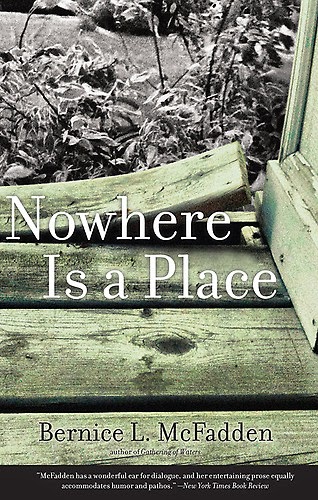
Nowhere is a Place by Bernice McFadden (2006)
About a year ago, I read a copy of Bernice McFadden's book Gathering of Waters (reviewed here) through the LibraryThing Early Reviewers program, and really loved it. Lo and behold, another McFadden book has come my way from the same source: Nowhere is a Place (2006).
The framing story here is a road trip with Sherry and her mother, Dumpling, from Dumpling's home in California to a family reunion in Georgia. Sherry is in her late-30s, secretly pregnant, coming out of a bad long-term relationship with a white man that her mother never liked, and living in Mexico after years of searching and globetrotting.
Sherry and Dumpling aren't that close, but at the start of the road trip, Sherry tells her mother that she wants to write a novel about their family history and the heart of the book are the words that Sherry writes each night after hearing her mother retell the family stories and that Dumpling reads and reacts to the next day.
The family story is rich, deep, and tragic. Starting from the massacre of an Indian village and the kidnapping and selling of the children into slavery, moving through rape, brutality, love, marriage, and heart break, heading north and cutting loose, and eventually ending right back in the car with Sherry and Dumpling. Much like Gathering of Waters, a simple plot description doesn't do this story justice. McFadden has a perfect sense of timing and description, and the hard-earned bursts of violence and revenge hit the reader just right.
This is a re-issue of a novel from several years ago, and it shares the same delicate balance between poetry and a harsh narrative that I found in the more recently published Gathering of Waters. While the framing narrative is a little clunky at first and the book took a bit to really click for me, the payoff is worth a little patience at the beginning. I'm definitely going to keep an eye out for more of McFadden's novels.
The framing story here is a road trip with Sherry and her mother, Dumpling, from Dumpling's home in California to a family reunion in Georgia. Sherry is in her late-30s, secretly pregnant, coming out of a bad long-term relationship with a white man that her mother never liked, and living in Mexico after years of searching and globetrotting.
Sherry and Dumpling aren't that close, but at the start of the road trip, Sherry tells her mother that she wants to write a novel about their family history and the heart of the book are the words that Sherry writes each night after hearing her mother retell the family stories and that Dumpling reads and reacts to the next day.
The family story is rich, deep, and tragic. Starting from the massacre of an Indian village and the kidnapping and selling of the children into slavery, moving through rape, brutality, love, marriage, and heart break, heading north and cutting loose, and eventually ending right back in the car with Sherry and Dumpling. Much like Gathering of Waters, a simple plot description doesn't do this story justice. McFadden has a perfect sense of timing and description, and the hard-earned bursts of violence and revenge hit the reader just right.
This is a re-issue of a novel from several years ago, and it shares the same delicate balance between poetry and a harsh narrative that I found in the more recently published Gathering of Waters. While the framing narrative is a little clunky at first and the book took a bit to really click for me, the payoff is worth a little patience at the beginning. I'm definitely going to keep an eye out for more of McFadden's novels.
Sunday, March 23, 2014
Where the Moon Isn't by Nathan Filer (2013)
Our latest Debbie Downer book club read (for which, as you might remember, we only read depressing books) is Where the Moon Isn't by Nathan Filer (2013) [published as The Shock of the Fall in the UK].
Our narrator is Matthew, a schizophrenic young man in Bristol, England.When Matthew was a child, he and his older brother Simon, who had Down Syndrome, snuck out of their family's vacation rental late at night. Matthew deliberately scares his brother who ends up having a tragic accident and dying.
Fast-forward ten years and Matthew is under professional care. He is alternately committed to a mental hospital or living on his own but coming into a day program for therapy, activities, and his mandated medication. Before he was hospitalized he had moved out of his parents house into his own apartment and then quickly started hearing his brother Simon talking to him. This escalated into a full-blown obsessive crazy person scenario that ultimately resulted in Matthew's hospitalization.
The book we are reading is the book Matthew is writing from the computer at the hospital day center and, when he goes off his meds and holes up in his apartment, from the typewriter that his grandmother gave him. The book uses different fonts to indicate the different writing locales and intersperses handwritten letters from Matthew's social worker and drawings that he creates to illustrate his story. I can't quite decide if I liked the conceit of the different fonts or found it distracting -- it really rides the line -- but I did like the construct of the book and the way that Matthew's narrative voices changes as his mental health ebbs and flows. The movement between the present and the past and his slow movement to describing the accident with his brother and the aftermath of his psychotic break are well timed and effective.
Filer worked as a mental health nurse for ten years before writing this book, and that experience combined with the energy of the story resulted in a lot of excitement for this debut novel. Multiple publishing houses entered into a bidding war that increased publicity for the book before it even came out, and Filer went on to win awards a lot of favorable reviews for his work.
This is definitely a strong debut novel and Filer's decade-long experience as a mental health nurse has given him a unique perspective on his subject matter. That being said, I'm not sure it lives up to its bidding war / award winning hype. Still, this is a fast and unique read and worth your time.
Our narrator is Matthew, a schizophrenic young man in Bristol, England.When Matthew was a child, he and his older brother Simon, who had Down Syndrome, snuck out of their family's vacation rental late at night. Matthew deliberately scares his brother who ends up having a tragic accident and dying.
Fast-forward ten years and Matthew is under professional care. He is alternately committed to a mental hospital or living on his own but coming into a day program for therapy, activities, and his mandated medication. Before he was hospitalized he had moved out of his parents house into his own apartment and then quickly started hearing his brother Simon talking to him. This escalated into a full-blown obsessive crazy person scenario that ultimately resulted in Matthew's hospitalization.
The book we are reading is the book Matthew is writing from the computer at the hospital day center and, when he goes off his meds and holes up in his apartment, from the typewriter that his grandmother gave him. The book uses different fonts to indicate the different writing locales and intersperses handwritten letters from Matthew's social worker and drawings that he creates to illustrate his story. I can't quite decide if I liked the conceit of the different fonts or found it distracting -- it really rides the line -- but I did like the construct of the book and the way that Matthew's narrative voices changes as his mental health ebbs and flows. The movement between the present and the past and his slow movement to describing the accident with his brother and the aftermath of his psychotic break are well timed and effective.
Filer worked as a mental health nurse for ten years before writing this book, and that experience combined with the energy of the story resulted in a lot of excitement for this debut novel. Multiple publishing houses entered into a bidding war that increased publicity for the book before it even came out, and Filer went on to win awards a lot of favorable reviews for his work.
This is definitely a strong debut novel and Filer's decade-long experience as a mental health nurse has given him a unique perspective on his subject matter. That being said, I'm not sure it lives up to its bidding war / award winning hype. Still, this is a fast and unique read and worth your time.
Wednesday, March 19, 2014
Malice Matrimonial by Joan Fleming (1959)
When we were in New York for my sister's wedding last August, one of my favorite stops was at the Strand Book Store ("18 miles of books. Since 1927."). I'd recommend adding a stop at the Strand (and some extra room in your baggage) to anyone heading to NYC for a visit. I got this pretty brittle but barely read copy of Malice Matrimonial by Joan Fleming (1959) in the basement of the book store from a big table full of other ignored books of this type for only $1. That is my kind of table, folks.
Fleming was a British crime novelist who published over 30 novels from the 1940s through the 1970s. For those of you who care about this kind of thing (Dr. M), she didn't write her first one until she was 41 and she had a very successful career.
This is the first of Fleming's novels that I've read, and while I finished it over a week ago I still haven't been able to get my head around how I feel about it. Our hero, Henry Ormskirk, is a rather dull young man with interesting friends. He is dumped by his fiance, loses his job, and then goes to a party given by Venice, an exotic woman who owns an exclusive fashion boutique, with his roommate to cheer himself up. While there, Henry meets and quickly falls madly in love with Venice's daughter Pia, recently reunited with her mother in England after being raised by her father, a Count, in Italy. Things move at a brisk pace and before you know it Henry and Pia are married, and Henry has a new job drawing sketches of models in new dresses at Venice's store. The heat cools off soon after they start living together. Pia quickly learns that she is pregnant and a cooling marriage plus a baby that he doesn't feel much attachment too lead to a dull and wandering Henry who is soon back in the arms of his ex-fiance.
This is all a little weird but not that mysterious until Pia divulges that she was pregnant before she met Henry and then disappears after a big fight. Everyone is pretty sure Henry killed her, and his dopiness doesn't help matters much, but when the clues start slowly rolling in, they just don't add up.
This book is very dark and more than a little bitter with few likable characters or hopeful plot lines. That edge gives a color to the pretty pedestrian mystery that makes the book very readable, but also a little off-putting. Like I said, I still can't figure out what I thought of this. I'll need to mull this one over a little bit more, but if I run across any more Fleming bargains in the basement of a book store, I'd definitely scoop them up.
Fleming was a British crime novelist who published over 30 novels from the 1940s through the 1970s. For those of you who care about this kind of thing (Dr. M), she didn't write her first one until she was 41 and she had a very successful career.
This is the first of Fleming's novels that I've read, and while I finished it over a week ago I still haven't been able to get my head around how I feel about it. Our hero, Henry Ormskirk, is a rather dull young man with interesting friends. He is dumped by his fiance, loses his job, and then goes to a party given by Venice, an exotic woman who owns an exclusive fashion boutique, with his roommate to cheer himself up. While there, Henry meets and quickly falls madly in love with Venice's daughter Pia, recently reunited with her mother in England after being raised by her father, a Count, in Italy. Things move at a brisk pace and before you know it Henry and Pia are married, and Henry has a new job drawing sketches of models in new dresses at Venice's store. The heat cools off soon after they start living together. Pia quickly learns that she is pregnant and a cooling marriage plus a baby that he doesn't feel much attachment too lead to a dull and wandering Henry who is soon back in the arms of his ex-fiance.
This is all a little weird but not that mysterious until Pia divulges that she was pregnant before she met Henry and then disappears after a big fight. Everyone is pretty sure Henry killed her, and his dopiness doesn't help matters much, but when the clues start slowly rolling in, they just don't add up.
This book is very dark and more than a little bitter with few likable characters or hopeful plot lines. That edge gives a color to the pretty pedestrian mystery that makes the book very readable, but also a little off-putting. Like I said, I still can't figure out what I thought of this. I'll need to mull this one over a little bit more, but if I run across any more Fleming bargains in the basement of a book store, I'd definitely scoop them up.
Tuesday, March 11, 2014
Ghostwritten by David Mitchell (1999)
My lovely friend John loaned me his copy of Ghostwritten by David Mitchell (1999) since he knew how much I loved Cloud Atlas (reviewed here) when our book club read it a few years ago. [Note to DAFFODILS: Holy Shit, we read Cloud Atlas three years ago!] John never steers me wrong, and my love of David Mitchell has been proven before, so this one was right on target.
This is Mitchell's first novel and its structure would only seem unambitious if you happened to read Cloud Atlas first. Ghostwritten consists of nine chapters (and one brief coda) that each take place in a different location. The chapters stand alone except for (at first) a small connection between one and the next. As the book progresses, the connections become stronger, but the individual stories still stand on their own and their wildly different narrators and styles keep the reader reeling between the feeling of jumping between some masterfully written short stories and experiencing a whole new kind of novel.
The only chapter I didn't really fall in love with was the final chapter, "Night Train," which takes place in the booth of a grating late-night New York DJ named Bat Segundo. The connections in this bit pushed a little too hard for me, and the intentionally irritating DJ just, well, irritated me. This chapter does, however, get bonus points for featuring a brief appearance by Luisa Rey, who went on to take a key role in Cloud Atlas. I do like me some connections...
I feel like I've only read two David Mitchell novels because I like him so much that I don't want to rush through all of them. Reading Ghostwritten, though, has reminded me that I probably don't need to wait three years before reading another one. Highly recommended!
This is Mitchell's first novel and its structure would only seem unambitious if you happened to read Cloud Atlas first. Ghostwritten consists of nine chapters (and one brief coda) that each take place in a different location. The chapters stand alone except for (at first) a small connection between one and the next. As the book progresses, the connections become stronger, but the individual stories still stand on their own and their wildly different narrators and styles keep the reader reeling between the feeling of jumping between some masterfully written short stories and experiencing a whole new kind of novel.
The only chapter I didn't really fall in love with was the final chapter, "Night Train," which takes place in the booth of a grating late-night New York DJ named Bat Segundo. The connections in this bit pushed a little too hard for me, and the intentionally irritating DJ just, well, irritated me. This chapter does, however, get bonus points for featuring a brief appearance by Luisa Rey, who went on to take a key role in Cloud Atlas. I do like me some connections...
I feel like I've only read two David Mitchell novels because I like him so much that I don't want to rush through all of them. Reading Ghostwritten, though, has reminded me that I probably don't need to wait three years before reading another one. Highly recommended!
Wednesday, February 26, 2014
Shirley Jackson: Novels and Stories, edited by Joyce Carol Oates (2010)
One of my book clubs (go DAFFODILS!) recently read The Haunting of Hill House by Shirley Jackson -- I'd read it before, but I had borrowed the copy, and this time I decided to get serious about my Shirley Jackson love and spring for the lovely, hardcover Library of America edition of her works, Shirley Jackson: Novels and Stories, edited by Joyce Carol Oates (2010). This was not a poor investment.
This jam-packed volume includes Jackson's short story collection, The Lottery, the aforementioned The Haunting of Hill House, We Have Always Lived in the Castle (which I'd also borrowed and read before), and a set of other stories and sketches, some published during Jackson's lifetime and others published posthumously by her husband. Topping it all off is a chronology of Jackson's life and notes for all the collected works. I really really liked Jackson when I had previously read these two novels, I'm now a Jackson worshiper after reading her short stories. So amazingly good. Here's the book-by-book run down:
The Lottery (1949)
I'd read the title story from this collection before, like many people, in high school (and possibly again in college). It was just as unsettling as the first time I read it, but its perspective and tone is different from the bulk of Jackson's short stories which tend to be more realistic (although just as biting) and focused on an individual instead of a whole group. Some of my favorites in the collection are the irrepressible "My Life with R.H. Macy," "Elizabeth," "Pillar of Salt," and the extremely creepy horror show that is "The Tooth."
Jackson deals expertly and pointedly with issues of race, domesticity, gender, isolation, and depression. And no one does the creepiness of being an outsider in a small town or a rube in the big city quite like she does.
The Haunting of Hill House (1959)
I reviewed this one earlier here, so I won't rehash what I said before except to add that for some reason the character of the doctor's wife really irked me this time -- I felt like her brash comic relief really derailed the psychological claustrophobia of being in Eleanor's head and could have used a lighter touch. Still, this story is pretty darn excellent.
We Have Always Lived in the Castle (1962)
And I reviewed this one here. I liked it even more the second time -- this could quite possibly be a perfectly constructed novel.
Other Stories and Sketches (1938-1965)
Some of these are a little lighter than Jackson's other work and are representative of her successful career publishing essays and stories in various magazines. Others, however, are creepier than anything else. I particularly liked "The Summer People," "A Visit," "Louisa, Please Come Home," and the story that gives "The Tooth" a run for its money, "The Bus."
***
It really doesn't matter where you start with Shirley Jackson, just go ahead and get started. The other day I bought a couple more of her novels, so don't be surprised when you see her around here again. She is quickly moving up to my favorite authors of all time list.
This jam-packed volume includes Jackson's short story collection, The Lottery, the aforementioned The Haunting of Hill House, We Have Always Lived in the Castle (which I'd also borrowed and read before), and a set of other stories and sketches, some published during Jackson's lifetime and others published posthumously by her husband. Topping it all off is a chronology of Jackson's life and notes for all the collected works. I really really liked Jackson when I had previously read these two novels, I'm now a Jackson worshiper after reading her short stories. So amazingly good. Here's the book-by-book run down:
The Lottery (1949)
I'd read the title story from this collection before, like many people, in high school (and possibly again in college). It was just as unsettling as the first time I read it, but its perspective and tone is different from the bulk of Jackson's short stories which tend to be more realistic (although just as biting) and focused on an individual instead of a whole group. Some of my favorites in the collection are the irrepressible "My Life with R.H. Macy," "Elizabeth," "Pillar of Salt," and the extremely creepy horror show that is "The Tooth."
Jackson deals expertly and pointedly with issues of race, domesticity, gender, isolation, and depression. And no one does the creepiness of being an outsider in a small town or a rube in the big city quite like she does.
The Haunting of Hill House (1959)
I reviewed this one earlier here, so I won't rehash what I said before except to add that for some reason the character of the doctor's wife really irked me this time -- I felt like her brash comic relief really derailed the psychological claustrophobia of being in Eleanor's head and could have used a lighter touch. Still, this story is pretty darn excellent.
We Have Always Lived in the Castle (1962)
And I reviewed this one here. I liked it even more the second time -- this could quite possibly be a perfectly constructed novel.
Other Stories and Sketches (1938-1965)
Some of these are a little lighter than Jackson's other work and are representative of her successful career publishing essays and stories in various magazines. Others, however, are creepier than anything else. I particularly liked "The Summer People," "A Visit," "Louisa, Please Come Home," and the story that gives "The Tooth" a run for its money, "The Bus."
***
It really doesn't matter where you start with Shirley Jackson, just go ahead and get started. The other day I bought a couple more of her novels, so don't be surprised when you see her around here again. She is quickly moving up to my favorite authors of all time list.
Sunday, February 16, 2014
Twelve Years a Slave by Solomon Northup (1853)
The most recent selection for my Debbie Downer book club (where we only read sad and depressing books) was Twelve Years a Slave by Solomon Northup (1853). It most definitely fits the parameters of the book club.
Northup had been born a free man and lived with his family in Saratoga Springs, New York. He made a living playing his fiddle and got a lead on a job from two white men with whom he traveled to Washington D.C. While there, he was drugged, put in chains, and sold as a slave. Without any way to get word to his family or friends in New York, he was taken down to New Orleans and then solid to a series of men on a group of plantations in Western Louisiana where he was held in slavery for a dozen years.
The reason we have Northup's memoir and no writings from the many other free men and women who were captured into slavery is because he miraculously got word to New York and, with the help of the Governor and a white man who knew Northup and his family, was recused from the Epps plantation. The promise of a somewhat happy ending made the horrors of the narrative a little more bearable, but Northup doesn't hold back from describing the institution of slavery to his white, Northern audience, and the book made quite an impression when it was first released, particularly for its parallels (and arguments with) the extremely popular Uncle Tom's Cabin, which had been published the year before.
I've read a few slave narratives, and this one is different from what I expect from the genre. Less overtly religious and rhetorical, the fast-reading book sometimes sounds like a novel (characterization, action sequences, foreshadowing) and sometimes as a sociological description of Southern life for the interested northerner.
I haven't seen the movie yet (since I was waiting to finish the book), but if any slave narrative could be made into a compelling modern film, this is the one. I'm very interested to check it out. And you should check this out --since this book is in the public domain, everyone can read it for free! I downloaded a free copy from Google Play and read it on my phone. You can also get it in all kinds of formats here.
Northup had been born a free man and lived with his family in Saratoga Springs, New York. He made a living playing his fiddle and got a lead on a job from two white men with whom he traveled to Washington D.C. While there, he was drugged, put in chains, and sold as a slave. Without any way to get word to his family or friends in New York, he was taken down to New Orleans and then solid to a series of men on a group of plantations in Western Louisiana where he was held in slavery for a dozen years.
The reason we have Northup's memoir and no writings from the many other free men and women who were captured into slavery is because he miraculously got word to New York and, with the help of the Governor and a white man who knew Northup and his family, was recused from the Epps plantation. The promise of a somewhat happy ending made the horrors of the narrative a little more bearable, but Northup doesn't hold back from describing the institution of slavery to his white, Northern audience, and the book made quite an impression when it was first released, particularly for its parallels (and arguments with) the extremely popular Uncle Tom's Cabin, which had been published the year before.
I've read a few slave narratives, and this one is different from what I expect from the genre. Less overtly religious and rhetorical, the fast-reading book sometimes sounds like a novel (characterization, action sequences, foreshadowing) and sometimes as a sociological description of Southern life for the interested northerner.
I haven't seen the movie yet (since I was waiting to finish the book), but if any slave narrative could be made into a compelling modern film, this is the one. I'm very interested to check it out. And you should check this out --since this book is in the public domain, everyone can read it for free! I downloaded a free copy from Google Play and read it on my phone. You can also get it in all kinds of formats here.
Tuesday, January 28, 2014
& Sons: A Novel by David Gilbert (2013)
I got this copy of & Sons: A Novel by David Gilbert (2013) through the LibraryThing EarlyReviewers program and it has finally risen to the top of my constantly growing to read pile.
This is a tale of men. New York men. Wealthy, literary, intelligent, New York men. At the center of the novel is A.N. Dyer, a famous novelist who is beloved for his first novel, Ampersand, a Catcher-in-the-Rye-esque novel he wrote when he was 27. He is now an old man with a long publishing career, a broken marriage, two grown-up and mostly estranged sons, and one teenage son whose appearance, 17 years ago, was the cause of that broken marriage.
Riding on a parallel track is Dyer's best friend from childhood, Charlie Topper, and Charlie's son, Philip, who has spent his life admiring the Dyer family and being paid back with a mix of indifference (from the senior Dyer) and cruelty (from the two older sons, Richard and Jamie).
Gilbert does a fine job of laying out the complicated past of the Dyer and Topping families, jumping seamlessly from past to present, and in and out of the narrative voices of the five primary men (along with a brief narrative piece from the estranged wife, Isabel, which honestly feels pretty out of place). The plot lets us explore the difficulty of aging, of being a teenager, of having sons, of relating to a father, of getting laid, of staying clean, and of being a famous writer. It also gives us a pretty clever novel within the novel with the plot and passages from Ampersand. What it doesn't give us is any insight into how the ever-present but never developed female characters relate to this twisted narrative.
Gilbert isn't alone in this macho New York genre of broken men held up by solid, admired, lusted after, practical, and completely one-dimensional women, but that doesn't make me respond any more warmly to another one of these books. That isn't to say that the novel isn't entertaining, or that Gilbert isn't good at what he does, just that what he does isn't really what I want to read. Saying you will like this if you like this kind of thing is a bit of a cop out, but I can't think of any other way to put this. Gilbert is good at this kind of thing, and if you like it, then this would be worth picking up.
Archivists note: There is a pretty great aside where Dyer and his agent go to the Morgan Library to negotiate the purchase of his papers, where the archivist and director throw in some barbs at the HRC as their main collecting competitor. There is also a juicy attempt by Dyer at recreating his original manuscript for Ampersand, which he burned years ago, just before the publication of the novel, but which is a key piece of his literary legacy and something the Morgan direly wants (and will pay big bucks for). I love thinking of the archival implications of this self-forgery...
This is a tale of men. New York men. Wealthy, literary, intelligent, New York men. At the center of the novel is A.N. Dyer, a famous novelist who is beloved for his first novel, Ampersand, a Catcher-in-the-Rye-esque novel he wrote when he was 27. He is now an old man with a long publishing career, a broken marriage, two grown-up and mostly estranged sons, and one teenage son whose appearance, 17 years ago, was the cause of that broken marriage.
Riding on a parallel track is Dyer's best friend from childhood, Charlie Topper, and Charlie's son, Philip, who has spent his life admiring the Dyer family and being paid back with a mix of indifference (from the senior Dyer) and cruelty (from the two older sons, Richard and Jamie).
Gilbert does a fine job of laying out the complicated past of the Dyer and Topping families, jumping seamlessly from past to present, and in and out of the narrative voices of the five primary men (along with a brief narrative piece from the estranged wife, Isabel, which honestly feels pretty out of place). The plot lets us explore the difficulty of aging, of being a teenager, of having sons, of relating to a father, of getting laid, of staying clean, and of being a famous writer. It also gives us a pretty clever novel within the novel with the plot and passages from Ampersand. What it doesn't give us is any insight into how the ever-present but never developed female characters relate to this twisted narrative.
Gilbert isn't alone in this macho New York genre of broken men held up by solid, admired, lusted after, practical, and completely one-dimensional women, but that doesn't make me respond any more warmly to another one of these books. That isn't to say that the novel isn't entertaining, or that Gilbert isn't good at what he does, just that what he does isn't really what I want to read. Saying you will like this if you like this kind of thing is a bit of a cop out, but I can't think of any other way to put this. Gilbert is good at this kind of thing, and if you like it, then this would be worth picking up.
Archivists note: There is a pretty great aside where Dyer and his agent go to the Morgan Library to negotiate the purchase of his papers, where the archivist and director throw in some barbs at the HRC as their main collecting competitor. There is also a juicy attempt by Dyer at recreating his original manuscript for Ampersand, which he burned years ago, just before the publication of the novel, but which is a key piece of his literary legacy and something the Morgan direly wants (and will pay big bucks for). I love thinking of the archival implications of this self-forgery...
Sunday, January 26, 2014
The Allure of the Archives by Arlette Farge, translated by Thomas Scott-Railton (1989, 2013)
"... the archive is like a forest without clearings, but by inhabiting it for a long time, your eyes become accustomed to the dark, and you can make out the outlines of the trees." (p. 69)
When The Allure of the Archives by Arlette Farge, translated by Thomas Scott-Railton (originally published in1989, translated in 2013) came into the library where I work, two different co-workers sent me notes telling me I should check it out. As a self-respecting archivist, how could I resist?
Farge is a French historian who studies social history in 18th century France, mainly using police and legal records to uncover the hidden voices of everyday people during and after the French Revolution. In this slim volume, Farge pays homage to the skills and techniques of archival research and, in a series of vignettes, pokes a little insider fun at the ins and outs of the stoic French reading rooms.
As a "lone arranger" archivist in a small collection in Texas, I find that my reading room procedures don't really match up with the old school antics of the French National Archives. Still, while some of Farge's affectionate jabs at obscure procedures and dictatorial research archivists sting, there are some kernels of truth there and reading this book will definitely bring the non-historian archivist a different perspective on our work.
Beyond the look at the procedural aspects of archival research, Farge shines in her alternately poetic and philosophical look at the practice of historiography. Her descriptions of teasing out meaning and context from incomplete documentary evidence, the need to see what is there and what isn't there, and her ability to bring life to the voices that exist between the official lines of history are a joy to read, and make this archivist feel pretty proud to do the work I do. I can't say I agreed with every word of this book, but I definitely enjoyed reading them.
When The Allure of the Archives by Arlette Farge, translated by Thomas Scott-Railton (originally published in1989, translated in 2013) came into the library where I work, two different co-workers sent me notes telling me I should check it out. As a self-respecting archivist, how could I resist?
Farge is a French historian who studies social history in 18th century France, mainly using police and legal records to uncover the hidden voices of everyday people during and after the French Revolution. In this slim volume, Farge pays homage to the skills and techniques of archival research and, in a series of vignettes, pokes a little insider fun at the ins and outs of the stoic French reading rooms.
As a "lone arranger" archivist in a small collection in Texas, I find that my reading room procedures don't really match up with the old school antics of the French National Archives. Still, while some of Farge's affectionate jabs at obscure procedures and dictatorial research archivists sting, there are some kernels of truth there and reading this book will definitely bring the non-historian archivist a different perspective on our work.
Beyond the look at the procedural aspects of archival research, Farge shines in her alternately poetic and philosophical look at the practice of historiography. Her descriptions of teasing out meaning and context from incomplete documentary evidence, the need to see what is there and what isn't there, and her ability to bring life to the voices that exist between the official lines of history are a joy to read, and make this archivist feel pretty proud to do the work I do. I can't say I agreed with every word of this book, but I definitely enjoyed reading them.
Saturday, January 18, 2014
Six Plays by Henrik Ibsen, Newly translated and with an introduction by Eva Le Galleinne (1951)
I bought this Modern Library edition of Six Plays by Henrik Ibsen, Newly translated and with an introduction by Eva le Galleinne (1951) some time ago, so when my Debbie Downer book club (which only reads depressing/sad books) decided to give "A Doll's House" a try, I decided to go Ibsen crazy and read the whole thing. I had read three of these plays before, but it was time to revisit them, and I learned that I can never have too much bleak, straightforward, Norwegian in my life.
The translator of this collection, Eva Le Galleinne, is pretty interesting in her own right, and provides a crisp translation and solid introduction to Ibsen and these six plays.
Here's the run down:
A Doll's House (1879)
One of the most consistently performed plays since Ibsen wrote it almost 140 years go, this story of the awakening of a flighty housewife to her own humanity takes on the flavor of the time and place of its production so easily that it never stops seeming fresh. Nora is so annoying, and Torvald so dense, but the play wouldn't work any other way. I've read this one several times, but this time I found myself the most fascinated with Nora's friend Mrs. Linde and her decision to force Nora to tell Torvald the truth about her financial falsehoods. And that door slam!
Ghosts (1881)
In this play you can really see why Ibsen was so controversial in the late 19th century -- venereal disease, adultery, children out of wedlock, sexual assault, arson, religious doubts, and calling out the domestic subjugation of women: it's all here! This is a perfect example of Ibsen's close, domestic staging where the action of the play has either happened in the past or away from the stage, and what we see are the characters dealing with the consequences.
An Enemy of the People (1882)
When Dr. Stockman discovers that the mineral baths his town just spent tons of money constructing for sick tourists is being contaminated by run-off from the tannery upstream, he is sure that his more responsible and stuffy brother, who is the Mayor of the town, and the rest of the townspeople will be so glad he told them that they will throw him a parade. Instead he is torn between the liberal and conservative factions of the town, both of whom want to save the town's cash cow. The mob scenes are disturbing, but the lampooning of the liberal press and the small-town government are often hilarious.
Rosmersholm (1886)
I hadn't ever read this one before, and I found it the hardest to like. The story of the wealthy Mr. Rosmer, whose sickly wife recently took her own wife, and his relationship with Rebekka, his wife's former nurse and companion who is still living in the house, comes off as melodramatic and old fashioned, which is so much different than the crisp realism of his other plays. After some reflection, the story grew on me, and I'm definitely not one to turn down a suitably tragic ending, but I still found this the hardest play in the collection to really get some traction for me.
Hedda Gabler (1890)
Hedda Gabler! Hedda Gabler! When I read this play in high school, it completely blew my mind, and it amazes me no less now. Hedda is a bad person, but complicatedly so, and watching her manipulate, lie, and play with the people around her is like a fascinating train wreck. In case you haven't noticed, I love a perfect ending, and Hedda Gabler definitely has one of those. If you haven't ever read this play, go read it right now. In her introduction Le Galleinne mentions that actresses love Ibsen because he created roles like Hedda Gabler, and there is no denying that this is an amazing character.
The Master Builder (1892)
I hadn't ever read this story of a prominent architect and his complicated family and work relationships before, and it goes down as one of the strangest plays I've ever read. Master Builder Solness has a successful business designing homes, two long-ago dead children, a distant wife, and a series of mistresses and near-mistresses. When Miss Hilde Wangel enters the scene -- seeking out Solness ten years after he made an off-hand comment when she was a little girl that he would make her his princess in ten years time -- the slate is set for some familial tragedy as well as some unexpected humor. I'm still not sure what to make of this one, but I definitely liked it.
Ibsen! You should read this wild Norwegian inventor of theatrical realism if for no other reason than his truly amazing hair.
The translator of this collection, Eva Le Galleinne, is pretty interesting in her own right, and provides a crisp translation and solid introduction to Ibsen and these six plays.
Here's the run down:
A Doll's House (1879)
One of the most consistently performed plays since Ibsen wrote it almost 140 years go, this story of the awakening of a flighty housewife to her own humanity takes on the flavor of the time and place of its production so easily that it never stops seeming fresh. Nora is so annoying, and Torvald so dense, but the play wouldn't work any other way. I've read this one several times, but this time I found myself the most fascinated with Nora's friend Mrs. Linde and her decision to force Nora to tell Torvald the truth about her financial falsehoods. And that door slam!
Ghosts (1881)
In this play you can really see why Ibsen was so controversial in the late 19th century -- venereal disease, adultery, children out of wedlock, sexual assault, arson, religious doubts, and calling out the domestic subjugation of women: it's all here! This is a perfect example of Ibsen's close, domestic staging where the action of the play has either happened in the past or away from the stage, and what we see are the characters dealing with the consequences.
An Enemy of the People (1882)
When Dr. Stockman discovers that the mineral baths his town just spent tons of money constructing for sick tourists is being contaminated by run-off from the tannery upstream, he is sure that his more responsible and stuffy brother, who is the Mayor of the town, and the rest of the townspeople will be so glad he told them that they will throw him a parade. Instead he is torn between the liberal and conservative factions of the town, both of whom want to save the town's cash cow. The mob scenes are disturbing, but the lampooning of the liberal press and the small-town government are often hilarious.
Rosmersholm (1886)
I hadn't ever read this one before, and I found it the hardest to like. The story of the wealthy Mr. Rosmer, whose sickly wife recently took her own wife, and his relationship with Rebekka, his wife's former nurse and companion who is still living in the house, comes off as melodramatic and old fashioned, which is so much different than the crisp realism of his other plays. After some reflection, the story grew on me, and I'm definitely not one to turn down a suitably tragic ending, but I still found this the hardest play in the collection to really get some traction for me.
Hedda Gabler (1890)
Hedda Gabler! Hedda Gabler! When I read this play in high school, it completely blew my mind, and it amazes me no less now. Hedda is a bad person, but complicatedly so, and watching her manipulate, lie, and play with the people around her is like a fascinating train wreck. In case you haven't noticed, I love a perfect ending, and Hedda Gabler definitely has one of those. If you haven't ever read this play, go read it right now. In her introduction Le Galleinne mentions that actresses love Ibsen because he created roles like Hedda Gabler, and there is no denying that this is an amazing character.
The Master Builder (1892)
I hadn't ever read this story of a prominent architect and his complicated family and work relationships before, and it goes down as one of the strangest plays I've ever read. Master Builder Solness has a successful business designing homes, two long-ago dead children, a distant wife, and a series of mistresses and near-mistresses. When Miss Hilde Wangel enters the scene -- seeking out Solness ten years after he made an off-hand comment when she was a little girl that he would make her his princess in ten years time -- the slate is set for some familial tragedy as well as some unexpected humor. I'm still not sure what to make of this one, but I definitely liked it.
Ibsen! You should read this wild Norwegian inventor of theatrical realism if for no other reason than his truly amazing hair.
Wednesday, January 08, 2014
The Works of Samuel Johnson: With an Essay on His Life and Genius, by Arthur Murphy. Volume 2 (1792)
If I want to make better progress on the 12 volumes of the Works of Samuel Johnson that I'm reading as part of Harold Bloom's western canon list, I should probably have taken less than two years between reading Volume 1 and finishing up The Works of Samuel Johnson: With an Essay on His Life and Genius, by Arthur Murphy. Volume 2 (1792). At this rate it will take me twenty years to finish the whole set!
This volume contains documentation of some of Johnson's greatest known works -- the proposal and preface to his Dictionary of the English Language, and the same for his definitive edition of the Works of Shakespeare, both of which give him cause to comment on the scholarship of one of his contemporaries:
In his preface to his edition of Shakespeare, he writes about his use of the work of the scholar Lewis Theobald (who he describes as "a man of narrow comprehension, and small acquisitions, with no native and intrinsic splendor of genius, with little of the artificial light of learning, but zealous for minute accuracy, and not negligent in pursuing it."):
"Of his notes I have generally retained those which he retained himself in his second edition, except when they were confuted by subsequent annotators, or were too minute to merit preservation. I have sometimes adopted his restoration of a comma, without inserting the panegyrick in which he celebrated himself for his achievement. The exuberant excrescence of his diction I have often lopped, his triumphant exultations over Pope and Rowe I have sometimes suppressed, and his contemptible ostentation I have frequently concealed; but I have in some places shown him, as he would have shown himself, for the reader's diversion, that the inflated emptiness of some notes may justify or excuse the contraction of the rest." (p. 119)
Beyond insanely complicated dictionary compilations and extremely thorough Shakespearean editing, Johnson's works in this volume jump from prefaces to other writers works, plans for a curriculum, political histories and commentaries, moral allegories, and a lot more. And all of them are witty, moving, and/or interesting. The man could write, and the man had opinions. Take, for example, his ideas about Canada, which I have to quote at length because they are so great:
"The French therefore contented themselves with sending a colony to Canada, a cold uncomfortable uninviting region, from which nothing but furs and fish were to be had, and where the new inhabitants could only pass a laborious and necessitous life, in perpetual regret of the deliciousness and plenty of their native country.
" Notwithstanding the opinion which our countrymen have been taught to entertain of the comprehension and foresight of French politicians, I am not able to persuade myself, that when this colony was first planted, it was thought of much value, even by those that encouraged it; there was probably nothing more intended than to provide a drain into which the waste of an exuberant nation might be thrown, a place where those who could do no good might live without the power of doing mischief. Some new advantage they undoubtedly saw, or imagined themselves to see, and what more was necessary to the establishment of the colony was supplied by natural inclination to experiments, and that impatience of doing nothing, to which mankind perhaps owe much of what is imagined to be effected by more splendid motives.
"In this region of desolate sterility they settled themselves, upon whatever principle; and as they have from that time had the happiness of a government by which no interest has been neglected, nor any part of their subjects overlooked, they have, by continual encouragement and assistance from France, been perpetually enlarging their bounds and increasing their numbers." (p. 301-302)
The French and Indian War may have colored his sentiments a little there...
Overall, Volume 2 was pretty entertaining and interesting in retrospect, and I'm not sure why it took me so long to read it. Since volumes three and four are already waiting for me on my new bookcase, I should scold myself into making more of an effort to show a little love to Dr. Johnson and his wonderful works.
This volume contains documentation of some of Johnson's greatest known works -- the proposal and preface to his Dictionary of the English Language, and the same for his definitive edition of the Works of Shakespeare, both of which give him cause to comment on the scholarship of one of his contemporaries:
In his preface to his edition of Shakespeare, he writes about his use of the work of the scholar Lewis Theobald (who he describes as "a man of narrow comprehension, and small acquisitions, with no native and intrinsic splendor of genius, with little of the artificial light of learning, but zealous for minute accuracy, and not negligent in pursuing it."):
"Of his notes I have generally retained those which he retained himself in his second edition, except when they were confuted by subsequent annotators, or were too minute to merit preservation. I have sometimes adopted his restoration of a comma, without inserting the panegyrick in which he celebrated himself for his achievement. The exuberant excrescence of his diction I have often lopped, his triumphant exultations over Pope and Rowe I have sometimes suppressed, and his contemptible ostentation I have frequently concealed; but I have in some places shown him, as he would have shown himself, for the reader's diversion, that the inflated emptiness of some notes may justify or excuse the contraction of the rest." (p. 119)
Beyond insanely complicated dictionary compilations and extremely thorough Shakespearean editing, Johnson's works in this volume jump from prefaces to other writers works, plans for a curriculum, political histories and commentaries, moral allegories, and a lot more. And all of them are witty, moving, and/or interesting. The man could write, and the man had opinions. Take, for example, his ideas about Canada, which I have to quote at length because they are so great:
"The French therefore contented themselves with sending a colony to Canada, a cold uncomfortable uninviting region, from which nothing but furs and fish were to be had, and where the new inhabitants could only pass a laborious and necessitous life, in perpetual regret of the deliciousness and plenty of their native country.
" Notwithstanding the opinion which our countrymen have been taught to entertain of the comprehension and foresight of French politicians, I am not able to persuade myself, that when this colony was first planted, it was thought of much value, even by those that encouraged it; there was probably nothing more intended than to provide a drain into which the waste of an exuberant nation might be thrown, a place where those who could do no good might live without the power of doing mischief. Some new advantage they undoubtedly saw, or imagined themselves to see, and what more was necessary to the establishment of the colony was supplied by natural inclination to experiments, and that impatience of doing nothing, to which mankind perhaps owe much of what is imagined to be effected by more splendid motives.
"In this region of desolate sterility they settled themselves, upon whatever principle; and as they have from that time had the happiness of a government by which no interest has been neglected, nor any part of their subjects overlooked, they have, by continual encouragement and assistance from France, been perpetually enlarging their bounds and increasing their numbers." (p. 301-302)
The French and Indian War may have colored his sentiments a little there...
Overall, Volume 2 was pretty entertaining and interesting in retrospect, and I'm not sure why it took me so long to read it. Since volumes three and four are already waiting for me on my new bookcase, I should scold myself into making more of an effort to show a little love to Dr. Johnson and his wonderful works.
Thursday, January 02, 2014
The Walking Dead, Volume 19: March to War by Robert Kirkman, Charlie Adlard, and Cliff Rathburn (2013)
The latest volume of the Walking Dead series, The Walking Dead, Volume 19: March to War by Robert Kirkman, Charlie Adlard, and Cliff Rathburn (2013) is another one of those water-treading volumes that connects two big sections of plot but doesn't do a whole lot else. Rick continues to be Ricky, Carl continues to be Carly, and Negan continues to be his verbosely evil Negany self.
Just as the title promises, the gangs here (both good and evil) are finally stopping their pretend dance of getting along with one another and ratcheting up the conflict to an all-out war. Alliances are secured, double-crossing is rampant, and there is a little taste of violence (including some tiger utilization) to cap things off. Not bad, not great, but (I'm assuming) necessary to get us to the not-yet-released twentieth volume.
Zombie on!
Just as the title promises, the gangs here (both good and evil) are finally stopping their pretend dance of getting along with one another and ratcheting up the conflict to an all-out war. Alliances are secured, double-crossing is rampant, and there is a little taste of violence (including some tiger utilization) to cap things off. Not bad, not great, but (I'm assuming) necessary to get us to the not-yet-released twentieth volume.
Zombie on!
Tuesday, December 31, 2013
The Walking Dead, Volume 18: What Comes After by Robert Kirkman, Charles Adlard, and Cliff Rathburn (2013)
Oh yes, my friends, we are back in the Walking Dead game with The Walking Dead, Volume 18: What Comes After by Robert Kirkman, Charles Adlard, and Cliff Rathburn (2013).
After the death blast extreme of Volume 17, this one calms down into more talk and less walk. And with new horrible villain Negan behind the talk box, that more talk is great! Seriously, I love that cussing egocentric cruel jerkbag when he starts talking.
Rick continues to tread water as a character, but his son Carl really starts coming into his own in this volume, and I'm interested to see where that one-eyed ragamuffin decides to do next...
Also: post-zombie apocalypse tiger introduction!
After the death blast extreme of Volume 17, this one calms down into more talk and less walk. And with new horrible villain Negan behind the talk box, that more talk is great! Seriously, I love that cussing egocentric cruel jerkbag when he starts talking.
Rick continues to tread water as a character, but his son Carl really starts coming into his own in this volume, and I'm interested to see where that one-eyed ragamuffin decides to do next...
Also: post-zombie apocalypse tiger introduction!
Sunday, December 29, 2013
The Orphan Master's Son by Adam Johnson (2012)
A friend from work lent me The Orphan Master's Son by Adam Johnson (2012) because she knew I liked depressing books, and I'm also not averse to reading Pulitzer Prize-winning novels. While there is certainly plenty to be depressed about in Johnson's exploration of the North Korean dictatorship, I'd argue that the book is ultimately uplifting if you look at it in the right light.
The novel is divided into two parts, in the first, "The Biography of Jun Do," we follow our protagonist on his journey through the North Korean machine. He starts as an orphan (or is he?), then a soldier training to fight in tunnels under the DMZ, then a kidnapper, then being trained to learn English, then a radio operator on a boat, before falling into the biggest assignment of his life so far, serving as an interpreter on an unofficial diplomatic trip to a Senator's ranch in Texas. Whew.
Through these positions, we learn a lot about the structure of Jun Do's life in North Korea, and even more about Jun Do himself. We gradually accept that fortunes can be made and lost on the whim of authority, that appearances are everything, and that the ability to tell a convincing story is more important than the truth. After he makes it back from Texas, Jun Do is sent to a prison mine, the kind that no one ever comes back out of alive, and that is the last we hear from him.
Until the second part: "The Confessions of Commander Ga." An interrogator has a man in his booth who is Commander Ga, a North Korean hero, a cruel man, the head of the prison mine system, the husband of the national actress, Sun Moon, and a rival of Kim Jung Il. This man has been called Commander Ga by the Dear Leader, so that's who he his, but that isn't who he has always been. The story of how our little John Doe became one of the most powerful men in North Korea, and how he ended up in the interrogation chamber, forms the heart of the book.
Johnson weaves a powerful, fast-moving story and skillfully plays the humanity and individualism of his characters against the unsmiling conformity of the state machine. There is no denying that the isolated country of North Korea is a fascinating subject, and I found myself getting online to find glimpses of state-released photographs and journalistic impressions of the closed off country. Because North Korea is so unknowable, and Johnson is not Korean (he went on a brief state-sponsored trip after he started writing the novel, but also researched the country extensively and interviewed refugees) we shouldn't rely on this story as a "true" vision of what life in North Korea is like for its citizens, but Johnson's impressions and imaginings give us an authentic-feeling (and bone chilling) view of what it might be like. As the book progresses the character of Jun Do takes on Forrest Gump-like qualities of being in the right place at the right time, and the plot nearly veers into the territory of science fiction, but Johnson's well-earned grounding of his characters and their goals keeps the novel from going off the rails.
This is not a cheery book by any means, but a fascinating and well-written one.
The novel is divided into two parts, in the first, "The Biography of Jun Do," we follow our protagonist on his journey through the North Korean machine. He starts as an orphan (or is he?), then a soldier training to fight in tunnels under the DMZ, then a kidnapper, then being trained to learn English, then a radio operator on a boat, before falling into the biggest assignment of his life so far, serving as an interpreter on an unofficial diplomatic trip to a Senator's ranch in Texas. Whew.
Through these positions, we learn a lot about the structure of Jun Do's life in North Korea, and even more about Jun Do himself. We gradually accept that fortunes can be made and lost on the whim of authority, that appearances are everything, and that the ability to tell a convincing story is more important than the truth. After he makes it back from Texas, Jun Do is sent to a prison mine, the kind that no one ever comes back out of alive, and that is the last we hear from him.
Until the second part: "The Confessions of Commander Ga." An interrogator has a man in his booth who is Commander Ga, a North Korean hero, a cruel man, the head of the prison mine system, the husband of the national actress, Sun Moon, and a rival of Kim Jung Il. This man has been called Commander Ga by the Dear Leader, so that's who he his, but that isn't who he has always been. The story of how our little John Doe became one of the most powerful men in North Korea, and how he ended up in the interrogation chamber, forms the heart of the book.
Johnson weaves a powerful, fast-moving story and skillfully plays the humanity and individualism of his characters against the unsmiling conformity of the state machine. There is no denying that the isolated country of North Korea is a fascinating subject, and I found myself getting online to find glimpses of state-released photographs and journalistic impressions of the closed off country. Because North Korea is so unknowable, and Johnson is not Korean (he went on a brief state-sponsored trip after he started writing the novel, but also researched the country extensively and interviewed refugees) we shouldn't rely on this story as a "true" vision of what life in North Korea is like for its citizens, but Johnson's impressions and imaginings give us an authentic-feeling (and bone chilling) view of what it might be like. As the book progresses the character of Jun Do takes on Forrest Gump-like qualities of being in the right place at the right time, and the plot nearly veers into the territory of science fiction, but Johnson's well-earned grounding of his characters and their goals keeps the novel from going off the rails.
This is not a cheery book by any means, but a fascinating and well-written one.
Monday, December 09, 2013
The Eternal Savage by Edgar Rice Burroughs (1914)
Time for some more Burroughs! The Eternal Savage by Edgar Rice Burroughs (1914) is a one-off / sort-of-Tarzan-spin-off that was serialized in 1914/1915 in All-Story Weekly and originally titled The Eternal Lover. It forms a pair with The Mad King, which I haven't read, but which sounds very fun and quite a bit different from many of Burroughs other books.
The book is divided into two parts. In the first, Victoria and Barney Custer, a brother and sister from Beatrice, Nebraska (!!) are staying with Lord Greystoke and his wife in Africa as part of a hunting party. Those in the know will remember that Lord Greystoke is Tarzan. Her whole life, Victoria has been frightened of earthquakes and visited with dreams about a hunky, half-naked cave man that she feels must be her only love. While the group is out hunting, the countryside is hit by a large earthquake which happens to open up a cave that was sealed by a similar earthquake 100,000 years ago. Oddly enough, the occupant of the cave, a hunky, half-naked cave man named Nu, Son of Nu, is still alive and very confused by his new surroundings. A combination of fate and a series of misunderstandings lead the time-crossed lovers together, then apart, then together again, and ultimately Victoria needs to decide if she should follow her heart and stay with Nu or reject him and stay with her brother and his rich friends.
But then!: Another earthquake happens and we are rocked back to 100,000 years ago where Victoria's counterpart, Nat-ul is waiting for her lover Nu to return to her with the head of a saber-toothed tiger that he promised to defeat before they became mates. A complicated combination of fate and a series of misunderstandings lead the lovers together, then apart, then together again in a very familiar pattern. Interspersed with the misunderstandings are lots of lion attacks, chases, and sniffing the air for the scent of one's mate.
In the end we are met with yet another earthquake and a slightly disappointing return to Victoria's life where the whole thing (spoiler alert) was just a dream (double spoiler alert) OR WAS IT!
In many ways, this plot is similar to The Monster Men, which I read a couple months ago: the smart and spunky heroine who still needs a lot of saving, the tough and straightforward hero who hasn't been corrupted by modernity, lots of lots of chasing and fighting, etc. In fact, the plot is similar to a lot of Burroughs books and a lot of serialized adventure novels in general, but who am I to argue with a successful formula?
Like much of Burroughs, one needs to accept a certain amount of sexism and racism with the story, and I could see an entire dissertation being written on gender roles and the issue of race in this book alone (for example, it is mentioned multiple times that Nu is white, although he was living in Africa 100,000 years ago and the current inhabitants are certainly black). The reader also has to suspend her disbelief when, for example, Nu is staying at Tarzan's house (Tarzan of the jungle who can speak to the apes and all that) and there are zero interactions between the two of them and not even any mention of how Tarzan might be able to help out with Nu's situation.
I'll leave you with this gem to help you start your dissertation: "Such reveries made Nu very sad, for he loved Nat-ul just as you or I would love -- just as normal white men have always loved -- with a devotion that placed the object of his affection upon a pedestal before which he was happy to bow down and worship. His passion was not of the brute type of the inferior races which oftentimes solemnizes the marriage ceremony with a cudgel and ever places the woman in the position of an inferior and a chattel." (p. 65)
[read the whole thing here!]
The book is divided into two parts. In the first, Victoria and Barney Custer, a brother and sister from Beatrice, Nebraska (!!) are staying with Lord Greystoke and his wife in Africa as part of a hunting party. Those in the know will remember that Lord Greystoke is Tarzan. Her whole life, Victoria has been frightened of earthquakes and visited with dreams about a hunky, half-naked cave man that she feels must be her only love. While the group is out hunting, the countryside is hit by a large earthquake which happens to open up a cave that was sealed by a similar earthquake 100,000 years ago. Oddly enough, the occupant of the cave, a hunky, half-naked cave man named Nu, Son of Nu, is still alive and very confused by his new surroundings. A combination of fate and a series of misunderstandings lead the time-crossed lovers together, then apart, then together again, and ultimately Victoria needs to decide if she should follow her heart and stay with Nu or reject him and stay with her brother and his rich friends.
But then!: Another earthquake happens and we are rocked back to 100,000 years ago where Victoria's counterpart, Nat-ul is waiting for her lover Nu to return to her with the head of a saber-toothed tiger that he promised to defeat before they became mates. A complicated combination of fate and a series of misunderstandings lead the lovers together, then apart, then together again in a very familiar pattern. Interspersed with the misunderstandings are lots of lion attacks, chases, and sniffing the air for the scent of one's mate.
In the end we are met with yet another earthquake and a slightly disappointing return to Victoria's life where the whole thing (spoiler alert) was just a dream (double spoiler alert) OR WAS IT!
In many ways, this plot is similar to The Monster Men, which I read a couple months ago: the smart and spunky heroine who still needs a lot of saving, the tough and straightforward hero who hasn't been corrupted by modernity, lots of lots of chasing and fighting, etc. In fact, the plot is similar to a lot of Burroughs books and a lot of serialized adventure novels in general, but who am I to argue with a successful formula?
Like much of Burroughs, one needs to accept a certain amount of sexism and racism with the story, and I could see an entire dissertation being written on gender roles and the issue of race in this book alone (for example, it is mentioned multiple times that Nu is white, although he was living in Africa 100,000 years ago and the current inhabitants are certainly black). The reader also has to suspend her disbelief when, for example, Nu is staying at Tarzan's house (Tarzan of the jungle who can speak to the apes and all that) and there are zero interactions between the two of them and not even any mention of how Tarzan might be able to help out with Nu's situation.
I'll leave you with this gem to help you start your dissertation: "Such reveries made Nu very sad, for he loved Nat-ul just as you or I would love -- just as normal white men have always loved -- with a devotion that placed the object of his affection upon a pedestal before which he was happy to bow down and worship. His passion was not of the brute type of the inferior races which oftentimes solemnizes the marriage ceremony with a cudgel and ever places the woman in the position of an inferior and a chattel." (p. 65)
[read the whole thing here!]
Friday, December 06, 2013
The Woodlanders by Thomas Hardy (1887)
"There was now a distinct manifestation of morning in the air, and presently the bleared white visage of a sunless winter day emerged like a dead-born child. The woodlanders everywhere had already bestirred themselves, rising this month of the year at the far less dreary time of absolute darkness."
For heaven's sake, how could you not just love Thomas Hardy to pieces. Hardy's The Woodlanders (1887) is my next selection from Harold Bloom's Western Canon list, and while I had to get myself over a hump of deciding to start it (why is it so hard to get started on a 19th century novel?), once I did I couldn't stop.
This is the story of the tragic romance of Giles Winterborne and Grace Melbury. They grew up together in the small village of Little Hintock and for a complicated but good-intentioned reason, Grace's father, one of the most well-to-do in the village, had planned for the two of them to marry, even though Giles was a little rough around the edges. After sending Grace away to school and seeing how refined and urban she seemed when she got home, however, Mr. Melbury decides she shouldn't marry beneath her and instead plots for her to marry the new doctor in town, Edred Fitzpiers, a learned man with a good name and not that much money of his own. Grace is sweet and smart, but also very obedient, and does just what her father says. Unfortunately, Fitzpiers is not that constant of a husband and starts an affair with a wealthy widow, Mrs. Charmond, that tears his young household apart.
Like any good tragedy, there are plenty of misunderstandings, missed opportunities, misinterpretations, and ultimately, death. There is also quite a bit of humor, some amazing descriptions of the woods and their rustic inhabitants, and a surprising amount of candid talk about sex and adultery. This one is less well-known than Hardy's Far from the Madding Crowd or Tess of the D'Ubrervilles, but it is a rewarding and entertaining read and worth a second look.
[Read the whole thing for free as an e-book here. Yay for the public domain!]
For heaven's sake, how could you not just love Thomas Hardy to pieces. Hardy's The Woodlanders (1887) is my next selection from Harold Bloom's Western Canon list, and while I had to get myself over a hump of deciding to start it (why is it so hard to get started on a 19th century novel?), once I did I couldn't stop.
This is the story of the tragic romance of Giles Winterborne and Grace Melbury. They grew up together in the small village of Little Hintock and for a complicated but good-intentioned reason, Grace's father, one of the most well-to-do in the village, had planned for the two of them to marry, even though Giles was a little rough around the edges. After sending Grace away to school and seeing how refined and urban she seemed when she got home, however, Mr. Melbury decides she shouldn't marry beneath her and instead plots for her to marry the new doctor in town, Edred Fitzpiers, a learned man with a good name and not that much money of his own. Grace is sweet and smart, but also very obedient, and does just what her father says. Unfortunately, Fitzpiers is not that constant of a husband and starts an affair with a wealthy widow, Mrs. Charmond, that tears his young household apart.
Like any good tragedy, there are plenty of misunderstandings, missed opportunities, misinterpretations, and ultimately, death. There is also quite a bit of humor, some amazing descriptions of the woods and their rustic inhabitants, and a surprising amount of candid talk about sex and adultery. This one is less well-known than Hardy's Far from the Madding Crowd or Tess of the D'Ubrervilles, but it is a rewarding and entertaining read and worth a second look.
[Read the whole thing for free as an e-book here. Yay for the public domain!]
Thursday, November 28, 2013
The Vacuum Cleaner: A History by Carroll Gantz (2012)
I requested this book through the LibraryThing Early Reviewers program on the basis of some other everyday-technology-specific histories I'd read that really managed to draw the reader in despite the apparent dullness of their topic. While Carroll Gantz's The Vacuum Cleaner: A History (2012) didn't meet all my expectations for an exciting read, it did manage to pull me along and teach me quite a bit about vacuum cleaners and the history of floor cleaning technology.
Gantz starts with pre-electric floor cleaning, including rug beating, carpet sweeping, and the most adorable sounding two-person floor cleaner where one person works a set of bellows with their feet while the other person moves the brush around to clean the room. When things get motorized, they start with large steam engines that live on a horse drawn cart in the street with nozzles and brushes brought in through the windows for a thorough cleaning. For many years rich people and hotels would have a large gasoline powered central vacuum engine in the cellar with attachments coming off at each floor for suction cleaning. We move through the slow electrification of the country in the 20s-40s, and then the post-war boom of electric gadgets and efficient housewives. Eventually we get all the way to the modern trinity of the Dustbuster, the Dyson, and the Roomba.
Gantz is well-qualified to write this book, since he is the man who designed the Dustbuster in the 1980s and helped push Black and Decker to hand-held-floor-cleaner stardom. The book is at its most interesting when Gantz discusses the history and influence of industrial design on modern life, and at its most dull when he indulges his need to itemize every vacuum make, model, and manufacturer in mind-numbing detail. Gantz has a pretty readable writing style with an occasionally goofy twist borne from a little too much research (for example: "To encourage, benefit, and provide communication opportunities to these somewhat unconventional enthusiasts, the Vacuum Cleaner Collectors Club was co-founded by Robert Tabor and John Lucia in 1983, the same year that Brooks Robinson (b. 1937), former third basement of the Baltimore Orioles, nicknamed 'The Human Vacuum Cleaner,' was coincidentally inducted into the Baseball Hall of Fame.")
The book is well-illustrated with black and white photographs of vacuum and floor cleaners as well as patent and design drawings. Gantz gets into a little bit of the history of advertising vacuum cleaners, and I would have liked to see more of that as well as some representative advertisements in the illustrations.
I'm not going to recommend that everyone go out and buy this, but if you have a propensity for nerding out on a topic and a general interest in floor cleaning technology, this is probably the book for you. I can't tell you how much more attention I've been paying to those Dyson ads....
Gantz starts with pre-electric floor cleaning, including rug beating, carpet sweeping, and the most adorable sounding two-person floor cleaner where one person works a set of bellows with their feet while the other person moves the brush around to clean the room. When things get motorized, they start with large steam engines that live on a horse drawn cart in the street with nozzles and brushes brought in through the windows for a thorough cleaning. For many years rich people and hotels would have a large gasoline powered central vacuum engine in the cellar with attachments coming off at each floor for suction cleaning. We move through the slow electrification of the country in the 20s-40s, and then the post-war boom of electric gadgets and efficient housewives. Eventually we get all the way to the modern trinity of the Dustbuster, the Dyson, and the Roomba.
Gantz is well-qualified to write this book, since he is the man who designed the Dustbuster in the 1980s and helped push Black and Decker to hand-held-floor-cleaner stardom. The book is at its most interesting when Gantz discusses the history and influence of industrial design on modern life, and at its most dull when he indulges his need to itemize every vacuum make, model, and manufacturer in mind-numbing detail. Gantz has a pretty readable writing style with an occasionally goofy twist borne from a little too much research (for example: "To encourage, benefit, and provide communication opportunities to these somewhat unconventional enthusiasts, the Vacuum Cleaner Collectors Club was co-founded by Robert Tabor and John Lucia in 1983, the same year that Brooks Robinson (b. 1937), former third basement of the Baltimore Orioles, nicknamed 'The Human Vacuum Cleaner,' was coincidentally inducted into the Baseball Hall of Fame.")
The book is well-illustrated with black and white photographs of vacuum and floor cleaners as well as patent and design drawings. Gantz gets into a little bit of the history of advertising vacuum cleaners, and I would have liked to see more of that as well as some representative advertisements in the illustrations.
I'm not going to recommend that everyone go out and buy this, but if you have a propensity for nerding out on a topic and a general interest in floor cleaning technology, this is probably the book for you. I can't tell you how much more attention I've been paying to those Dyson ads....
Monday, November 18, 2013
Dracula's Guest: A Connoisseur's Collection of Victorian Vampire Stories edited by Michael Sims (2010)
My sweet Dr. Mystery got me a copy of Dracula's Guest: A Connoisseur's Collection of Victorian Vampire Stories edited by Michael Sims* (2010) for my birthday last year, and since we are almost to my birthday this year, I figured I ought to read the thing.
This is a solid collection of vampire stories, both Victorian and near-Victorian, and is readable as much for the supernatural content as it is for a glimpse into historic popular fiction. Sims gives us a solid introduction to the book as a whole as well as brief introductory essays for each story in the book giving some information on the author and context to the story itself.
Most of these stories were new to me, although I had read Fitz-James O'Brien's "What Was It?" before (and OMG if you haven't ever read it, click on that link and check it out. So excellent and weird and sad and funny.) The other stories in the book feature both male and female and old school and new school vampires. There are a lot of academics making lonely journeys into tombs with ominous histories in order to study ancient frescoes (bad idea), and a lot of men and women in the prime of life quickly losing their vitality and dying. There are a few goofy stories and some serious potboilers, but the collection also includes a good number of legitimately freaky tales. Definitely recommended.
*I've read one other Michael Sims book, Adam's Navel: A Natural and Cultural History of the Human Form (2003), which I really liked and wrote about in 2005 when I was very first starting to write book reviews on this blog (hey, remember when I used to write other stuff too -- those were the days...). And then, because there wasn't much on the internet in those days, Sims found my post and wrote me a nice e-mail about it, which I also wrote about.** All this goes to say that I'm predisposed to like the editor of this anthology, even though Josh did not remember that the author had contacted me personally eight years ago.
** In the link above there is also a super cute mention of Amanda linking to me from her Receptionista blog. If you are reading this, you seriously seemed like a celebrity to me in 2005! For anyone following that saga, I have met Amanda in person since then and can confirm that she is very fun and nice and I still read her blog and Tumblr all the time!
This is a solid collection of vampire stories, both Victorian and near-Victorian, and is readable as much for the supernatural content as it is for a glimpse into historic popular fiction. Sims gives us a solid introduction to the book as a whole as well as brief introductory essays for each story in the book giving some information on the author and context to the story itself.
Most of these stories were new to me, although I had read Fitz-James O'Brien's "What Was It?" before (and OMG if you haven't ever read it, click on that link and check it out. So excellent and weird and sad and funny.) The other stories in the book feature both male and female and old school and new school vampires. There are a lot of academics making lonely journeys into tombs with ominous histories in order to study ancient frescoes (bad idea), and a lot of men and women in the prime of life quickly losing their vitality and dying. There are a few goofy stories and some serious potboilers, but the collection also includes a good number of legitimately freaky tales. Definitely recommended.
*I've read one other Michael Sims book, Adam's Navel: A Natural and Cultural History of the Human Form (2003), which I really liked and wrote about in 2005 when I was very first starting to write book reviews on this blog (hey, remember when I used to write other stuff too -- those were the days...). And then, because there wasn't much on the internet in those days, Sims found my post and wrote me a nice e-mail about it, which I also wrote about.** All this goes to say that I'm predisposed to like the editor of this anthology, even though Josh did not remember that the author had contacted me personally eight years ago.
** In the link above there is also a super cute mention of Amanda linking to me from her Receptionista blog. If you are reading this, you seriously seemed like a celebrity to me in 2005! For anyone following that saga, I have met Amanda in person since then and can confirm that she is very fun and nice and I still read her blog and Tumblr all the time!
Thursday, November 07, 2013
Habibi by Craig Thompson (2011)
So my other new book club is one a friend is putting together where we will read nothing but graphic novels (yay!), and our first selection is Habibi by Craig Thompson (2011). After reading Goodbye, Chunky Rice, Blankets, and Carnet de Voyage I knew that I would not be able to resist anything else that Thompson should ever choose to draw and write. And although it took me a couple years, this book club has finally given me the push to jump into Thompson's most recent book, Habibi, a long epic story of two orphans in a fictional Islamic country.
Dodola is 9 and Cham is 3 when they meet for the first time and she claims him as her brother in a slave market. When she escapes, she takes him with her and they live in an impoverished but happy peace out in the desert for six years before their partnership is brutally snatched away from them.
The first thing to say about this book is that it is absolutely gorgeous. The size and weight of it, the detail on the cover, and Thompson's wonderful drawings dare you to immerse yourself in the book and not come up for air until you've finished it.
The second thing to say about this book is that it is just as brutal as it is beautiful, and if you read it all in one chunk, you might have some kind of nervous breakdown. When I checked this one out from the library, the woman behind the desk said that she loved the book so much but that she could never read it again because it just hurt too much. I can understand how she felt, although the complexity of Thompson's drawings and story make me want to give this one another read where I can pay more attention to the page and less to the plot.
While some readers have taken issue with Thompson's portrayal of sexuality and Islamic culture, I think this book shows his own immersion in an unfamiliar world and his desire to share all he learned about the words and faith of Islam with the graphic-novel-reading West.
Finally: no one draws a naked woman quite like Craig Thompson.
[Check out some sketches and in-progress drawings here!]
Dodola is 9 and Cham is 3 when they meet for the first time and she claims him as her brother in a slave market. When she escapes, she takes him with her and they live in an impoverished but happy peace out in the desert for six years before their partnership is brutally snatched away from them.
The first thing to say about this book is that it is absolutely gorgeous. The size and weight of it, the detail on the cover, and Thompson's wonderful drawings dare you to immerse yourself in the book and not come up for air until you've finished it.
The second thing to say about this book is that it is just as brutal as it is beautiful, and if you read it all in one chunk, you might have some kind of nervous breakdown. When I checked this one out from the library, the woman behind the desk said that she loved the book so much but that she could never read it again because it just hurt too much. I can understand how she felt, although the complexity of Thompson's drawings and story make me want to give this one another read where I can pay more attention to the page and less to the plot.
While some readers have taken issue with Thompson's portrayal of sexuality and Islamic culture, I think this book shows his own immersion in an unfamiliar world and his desire to share all he learned about the words and faith of Islam with the graphic-novel-reading West.
Finally: no one draws a naked woman quite like Craig Thompson.
[Check out some sketches and in-progress drawings here!]
Sunday, October 20, 2013
Hiroshima by John Hersey (1946)
Okay, so I've joined another book club (actually, two other book clubs, but more on that in another post). This new book club is a mean and lean group of 3-5 friends who will get together to read and discus depressing books of fiction and non-fiction. We've dubbed it the Debbie Downer Book Club, and I'm pretty excited about it.
Our first read truly qualifies for the book club theme. Hiroshima by John Hersey (1946) is a plainspoken account of the experiences of six survivors of the atomic bomb that was dropped on Hiroshima both before, during, and after the bomb fell. Hersey wrote the piece in four sections that were initially supposed to be published in four consecutive issues of The New Yorker, but when he read the work as a whole, editor William Shawn decided to devote the entire August 31, 1946 issue to Hersey's piece. Shortly thereafter the piece was published as a book which became a bestseller and has never since gone out of print. In 1985, Hersey went back to Hiroshima and followed up on the lives of his six protagonists, adding a fifth chapter to later printings of the book (which I didn't read, since my library had the 1946 edition).
I'm not sure why I had never heard of this influential book, and I'm so glad my book club members brought it to my attention. Hersey's straightforward writing style does nothing to hide the horror of that day and the direct impact the actions of the United States had on the people of Hiroshima. Small details and hints of every day life creep in here and there and are met by radiation sickness, melted eyeballs, vaporized people, and other unimaginable horrors. The cultural reactions of the Japanese to the tragedy are fascinating and surprising, and while the group of survivors that Hersey decides to follow are diverse, their experiences are relatable and moving.
Everyone should read this book. It's short and engrossing and widely available. If you'd like to check out the copy and don't mind reading things electronically, get yourself over to the Internet Archive where they have it available in a bunch oh formats, including PDF, EPUB, and Kindle.
Our first read truly qualifies for the book club theme. Hiroshima by John Hersey (1946) is a plainspoken account of the experiences of six survivors of the atomic bomb that was dropped on Hiroshima both before, during, and after the bomb fell. Hersey wrote the piece in four sections that were initially supposed to be published in four consecutive issues of The New Yorker, but when he read the work as a whole, editor William Shawn decided to devote the entire August 31, 1946 issue to Hersey's piece. Shortly thereafter the piece was published as a book which became a bestseller and has never since gone out of print. In 1985, Hersey went back to Hiroshima and followed up on the lives of his six protagonists, adding a fifth chapter to later printings of the book (which I didn't read, since my library had the 1946 edition).
I'm not sure why I had never heard of this influential book, and I'm so glad my book club members brought it to my attention. Hersey's straightforward writing style does nothing to hide the horror of that day and the direct impact the actions of the United States had on the people of Hiroshima. Small details and hints of every day life creep in here and there and are met by radiation sickness, melted eyeballs, vaporized people, and other unimaginable horrors. The cultural reactions of the Japanese to the tragedy are fascinating and surprising, and while the group of survivors that Hersey decides to follow are diverse, their experiences are relatable and moving.
Everyone should read this book. It's short and engrossing and widely available. If you'd like to check out the copy and don't mind reading things electronically, get yourself over to the Internet Archive where they have it available in a bunch oh formats, including PDF, EPUB, and Kindle.
Sunday, October 06, 2013
A Clearing in the Distance: Frederick Law Olmsted and America in the 19th Century by Witold Rybczynski (1999)
My friend Jennifer loaned me her copy of A Clearing in the Distance: Frederick Law Olmsted and America in the 19th Century by Witold Rybczynski (1999) before our trip to New York this summer. I didn't get a chance to crack the book before we left, but I read it just after we came back. This is one of those books with a topic that I wouldn't have really thought I'd be that into, but which ended up being fascinating. Definitely recommended.
Rybczynski's sub title "and America in the 19th Century" is no joke. This is certainly a biography, and the reader gets a full picture of Olmsted and his influence on the landscape of the United States and the formation of landscape architecture as a profession, but there is so much more than that: Civil War, 19th century gentlemen, German settlers in Texas, European tours, early New York commerce, the Chicago World's Fair, and just about everything else that a New England man of property and good breeding could be expected to dabble in.
Rather than overwhelming the reader with detail and context, the author expertly weaves Olmsted's personal narrative with everything that is going on around him into a nicely readable and extremely educational text. Pick this one up, dudes!
Rybczynski's sub title "and America in the 19th Century" is no joke. This is certainly a biography, and the reader gets a full picture of Olmsted and his influence on the landscape of the United States and the formation of landscape architecture as a profession, but there is so much more than that: Civil War, 19th century gentlemen, German settlers in Texas, European tours, early New York commerce, the Chicago World's Fair, and just about everything else that a New England man of property and good breeding could be expected to dabble in.
Rather than overwhelming the reader with detail and context, the author expertly weaves Olmsted's personal narrative with everything that is going on around him into a nicely readable and extremely educational text. Pick this one up, dudes!
Tuesday, September 03, 2013
The Monster Men by Edgar Rice Burroughs (1913)
The Monster Men by Edgar Rice Burroughs (1913) is a very enjoyable one-off novel that combines a classic horror set-up with Burroughs' eye for adventure.
Professor Maxon is a brilliant and ambitious scientist who has discovered the secret to creating life, although he hasn't quite perfected it yet. After a harrowing time disposing of a body of a failed not-actually-human human in the States, Maxon decides to take his beautiful daughter Virginia and a newly hired assistant, Dr. Van Horn, to a deserted Indonesian island where he can work on his experiments without raising any questions. To help them set up shop they bring a whole gang of natives from another island, as well as their extremely resourceful Chinese cook, Sing Lee. Maxon doesn't tell Virginia what he is up to, but lays everything out for Dr. Van Horn who, in the midst of a secret escape from some unpleasant circumstances, is happy to sign on.
The experiments continue, with Maxon creating a whole stable of unsuitable Frankensteins who he uncreatively names by the order of their appearance as Number 1, Number 2, etc. until he hits the jackpot with the perfectly beefcakey specimen of Number 13. By this point Maxon has gone completely crazy and divulges his ultimate plan of breeding a perfect man to mate with his lovely daughter.
At this point, everyone wants to get with Virginia: including Van Horn, Number 13, the chief of a tribe from near-by Borneo. This lust for the beautiful woman carries us into the second half of the novel where Number 13 leads a band of his deformed brothers against the various tribes of Borneo in a quest to rescue the woman he loves (and the only woman he has ever seen), while Van Horn shows his evil side and tries to get to Virginia and her family money before the monster can make his move.
This was one of Burroughs' early books, published just a year after he delivered the one-two punch of Tarzan of the Apes and A Princess of Mars (on an unrelated note, did you know Burroughs was 35 when he published his first novel!). You can tell that he is finding his path, but regardless of your love for John Carter or Tarzan, it is just fun to read some Burroughs that isn't a part of one of his landmark series. There are some racial stereotypes to crawl over (although, surprisingly, not as many as you would think), but even with that I can't believe this one was never made into a movie.
Want to read the whole thing for free right now? Well, thanks to the power of the public domain, you can do just that right here.
[And if you are a nerd who wonders this kind of thing, I believe the edition I have, from which comes this amazing cover, is the 1963 mass-market paperback by Ace Books.]
Professor Maxon is a brilliant and ambitious scientist who has discovered the secret to creating life, although he hasn't quite perfected it yet. After a harrowing time disposing of a body of a failed not-actually-human human in the States, Maxon decides to take his beautiful daughter Virginia and a newly hired assistant, Dr. Van Horn, to a deserted Indonesian island where he can work on his experiments without raising any questions. To help them set up shop they bring a whole gang of natives from another island, as well as their extremely resourceful Chinese cook, Sing Lee. Maxon doesn't tell Virginia what he is up to, but lays everything out for Dr. Van Horn who, in the midst of a secret escape from some unpleasant circumstances, is happy to sign on.
The experiments continue, with Maxon creating a whole stable of unsuitable Frankensteins who he uncreatively names by the order of their appearance as Number 1, Number 2, etc. until he hits the jackpot with the perfectly beefcakey specimen of Number 13. By this point Maxon has gone completely crazy and divulges his ultimate plan of breeding a perfect man to mate with his lovely daughter.
At this point, everyone wants to get with Virginia: including Van Horn, Number 13, the chief of a tribe from near-by Borneo. This lust for the beautiful woman carries us into the second half of the novel where Number 13 leads a band of his deformed brothers against the various tribes of Borneo in a quest to rescue the woman he loves (and the only woman he has ever seen), while Van Horn shows his evil side and tries to get to Virginia and her family money before the monster can make his move.
This was one of Burroughs' early books, published just a year after he delivered the one-two punch of Tarzan of the Apes and A Princess of Mars (on an unrelated note, did you know Burroughs was 35 when he published his first novel!). You can tell that he is finding his path, but regardless of your love for John Carter or Tarzan, it is just fun to read some Burroughs that isn't a part of one of his landmark series. There are some racial stereotypes to crawl over (although, surprisingly, not as many as you would think), but even with that I can't believe this one was never made into a movie.
Want to read the whole thing for free right now? Well, thanks to the power of the public domain, you can do just that right here.
[And if you are a nerd who wonders this kind of thing, I believe the edition I have, from which comes this amazing cover, is the 1963 mass-market paperback by Ace Books.]
Thursday, August 29, 2013
The Remains of the Day by Kazuo Ishiguro (1989)
For our latest read, my wonderful book club (go DAFFODILS!) decided to read something from a decade we had not yet explored, the 1980s. We had a democratic vote and ended up selecting a book that I suggested, and that I had read before, back in college, The Remains of the Day by Kazuo Ishiguro (1989).
When I read this book almost 15 years ago, I thought it was amazing, and I still think it is very very good, although with my intense memories of how great it was I set myself a pretty high bar. The Remains of the Day tells the story of Mr. Stevens, a man who has been the butler in a wealthy and formerly well-respected house in England for over 30 years. His former employer, Lord Darlington, has died, and Stevens "came with the house" when a wealthy American recently bought it.
His new boss does the very American thing of telling Stevens to take a little road trip while he will be out of the country and not needing any buttling. He even loans Stevens his car and gives him a little traveling money. Stevens sets out to explore the English countryside, and to visit a former housekeeper who served during the reign of Lord Darlington, Miss Kenton.
Mr. Stevens narrates the book and takes us back and forth between his current travels and his memories of his years of service, the past grandeur of the house, and his colleague, Miss Kenton. Stevens is a classic unreliable narrator, not because he is crazy or deceptive, but because his own rigid codes of behavior don't allow him to see what has been happening around him, both with the people in his life and with his employer and his ill-informed dabblings in international politics.
Ishiguro uses Stevens' unreliability to slowly reveal to us what has happened in the past and what kind of man Stevens really is. That authorial control, the narrative voice, and the perfect structure of the novel are what makes this a great one, even if the ultimate message is a little disappointingly simple.
And just in case I've made this sound like some kind of boring writing exercise, be assured that the book has a lot of humor in it (like Stevens studiously studying the art of bantering, or Stevens trying to teach a young gentleman about the birds and the bees as ordered by his employer). This is a book that is both literary and fast-moving, and if it leaves the reader feeling a little cold, I think we can just blame that on Steven's surfeit of dignity.
When I read this book almost 15 years ago, I thought it was amazing, and I still think it is very very good, although with my intense memories of how great it was I set myself a pretty high bar. The Remains of the Day tells the story of Mr. Stevens, a man who has been the butler in a wealthy and formerly well-respected house in England for over 30 years. His former employer, Lord Darlington, has died, and Stevens "came with the house" when a wealthy American recently bought it.
His new boss does the very American thing of telling Stevens to take a little road trip while he will be out of the country and not needing any buttling. He even loans Stevens his car and gives him a little traveling money. Stevens sets out to explore the English countryside, and to visit a former housekeeper who served during the reign of Lord Darlington, Miss Kenton.
Mr. Stevens narrates the book and takes us back and forth between his current travels and his memories of his years of service, the past grandeur of the house, and his colleague, Miss Kenton. Stevens is a classic unreliable narrator, not because he is crazy or deceptive, but because his own rigid codes of behavior don't allow him to see what has been happening around him, both with the people in his life and with his employer and his ill-informed dabblings in international politics.
Ishiguro uses Stevens' unreliability to slowly reveal to us what has happened in the past and what kind of man Stevens really is. That authorial control, the narrative voice, and the perfect structure of the novel are what makes this a great one, even if the ultimate message is a little disappointingly simple.
And just in case I've made this sound like some kind of boring writing exercise, be assured that the book has a lot of humor in it (like Stevens studiously studying the art of bantering, or Stevens trying to teach a young gentleman about the birds and the bees as ordered by his employer). This is a book that is both literary and fast-moving, and if it leaves the reader feeling a little cold, I think we can just blame that on Steven's surfeit of dignity.
Monday, August 26, 2013
The Family Handyman Home Improvement edited by Ken Collier (2012)
In my never-ending quest to become the perfect handy homeowner, I have read through yet another repair/renovation guide, this time the rather awkwardly titled The Family Handyman Home Improvement edited by Ken Collier (2012).
This book series is basically an annual compendium of selected articles that had previously been published in The Family Handyman magazine, loosely organized by topic. Each stand-alone article is well-illustrated and walks the theoretical handyman through the necessary tools and steps to get the job done.
I could see myself undertaking some of these projects, but more than a how-to guide, I like this book because it gives me an idea of what is possible and what isn't, and what questions I should be asking when I inevitably call my handyma'am to come make the repairs for me. No surprises here, and certainly not a complete guide to improving your home, but worth reading and keeping around as a reference.
This book series is basically an annual compendium of selected articles that had previously been published in The Family Handyman magazine, loosely organized by topic. Each stand-alone article is well-illustrated and walks the theoretical handyman through the necessary tools and steps to get the job done.
I could see myself undertaking some of these projects, but more than a how-to guide, I like this book because it gives me an idea of what is possible and what isn't, and what questions I should be asking when I inevitably call my handyma'am to come make the repairs for me. No surprises here, and certainly not a complete guide to improving your home, but worth reading and keeping around as a reference.
Friday, August 23, 2013
Time Out Shortlist New York City (2012)
The lovely Jennifer LaSuprema loaned me yet another NYC travel guide before our big trip, the Time Out Shortlist New York City (2012). I have a weird love for travel guides, and I hadn't ever read a Time Out guide before, so I was interested to see how the series would roll.
This was a readable and very full introduction to all things NYC and all things 2012. A good mix of the tried and true and the up-to-the-moment, the guide also includes easy to read maps and lists of cultural, shopping, and food-based attractions.
I did read the whole book before I went (I'm a completest nerd), but I didn't take it out much while I was there. Still, I feel like this guide, in tandem with the National Geographic walking guide and some internet research, gave me a good foundation for the NYC trip.
And the trip was so much fun! Photographic evidence here, if you are into that sort of thing...
This was a readable and very full introduction to all things NYC and all things 2012. A good mix of the tried and true and the up-to-the-moment, the guide also includes easy to read maps and lists of cultural, shopping, and food-based attractions.
I did read the whole book before I went (I'm a completest nerd), but I didn't take it out much while I was there. Still, I feel like this guide, in tandem with the National Geographic walking guide and some internet research, gave me a good foundation for the NYC trip.
And the trip was so much fun! Photographic evidence here, if you are into that sort of thing...
Tuesday, August 13, 2013
Rats: Observations on the History and Habitat of the City's Most Unwanted Inhabitants by Robert Sullivan (2004)
Our dear friend Alex thoughtfully gave us a copy of Rats: Observations on the History and Habitat of the City's Most Unwanted Inhabitants by Robert Sullivan (2004) as a housewarming present shortly after we moved into our new house with its increasingly hopeless seeming rat problem. It took us about eight months to figure out the solution (back flow valve in the main sewer line into the house!), and since then we have been completely rat free (9 months and counting!). Now that the rats are really really gone, I felt like I could finally handle this book.
Sullivan spent a year observing rats in a single alley in the financial district of Manhattan. What originally started as a magazine article was bulked up into a book-length work that covers the history of rats in New York, the history of the plague, the profession and life of the exterminator, and Sullivan's own many observations on the activities and preferences of his particular alley rats. His observations were interrupted by the attacks on the World Trade Center, and the book ends up exploring the effects of the collapse of the towers on both the people of New York and her rats.
Sullivan occasionally gets a little cute, and his comparisons of the activities of people to the activities of rats can get a little dull, but ultimately this is a pretty fascinating book, regardless of your feelings for rodents. As much a history of New York City as an exploration of a single animal, the wide-reaching nature of Sullivan's reporting is a real strength and keeps the book from getting too bogged down in a single corner.
Coincidentally, I'm about to head on my first trip to New York City (so excited!), so I'll be on the lookout for any rodents of unusual size. If nothing else, this book has given me some perspective on the little animals that drove me crazy for two thirds of last year.
Sullivan spent a year observing rats in a single alley in the financial district of Manhattan. What originally started as a magazine article was bulked up into a book-length work that covers the history of rats in New York, the history of the plague, the profession and life of the exterminator, and Sullivan's own many observations on the activities and preferences of his particular alley rats. His observations were interrupted by the attacks on the World Trade Center, and the book ends up exploring the effects of the collapse of the towers on both the people of New York and her rats.
Sullivan occasionally gets a little cute, and his comparisons of the activities of people to the activities of rats can get a little dull, but ultimately this is a pretty fascinating book, regardless of your feelings for rodents. As much a history of New York City as an exploration of a single animal, the wide-reaching nature of Sullivan's reporting is a real strength and keeps the book from getting too bogged down in a single corner.
Coincidentally, I'm about to head on my first trip to New York City (so excited!), so I'll be on the lookout for any rodents of unusual size. If nothing else, this book has given me some perspective on the little animals that drove me crazy for two thirds of last year.
Sunday, August 04, 2013
Walking New York: The Best of the City by Katherine Cancila (2012)
The lovely Jennifer LaSuprema* loaned me this copy of Walking New York: The Best of the City by Katherine Cancila (2012) in preparation for an upcoming trip.
I've never been to New York City before and this was a nice overview of the different neighborhoods and main attractions. I tend to be pretty map-based, and this gave me a good sense of where things were in relation to other things and how Manhattan in general was laid out.
The book is published by National Geographic and is very nicely laid out and illustrated. It's also a perfect size for tossing in your bag before heading out into the city. I can't wait to try this one out on the ground and see how the recommendations hold up.
* Go to Jennifer's Austin Fanzine Project page right now and check out the cool work she is doing to crowdsource the transcription of local fanzines from the 1990s (starting with her own Geek Weekly). It's cool and fun and you can help!
I've never been to New York City before and this was a nice overview of the different neighborhoods and main attractions. I tend to be pretty map-based, and this gave me a good sense of where things were in relation to other things and how Manhattan in general was laid out.
The book is published by National Geographic and is very nicely laid out and illustrated. It's also a perfect size for tossing in your bag before heading out into the city. I can't wait to try this one out on the ground and see how the recommendations hold up.
* Go to Jennifer's Austin Fanzine Project page right now and check out the cool work she is doing to crowdsource the transcription of local fanzines from the 1990s (starting with her own Geek Weekly). It's cool and fun and you can help!
Saturday, July 27, 2013
My Brain is Hanging Upside Down by David Heatley (2008)
I was at the library the other week without much of a plan and started browsing through the graphic novels section for something to take home with me when My Brain is Hanging Upside Down by David Heatley (2008) caught my eye and I decided to take a pretty low-risk chance on an author I'd never heard of before.
Heatley's book is a memoir in comic form. He covers some big topics: sex, race, mother, father, family tree, and fatherhood, and although he is oftentimes brutally revealing about his own life, the mixture of humor and honestly keeps the book from drifting too far into either "big themes" or navel gazing territory.
Helping things along is Heatley's informal drawing style which is a perfect match for the often emotional content of the narrative. Delivered in a combination of small, memory-driven panels and lush full-color spreads illustrating Heatley's dreams, the full package gives us a sympathetic (and somewhat voyeuristic) view of Heatley and his family. This is worth checking out for numerous reasons, not the least of which is the adorable pink bars over the many many many penises in the Sex section.
Heatley's book is a memoir in comic form. He covers some big topics: sex, race, mother, father, family tree, and fatherhood, and although he is oftentimes brutally revealing about his own life, the mixture of humor and honestly keeps the book from drifting too far into either "big themes" or navel gazing territory.
Helping things along is Heatley's informal drawing style which is a perfect match for the often emotional content of the narrative. Delivered in a combination of small, memory-driven panels and lush full-color spreads illustrating Heatley's dreams, the full package gives us a sympathetic (and somewhat voyeuristic) view of Heatley and his family. This is worth checking out for numerous reasons, not the least of which is the adorable pink bars over the many many many penises in the Sex section.
Wednesday, July 24, 2013
The Beach at Galle Road: Stories from Sri Lanka by Joanna Luloff (2012)
The Beach at Galle Road: Stories from Sri Lanka, the debut book by Joanna Luloff (2012), was one of my recent finds through the LibraryThing Early Reviewers program. I've found that debut short story collections can be pretty hit or miss, and I was pleasantly surprised to discover that this one fell on the hit side of the equation.
Luloff gives us a collection of loosely interconnected stories that can either stand alone or be read as a single piece. The wide variety of protagonists (including old women, young mothers, teenage girls, little boys, adult men, and young American men and women serving in the Peace Corp in Sri Lanka) adds variety and depth to the book, but a theme of isolation, longing, and regret ties the wildly different lives of our different narrators together.
Luloff's book takes place in pre-tsunami Sri Lanka, much of it right in the middle of the breathtakingly violent civil war between the Sinhalese government and the Tamil insurgency. While there are elements of humor, love, and peace throughout the book, the circumstances of the country crawl deep into the lives of the characters. The arc of the book moves us masterfully into the final perfectly tragic story -- one of the most upsetting in the book -- where the lead character ultimately earns her twisted triumph, but it doesn't make the reader quite as happy as it makes her.
Definitely recommended, and I'll be very interested to see what Luloff does next.
Luloff gives us a collection of loosely interconnected stories that can either stand alone or be read as a single piece. The wide variety of protagonists (including old women, young mothers, teenage girls, little boys, adult men, and young American men and women serving in the Peace Corp in Sri Lanka) adds variety and depth to the book, but a theme of isolation, longing, and regret ties the wildly different lives of our different narrators together.
Luloff's book takes place in pre-tsunami Sri Lanka, much of it right in the middle of the breathtakingly violent civil war between the Sinhalese government and the Tamil insurgency. While there are elements of humor, love, and peace throughout the book, the circumstances of the country crawl deep into the lives of the characters. The arc of the book moves us masterfully into the final perfectly tragic story -- one of the most upsetting in the book -- where the lead character ultimately earns her twisted triumph, but it doesn't make the reader quite as happy as it makes her.
Definitely recommended, and I'll be very interested to see what Luloff does next.
Monday, July 08, 2013
Lost Austin by John H. Slate (2012)
I may be a little biased since acclaimed author and archivist for the City of Dallas, John Slate, is a close personal friend, but I'm pretty sure his book, Lost Austin (2012) is one of the best collections of historic photographs ever compiled.
The aim of this book is to document the buildings, businesses, and institutions that have been replaced, destroyed, faded away, or superseded in Austin's move from a small settlement on the Colorado river to the 11th biggest metropolitan area in the country.
John was helped out by the fabulous historic photograph collections at the Austin History Center and other local repositories, along with his own memories as a native Austinite. The real strength of this collection is in its sense of balance -- we see old old 19th century Austin buildings along with local hot spots from the 1970s and 1980s that lost the fight to development. We get a good mix of the important Hispanic and African American Austin heritage that has influenced our city in countless (sometimes ignored) ways. And we see both architectural and design marvels and the people who used to live with those buildings every day.
If you've lived in Austin for any amount of time, a common refrain is how great things used to be if you had been here X years ago (five, ten, twenty, fifty -- it was always better before than it is now). If you've ever gotten trapped by the blanket of Austin nostalgia, this book can help you catch up on what you've been missing, even if it hasn't been around since the 1920s!
[If you'd like to check out some cool archival pictures, take a look at the Austin History Centers online photographic collections here. You can keep track of John's book signings here. And if you are in Austin, run, don't walk, to your nearest bookstore to pick up your own copy of Lost Austin. Or order it here!]
The aim of this book is to document the buildings, businesses, and institutions that have been replaced, destroyed, faded away, or superseded in Austin's move from a small settlement on the Colorado river to the 11th biggest metropolitan area in the country.
John was helped out by the fabulous historic photograph collections at the Austin History Center and other local repositories, along with his own memories as a native Austinite. The real strength of this collection is in its sense of balance -- we see old old 19th century Austin buildings along with local hot spots from the 1970s and 1980s that lost the fight to development. We get a good mix of the important Hispanic and African American Austin heritage that has influenced our city in countless (sometimes ignored) ways. And we see both architectural and design marvels and the people who used to live with those buildings every day.
If you've lived in Austin for any amount of time, a common refrain is how great things used to be if you had been here X years ago (five, ten, twenty, fifty -- it was always better before than it is now). If you've ever gotten trapped by the blanket of Austin nostalgia, this book can help you catch up on what you've been missing, even if it hasn't been around since the 1920s!
[If you'd like to check out some cool archival pictures, take a look at the Austin History Centers online photographic collections here. You can keep track of John's book signings here. And if you are in Austin, run, don't walk, to your nearest bookstore to pick up your own copy of Lost Austin. Or order it here!]
Friday, July 05, 2013
Andersen's Fairy Tales by Hans Christian Andersen, translated by Mrs. E. V. Lucas and Mrs. H. B. Paull (circa 1953?)
Being half Danish, I've always had a soft spot for fairy tale-er Hans Christian Andersen. About a year ago I won a big box of old books through the Forgotten Bookmarks blog (such a fun blog -- definitely worth adding to your reader), and in it was a copy of Andersen's Fairy Tales by Hans Christian Andersen, translated by Mrs. E. V. Lucas and Mrs. H. B. Paull (circa 1953*).
This was an interesting collection because while it featured some familiar stories ("The Ugly Duckling," "The Steadfast Tin Soldier," "The Shepherdess and the Sweep," and one of my all-time favorites "The Snow Queen"), most of the 22 stores in the book were new to me. Many of these feature important (and harsh) lessons on the importance of being humble and kind. We get a lot of inanimate objects (like the tin soldier or the porcelain shepherdess) acting like humans and learning those lessons for us. My favorite new-to-me story in the collection is the rather odd tale "The Old Street Lamp." Do yourself a favor and click on that link -- it will only take a few minutes to read it, and how could you possibly resist a story that begins "Have you ever heard the story of the old Street Lamp? It's really not very amusing, but you might listen to it for once."
Oh, and if you really want to have some fun, click here for some amazing illustrations of Andersen's stories from 1920s Japan.
* It is hard to pinpoint a publication year on this undated volume, since this translation has been reproduced about a million times. It was originally published in 1945 (although this isn't the first edition since it isn't illustrated), and there is a dedication ("1953 - Carole from Mother"), so this volume must have come out sometime between 1945 and 1953. I think this was originally published as a set with a volume of Grimm's fairy tales. And that's all I had patience to find -- I'm an archivist, not a cataloguer!
This was an interesting collection because while it featured some familiar stories ("The Ugly Duckling," "The Steadfast Tin Soldier," "The Shepherdess and the Sweep," and one of my all-time favorites "The Snow Queen"), most of the 22 stores in the book were new to me. Many of these feature important (and harsh) lessons on the importance of being humble and kind. We get a lot of inanimate objects (like the tin soldier or the porcelain shepherdess) acting like humans and learning those lessons for us. My favorite new-to-me story in the collection is the rather odd tale "The Old Street Lamp." Do yourself a favor and click on that link -- it will only take a few minutes to read it, and how could you possibly resist a story that begins "Have you ever heard the story of the old Street Lamp? It's really not very amusing, but you might listen to it for once."
Oh, and if you really want to have some fun, click here for some amazing illustrations of Andersen's stories from 1920s Japan.
* It is hard to pinpoint a publication year on this undated volume, since this translation has been reproduced about a million times. It was originally published in 1945 (although this isn't the first edition since it isn't illustrated), and there is a dedication ("1953 - Carole from Mother"), so this volume must have come out sometime between 1945 and 1953. I think this was originally published as a set with a volume of Grimm's fairy tales. And that's all I had patience to find -- I'm an archivist, not a cataloguer!
Subscribe to:
Posts (Atom)