Showing posts with label cooking. Show all posts

Thursday, March 31, 2016

In a French Kitchen: Tales and Traditions of Everyday Home Cooking in France by Susan Herrmann Loomis (2015)

I got an advance reader's copy of In a French Kitchen: Tales and Traditions of Everyday Home Cooking in France by Susan Herrmann Loomis (2015) through the LibraryThing Early Reviewers program. The concept sounds right up my alley, and the LibraryThing algorithm usually doesn't steer me wrong, but in this case the book and I just did not connect.

Loomis is an American who has lived in France for decades. She is well known for books on French cooking and a well-received memoir about her live abroad. I haven't read her other books, but a generous interpretation of In a French Kitchen might be that she was resting on her laurels a bit and that fans who are familiar with her history and style will like even the most casually written combination of anecdotes and recipes.

The recipes almost save the book -- they are without exception interesting, well composed, hearty, simple, and very French. I could see fitting many of these into my regular cooking routine, and I'm glad I had a chance to look through them.

Unfortunately the "tales and traditions" part of the book reads more like a rambling blog post (a familiar format for Loomis) and don't translate well to the printed page. Sweeping declarations about all the French and all Americans rubbed me the wrong way and one more description of a beautiful Frenchwoman who had a challenging job and came home to throw together an economical and delicious meal from scratch for her lovely children AND THEN created a multi-course dinner party for her friends after the kids went to bed and I would have had to throw the book off a bridge. This scenario really happened more than once in the book. The secret: the French are 1) organized and 2) don't eat processed food and 3) learn everything from their grandmothers. And maybe just the atmosphere of France. Also, men don't cook and if any Frenchmen do cook, the author notes that it is the exception and not the rule.

I don't know, maybe I was feeling cranky when I read this, but the tone really did not work, neither as a memoir nor as a cookbook. Fans may have a different view, but this was not a good introduction to Loomis for me.

Sunday, January 24, 2016

The Bread Lover's Bread Machine Cookbook by Beth Hensperger (2000)

I got myself a bread maker last year when I found a super sale on woot.com and I bought The Bread Lover's Bread Machine Cookbook by Beth Hensperger (2000) to help walk me through some of the science and art of bread machine baking.

I realize bread machines are a little out-of-fashion, and I do have non-machine bread baking experience -- I really enjoy it, but almost never do it because I don't feel like I have the time / don't want to heat up the kitchen / don't think about it. I also am not totally satisfied with the browning capabilities of my current oven -- it just doesn't do bread that well. My lovely bread machine though, is so easy! I get the feeling of accomplishment from making a homemade loaf of bread without getting myself and the kitchen totally covered with flour, and the enclosed little oven doesn't heat up the kitchen and browns the bread just the way I ask it to.

This book is an exhaustive look at all the things you can do in your bread machine and includes recipes for pretty much every kind of bread or roll or pastry or dough that I've ever heard of. Hensperger is an accomplished and enthusiastic baker (both with and without the machine) and her notes on ingredients, baking processes, baking science, and the history of different kinds of bread are fascinating. I actually read the whole cookbook!

One qualm is that she insists on using SAF or bread machine yeast, which is hard to find now that the bread machine is passé and no one wants to eats carbs or gluten anymore. I just wing it with regular yeast and it seems fine. The best tip I got from this book was to add in a tablespoon or so of gluten in with the flour. It really improves the texture of the bread in the machine and gives it more of a non-machine lift and texture. You can buy gluten in a bag in the baking aisle -- it felt so scandalous to buy an entire bag of gluten from a shelf right next to the gluten free baking mixes!

In short: I love bread, I love my bread machine, and I think if you like bread in any form, you'd probably like this book.

Friday, June 12, 2015

Austin's First Cookbook: Our Home Recipes, Remedies and Rules of Thumb by Michael C. Miller (2015)

I really couldn't be happier with Austin's First Cookbook: Our Home Recipes, Remedies and Rules of Thumb by Michael C. Miller (2015) [in partnership with the Austin History Center], and not just because Mike is a fellow-archivist and good friend.

When Mike and his colleagues were researching an exhibit on early foodways in Austin, they came across an intriguing book in their collection, the Our Home Cookbook compiled by the women of the First Cumberland Presbyterian Church as a fundraiser in 1891. Few other libraries held the book, the earliest known published cookbook from Austin, and the copy at the Austin History Center was very fragile, but filled with fascinating information reflecting the lives and values of the women who put it together. Mike and his publisher decided to reprint the volume, including all the penciled in notes from its previous owners, in order to share the history with the Austin community (and beyond!).

To add to the fun, Mike wrote a well-researched introduction delving into Austin life in the 1890s and the biographies of about a dozen of the women who contributed recipes. Rounding things off are an essay on the history of cookbooks in Austin and an exhaustive bibliography of every cookbook written, published, or about Austin, Texas. The beginning and concluding essays include lots of historic photographs, reproduced from the collections at the Austin History Center.

The book is nicely printed and the reproduced cookbook is crisply scanned and easy to read. The recipes are fascinatingly vague, sometimes pretty gross sounding, and often intriguing (you can broil deviled eggs?). If you buy this, you will never need another recipe for fruit cake! An unexpectedly fascinating part of the cookbook are the many ads that local businesses put at the beginning and end of the publication, a common practice at the time, which give a little more flavor to this piece of Austin history (see what I did there?).

Y'all. Go buy this book. All proceeds benefit the Austin History Center, and you will get some serious enjoyment from it. Great job, Mike!

Tuesday, July 13, 2010

The Bread Bible by Christine Ingram and Jennie Shapter (2006)

One of my resolutions this year was to finally get tough and make my own bread. I had made my share of banana bread and beer bread, but I wanted to make the kind that uses yeast and that you have to knead and wait around for. The internet led me to some tips and simple recipes, and I completed my goal pretty early in the year. But I wanted more!

I found just the book to scratch my bread knowledge itch in Christine Ingram and Jennie Shapter's The Bread Bible (2006). This book starts with some introductory material on the history of bread making and the ingredients used in baking bread, then moves into some nicely illustrated step-by-step techniques and a nod to the different equipment a bread-maker might want. After this preparation the book pushes into an encyclopedic look at different types of bread from around the world, with a pretty heavy emphasis on breads from the U.K. and Europe. Finally, after reading about all the tasty bread options and drooling over the full-color photography on every page, Ingram and Shapter give us over 100 step-by-step recipes for a selection of breads that we read about in the first section of the book.

I haven't tried making any of these yet, but I have about a dozen recipes marked for immediate experimentation. My only qualm is that this book is a British publication and while the measurements are converted into US units, I still think a certain amount of translation is going to be necessary. There are also some endearing (and sometimes confusing) Britishisms used throughout: "greased greaseproof paper," "maize meal" (instead of corn meal), and she always seems to call a measuring cup a "jug." Overall, this is a fun read for a curious breadmaker and includes such a variety of recipes that it should cover pretty much every bread baking need (or knead).

Let the bready experiments begin!

Saturday, July 25, 2009

My second favorite meal...

...is grilled cheese with tomato soup. And even though it was really hot out yesterday, I decided to run the oven and roast up a bunch of veggies for this really quite delicious and easy Roasted Tomato Soup recipe. I think I should have roasted the tomatoes a little bit longer (but, as mentioned before, it was really hot out already and I got impatient about having the oven on), but it was still delicious. Three onions seems like a lot, but they just melt into the soup when you blend it and every flavor balances perfectly.

To make it an extra exciting dinner, I made fancy grilled cheese sandwiches using fontina and gouda cheese and a very exciting roasted garlic bread that I got at HEB.

Oh my god. I want to eat it again right now. Luckily the soup made lots of leftovers...

[P.S. My favorite meal is tacos. You can ask Dr. M: if it possible to turn any combination of food into a taco, I will try it.]

[Photo by roboppy]

Friday, June 26, 2009

Horchata!

I had never heard of horchata before moving to Texas, but now I love this cool, smooth, rice-based drink. And thanks to Mary P., I know how to make it at home! There are a bunch of recipes out there, but I used this one, and it turned out great. I don't like things to be too sweet, so I only used half of the sugar, and I might also try reducing the cinnamon just a bit the next time I make it. This couldn't be easier (although waiting for the rice to soak for three hours is a little hard if you are thirsty) -- go make it right now!

***
In other news, I'm heading north to escape the 100+ degree temperatures we've been having down here, to visit some family and friends, and to celebrate an awesome wedding on the fourth of July, so it might be quiet around here for a bit. Just drink a bunch of horchata and you won't miss me at all.

Wednesday, April 22, 2009

German Pancakes

If you are not one of the 2.4 million people to whom I have already raved about this recipe and harassed into making it in their own kitchens, then you need to pay attention. These puffy oven pancakes are amazing and exciting. You will love them.

To make:

1. Whisk together 1 cup of flour, 1 tsp of sugar, and 1/3 a tsp of salt.

2. In another bowl, thoroughly whisk together 4 eggs and 1 cup of milk.

3. Put the dries into the wets and whisk the whole gang together until well blended, then let the batter sit at room temperature for 1/2 an hour.

4. Heat your oven to 475.

5. Divide 1/2 a stick of butter between two pie pans. I used one pie pan and one 9X9 baking dish. A woman I work with sometimes puts all the butter and all the batter into one big rectangular baking dish instead of dividing it.

6. Move your lowest oven rack down to the lowest slot in the oven. Make sure the other rack is considerably higher so that your pancakes don't puff into it.

7. Put the pie pans with their butter into the oven until the butter melts.

8. When the butter is melted, swoosh it around to coat the bottom and sides of each pie pan, then divide your batter evenly between the two pans.

9. Bake for 12-15 minutes until they are golden brown and set in the center. They will puff up to a considerable degree (like three or four inches above the side of the pan).

10. Cut into wedges and squeeze lemon juice on top, then dust with powdered sugar.

Y.U.M.

Saturday, August 16, 2008

Heat (2006)

I read Heat: An Amateur's Adventures as Kitchen Slave, Line Cook, Pasta-Maker, and Apprentice to a Dante-Quoting Butcher in Tuscany by Bill Buford (2006), thanks to the lovely Choo who has an unlimited number of books that she is always graciously willing to loan.

Buford is a journalist (including 16 years as an editor for Granta, and a stint as the fiction editor for The New Yorker). After inviting Mario Batali to a dinner party, he decides to write a profile on Batali and his restaurant, Babbo, and embarks on a lengthy research-based journey as a slave in the Babbo kitchen -- chopping, carrying, picking, grating, braising, and boiling his way up to a spot in the kitchen during dinner service. Then after a brief period back at his desk job, Buford quits everything and goes back to Babbo.

This section of the book is an equal mix of profiles of the eccentric members of the kitchen staff, revelations of "shocking" kitchen secrets (Mario thinks the pasta dough is kneaded for 45 minutes, but they really only knead it for 10 minutes if he isn't around!), a history of Batali's education as a chef, and detailed descriptions of the work of a professional kitchen. It's this last part that was most interesting to me, and Buford's status as an outsider on the inside makes him a perfect guide. Since I don't have cable and have never seen "Molto Mario" or any of Batali's other shows, the biographical profile of him as a chef and the "behind the scenes" look at his personality was a little less interesting to me (although he is a pretty engaging character, so I got on board with him pretty quickly).

In the second half of the book, Buford follows the steps of the pre-Babbo Batali and goes to Italy to learn how to make pasta and later, to apprentice himself to a volatile and impulsive Tuscan butcher. Oddly enough, the fictional biography of Michelangelo that I read a few weeks ago takes place primarily in this same region of Italy, and I found a lot of overlap between Buford's historical profiling of the region and Irving Stone's meticulous recreation of the 15th century Tuscan countryside.

Luckily for me, Dr. M cooked exclusively pasta dishes this week, so I got a taste of the Italian food that I was reading about every day. This book made me very hungry.

If you have an interest in Italian cooking, the New York restaurant scene, or the life of a professional chef, then you won't go wrong reading this book. At the end Buford hints at a future book exploring French cooking in the same way, and I would love to read it.

Monday, January 21, 2008

Kitchen Confidential or a Big Welcome to Secret Boyfriend #51

Oh Anthony Bourdain, you are such a sexy bad-boy chef. You deserve your place on the mantel of Secret Boyfriendom, even though my weekly excursion to SB-land has stopped. Welcome to the club...

And thanks to two awesome dudes, Dr. M and I received a copy of the book that brought you to the public eye, your memoir and insider's look at the professional kitchen -- Kitchen Confidential: Adventures in the Culinary Underbelly (2000).

This book is as sexy and fun to read as the adventurous and charismatic Bourdain is to watch. He takes us on a tour of his career, from his first job washing dishes in Cape Cod and his stint at the Culinary Institute of America, to a never-ending series of rises and falls through a variety of high and low-end chef jobs -- nameless restaurants that failed, and named restaurants that went on to succeed without him. Along the way, we get a look at what it is that a professional chef does with his day: how orders are procured, how the line works, how staff is handled, and how specials are thought up. Most of all, we share Bourdain's infectious love of good food, dismissal of pretentiousness, and the difficult but rewarding life of a professional chef.

In the end, we merge with Bourdain as the executive chef of Brasserie Les Halles in New York, and then send him off to his impending career as celebrity food raconteur and TV personality. And of course, his greatest honor of all: a place on the Spacebeer Secret Boyfriend Hall of fame.

Thursday, July 05, 2007

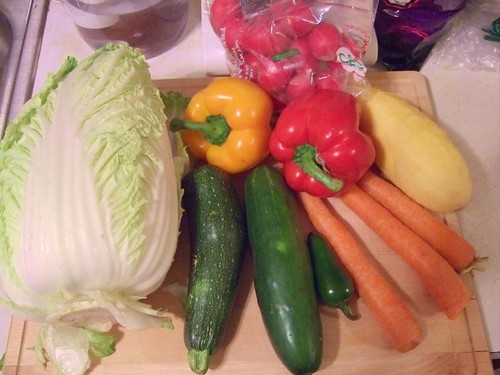
Julienned

What do you get when you take the produce above, chop away at it for an hour or so (together with some green onions and a buttload of cilantro, sadly unphotographed) and then mix it up with a combination of lime juice, fish sauce, sambal oelek, sugar and water? Something like this. It is a Thai flavored cole slaw mega veggie explosion that I took to a friend's fourth of July bbq, and I think it turned out reasonably well, although since the chopping intensity to eating enjoyment ratio wasn't quite to my liking, I probably won't be making it again. Unless I get an awesome new knife that I want to put to the test.

Thursday, October 12, 2006

Strange bedfellows

This recipe may sound odd, but I swear it will be your new favorite salad:

Take a pound of strawberries (one of the regular-sized containers full), wash them, hull them, and cut them into quarters.

Thinly slice (or chiffonade, which is one of my favorite words) some fresh basil until you have a couple tablespoons worth.

Put the strawberries and basil together in a bowl with a teaspoon of sugar and two teaspoons of balsamic vinegar. Toss them all up gently till the strawberries are coated with the vinegar. Put that stuff in the fridge for an hour.

After a bit, take two cucumbers, peel them, slice them lengthwise, scoop out all the seeds, and thinly slice them.

Mix that cucumber up with a teaspoon or so of freshly squeezed lemon juice.

Take the strawberries out of the fridge, mix the cucumbers in with the strawberries, and throw some salt and pepper in there until it tastes just right.

Now eat it. And tell me what you think.