Tuesday, August 17, 2010

The Company of Heaven: Stories from haiti by Marilène Phipps-Kettlewell (2010)

The always intriguing LibraryThing Early Reviewers program recently sent me a copy of Marilène Phipps-Kettlewell's short story collection The Company of Heaven: Stories from Haiti (October 2010).

Besides writing short stories, Phipps-Kettlewell is a visual artist and poet (you can see some examples of her work on her web site), and her work in these other artistic mediums is reflected in her often lyrical storytelling and economical description. While most of the stories stand alone, there is a subtle interlocking of characters and events that strings through the collection. Her narrative criss-crosses her native country of Haiti, touching on the black and the white, the rich and the poor, the old and the young. All the stories were interesting and readable, and some (like "Dogs," "River Valley Rooms," and "At the Gate") were just about perfect. Definitely worth a look.

Monday, August 09, 2010

The Would-Be Gentleman by Molière (1670)

My next stop on the non-stop literature train that is Harold Bloom's Western Canon list is the French play "The Would-Be Gentleman" by Molière (1670).

Molière is known as one of the great masters of comedy and "The Would-Be Gentleman" is no exception. Here Molière pokes fun at the greatly expanding French middle-class, typified by Monsieur Jourdain, a nouveau riche merchant who has plenty of money to spend on learning how to be a "person of quality." To this end he hires music instructors, dancing instructors, and fencing instructors who all gladly take his money and put up with his gauche opinions while waiting for a commission from a real noble.

Jourdain has a very practical and witty wife, and a lovely daughter, Lucile, who is in love with Cléonte. Madame Jourdain would be very happy for her daughter to marry Cléonte, but her husband is bound and determined for his daughter to marry a nobleman. Through a series of disguises, and leaning heavily on the suggestibility of Monsieur Jourdain, the romance is brought to a suitable ending for a comedy.

I really enjoyed this play -- it is predictable, but in just the way you want a good comedy to be, and many of the jokes and gags are just as funny now as they were over 300 years ago. All plays are meant to be performed, of course, and not just read, and since this play also includes several music/dance numbers, it perhaps loses even more than most by being read on the page instead of watched on the screen. Still, Molière's sense of fun and the comedy of his characters comes through in this archetypal French comedy.

***
Luckily for me, I got my copy of "The Would-Be Gentleman" in a collection of Molière's plays that includes four other plays from Bloom's canon list, and which I have bookmarked to read later. Since there were just two plays in this collection that Bloom overlooked, I read them this time around.

The first: "The Doctor In Spite of Himself" (1666) is a very funny story of a poor man who gets mad at his wife and hits her (that's not the funny part) -- she gets her revenge by telling two men who are in search of a doctor to cure their rich master's daughter that her husband is the greatest doctor of all time, but he has the eccentricity of denying that he is a doctor unless you beat him senseless. After you do that, he will agree he is a doctor and cure your patient. As you might imagine, everything eventually works out, and along the way is a play that is so funny I can't figure out why it didn't make the big W.C. list.

The second is "The Mischievous Machinations of Scapin" (1671) which focuses on the entertainingly conniving valet Scapin who gets himself and his masters into plenty of trouble, but always manages to get them back out again. Some really nice gags in this one, which also features the familiar doomed love affairs that end up working out just perfectly.

Friday, August 06, 2010

1000!

Hey jerks, this is my 1000th post! What have I been doing for the past five and a half years (since February 16, 2005), you might ask? Well, lately I've been writing a lot about books, of course. I've also explored the intimate world of my secret boyfriends. And there was that wonderful spring that was dominated by The Serious Debate (which is by far the most popular post on this blog).

Thanks for stopping by for the first 1000 posts, and maybe over the next five years or so I will grace you with 1000 more.

Zip!

Tuesday, August 03, 2010

The Girl Who Fell From the Sky by Heidi W. Durrow (2010)

The always lovely choo thrust this book upon me a few months ago, and it took quite some time to work its way up to the top of my ever-expanding pile. Once it did, though, I zoomed through it in a day and a half and enjoyed every second of it.

The Girl Who Fell From the Sky (2010) by Heidi W. Durrow is a coming-of-age story, a novel about race, a psychological study, and an engaging read. The book tells the story of Rachel, the daughter of a Danish woman and an African-American military man who has mostly grown up overseas on military bases. When she alone survives a family tragedy, she is sent off to live with her father's mother and sister in Portland. Rachel tries to put on a happy face while inside she struggles with her racial identity and her lost family.

The book alternates between the viewpoints of Rachel, the diaries of her late mother, her mom's boss and friend, her father, and a boy from Chicago who witnessed her family's last moments. While the story seems like it could be a heavy-handed or simplistic look at race and growing up, Durrow's straightforward (and yet sometimes poetic) prose, gradual revelations about the family secrets, and her perfect control of the plot keep things from getting too easy or clichéd. A great book for anyone, and one that I think would particularly resonate with teenagers.

Monday, August 02, 2010

Banana + Lime = Jam??

Do you like bananas? Do you like limes? Do you think you could even figure out what Banana-Lime Jam would taste like?

Lucky for you I took the plunge and made this recipe from Cooking Light (very nicely described and photographed on the Noble Pig blog). It was weird. But good! But also weird. I honestly can't describe it entirely, although it is more tart than I thought it would be, and the consistency is extremely satisfying.

To make myself seem even more awesome, I made buttermilk biscuits for the first time in my life as a vehicle for some of the jam. Both making biscuits and making jam were way easier than I thought they would be. Is there a life lesson in there somewhere?

Sunday, August 01, 2010

Happy Endings edited by Diana Schutz (2002)

Dr. M bought this Dark Horse comics anthology [Happy Endings edited by Diana Schutz (2002)] when we were on vacation in Fort Collins, at the same comics shop he would sometimes get to go to as a kid. From the same grumpy comic book guy. With the same awesome grumpy cat.

The anthology, like most anthologies, is pleasant enough, although not particularly mind-blowing. Schutz brought together sixteen established comic artists and had them each produce a short piece on the theme "Happy Endings." Some interpreted that quite literally, some poked fun at the idea, but they all tackled it creatively and true to their own style. I liked the entries by Bernie Mireault, Craig Thompson, Farel Dalrymple and Harvey Pekar the best -- especially the Craig Thompson piece, which was by far the strongest in the book.

Which reminds me, does anyone have a copy of Blankets I could borrow? I'd really like to get more Craig Thompson into my life...

Thursday, July 29, 2010

Louisa May Alcott: The Woman Behind Little Women by Harriet Reisen (2009)

As I've probably mentioned before, I've loved Louisa May Alcott ever since I read Little Women as a child and then found out that Alcott and I shared the same birthday. When I picked her as the topic for an elementary school report I also learned that she was tall and thin, had only sisters, and that she loved to read. And now that I've read this well written biography by Harriet Reisen, I've also learned that, like me, Alcott shared a birthday with one of her relatives (in her case, her father; in my case, my sister) and that she loved to read (and made quite a bit of money writing) pulpy fiction serials for popular magazines.

Okay, the similarities between myself and Louisa May Alcott pretty much end there: my dad is sometimes philosophical, but he is a good provider and way more down to earth than Transcendentalist Bronson Alcott; I only lived in three houses growing up -- Alcott moved 30 times before she was in her mid-twenties; I'm no fiction writer; and my personality tends to be pretty even keeled and not as frenetic as Louisa May Alcott's. Still, I like to think we would be good friends if she hadn't passed away back in 1888.

Reisen's biography is an extremely readable exploration of Louisa May Alcott's life, starting with her parents' childhoods and ending with her death (which, incidentally, was only two days after the death of her father). While the author is closely focused on the life of Alcott, her family was at the center of many important aspects of 19th century America (abolition, Transcendentalism, the Civil War, women's suffrage) that the reader can't help but get a healthy dose of American (and Bostonian) history.

It is well known that Alcott based her best-selling novel, Little Women on her own family, and in fact much of Alcott's fiction was drawn from her real life experiences. And while all the characters and many of the events in Little Women have their parallels in reality, Louisa May Alcott's childhood was much rougher than the book allows. Having a Transcendentalist father meant that Alcott grew up with Emerson and Thoreau as neighbors and friends, but her father's writing was never successful, and for much of his life he was not much respected outside of his circle of friends. He never made money at his philosophical and educational work, and the Alcott family struggled to make ends meet through loans from friends and family (that were never paid back), and by moving frequently to escape their debts. Bronson Alcott's philosophies of diet (nothing but bread, water and apples) and cleanliness (cold shower outdoors) didn't make life any more comfortable for his wife and four daughters. And yet, the family was very close, and Louisa May Alcott was ultimately able to support both her parents and her sisters through her writing.

Lucky for us, an intellectual family like the Alcotts placed a big emphasis on writing and Alcott kept a journal from the time of her childhood and sent out a huge number of letters to her friends and family. Because of this, Reisen is often able to tell us Alcott's story in her own voice and cut our impression of the moralistic narrator of Little Women with the biting wit and outspoken nature of the real Louisa May Alcott.

And now that I've read this biography, I want to go out and read everything by Louisa May Alcott that I can get my hands on....

Monday, July 19, 2010

Sailor & Lula: The Complete Novels by Barry Gifford (2010)

Lula Pace Fortune. Sailor Ripley. Coot Veal. Buford Dufour. Rip Ford. Dalceda Hopewell Delahoussaye. Lefty Grove. Elmer Désespéré. The names alone make this collection a first rate contribution to American literature.

Sometimes (although not often) I have to slog a bit to get through a free book from the LibraryThing Early Reviewers program. Other times the magical algorithm reads my tastes perfectly and sends me a book that couldn't do anything else but make me smile -- Sailor & Lula: The Complete Novels by Barry Gifford (2010) is just that kind of book.

If you have seen David Lynch's movie Wild at Heart, (which includes one of my favorite Nicolas Cage lines of all time) then you are already familiar with the cast of the first novel in this collection: the star-crossed lovebirds, Sailor and Lula; Lula's overprotective mother, Marietta; and the ill-fated Bobby Peru and his girlfriend, Perdita Durango.

In fact, the second novel in the collection, Perdita Durango was also made into a movie -- I've never seen it, but it has been added to my list. And if you take a second to watch the trailer, you will see that Javier Bardem's haircut in No Country for Old Men is actually not the most unflattering hairstyle he has ever sported.

Gifford wrote the screenplays for both of these film adaptations of his work (as well as the original screenplay for Lost Highway), and while Lynch obviously brought a big bag of his own Lynchiness to Wild at Heart, these books have the same humor, violence, philosophies, and energy.

I won't go through the whole collection except to say that the books as a whole, written between 1990 and 2009, take us way beyond the end of Wild at Heart, through Sailor and Lula's middle age, the life of their son, and all the way until the end of their lives. In each episode, the main narrative shoots out on side stories, brushes up against minor characters with one-paragraph plots (and awesome names), steps up to the radio to tell us of a crazy crime, has a little sex, reads the newspaper for a bit, tells us about someone's dream, and then unexpectedly and inevitably blows apart with a breath-taking (and plot changing) act of violence. And just when things seem like they can't get any worse, an equally unexpected act of violence and some good luck set everything right again.

Oddly enough, even though this collection is sub-titled "The Complete Novels," there is another Sailor and Lula novel that wasn't included, Baby Cat-Face (1995). That the publishers didn't include that novel doesn't make me too sad, though, because just when I thought I had exhausted the Southern mythology of Sailor and Lula, I've found that there is a whole other chapter waiting for me.

Tuesday, July 13, 2010

The Bread Bible by Christine Ingram and Jennie Shapter (2006)

One of my resolutions this year was to finally get tough and make my own bread. I had made my share of banana bread and beer bread, but I wanted to make the kind that uses yeast and that you have to knead and wait around for. The internet led me to some tips and simple recipes, and I completed my goal pretty early in the year. But I wanted more!

I found just the book to scratch my bread knowledge itch in Christine Ingram and Jennie Shapter's The Bread Bible (2006). This book starts with some introductory material on the history of bread making and the ingredients used in baking bread, then moves into some nicely illustrated step-by-step techniques and a nod to the different equipment a bread-maker might want. After this preparation the book pushes into an encyclopedic look at different types of bread from around the world, with a pretty heavy emphasis on breads from the U.K. and Europe. Finally, after reading about all the tasty bread options and drooling over the full-color photography on every page, Ingram and Shapter give us over 100 step-by-step recipes for a selection of breads that we read about in the first section of the book.

I haven't tried making any of these yet, but I have about a dozen recipes marked for immediate experimentation. My only qualm is that this book is a British publication and while the measurements are converted into US units, I still think a certain amount of translation is going to be necessary. There are also some endearing (and sometimes confusing) Britishisms used throughout: "greased greaseproof paper," "maize meal" (instead of corn meal), and she always seems to call a measuring cup a "jug." Overall, this is a fun read for a curious breadmaker and includes such a variety of recipes that it should cover pretty much every bread baking need (or knead).

Let the bready experiments begin!

Friday, July 09, 2010

Giant by Edna Ferber (1952)

I bought this copy of Giant by Edna Ferber (1952) about a year ago when I was up in Madison, Wisconsin for the wedding celebration of a year. It may seem odd to have purchased a novel all about Texas in a state about as far from Texas as you can get, but Ferber herself was born in Michigan and raised in the lovely city of Appleton, Wisconsin, so it is actually quite appropriate.

Giant is the story of Bick Benedict, the head of the Benedict Ranch, one of the largest and most prosperous in Texas. After the first World War, while doing business in Washington, he stops in Virginia to see a man about a horse. He comes back to Texas not only with the horse, but also with the man's lovely and outspoken daughter Leslie. Bick and Leslie are about as different as 1920s Virginia and Texas, but they are passionately in love and Leslie makes plenty of sacrifices to make their family work. Things aren't made any easier by Jett Rink, a crude and outspoken ranch hand who pretty awesomely crosses Bick and becomes a lifelong enemy of the family at the same time that he strikes it rich in oil.

Giant encompasses the story of the Benedict family and their friends and neighbors, but it also gives the reader a series of contrasts: cattle vs. oil, the old generation vs. the new one, the east cost vs. Texas, men vs. women, Mexicans vs. Anglos. Not surprisingly for Ferber (who also wrote the novel that Showboat -- one of the best musicals of all time -- was based on), racial equality and social justice are big themes in the book. While sometimes these themes are pushed at the expense of the story, the book is an interesting read as a non-Texan's view of these ranching men and women with all their quirks -- both the endearing ones and the irritating ones. Of course, maybe I liked it because I'm not from Texas either, even though I've lived here for ten years. I could see "real" Texans having some problems with the book...

I haven't ever seen the film version of Giant, the one staring James Dean and Elizabeth Taylor, but I have put it high on my list. I imagine it is chock full of 1950s hugeness and melodrama, and sometimes that is just the thing I want.

Wednesday, June 16, 2010

The Girl with the Dragon Tattoo by Stieg Larsson (2004)

I am trying my hardest to understand why Stieg Larsson's The Girl with the Dragon Tattoo (2004) is such a runaway bestseller, because I really did not like this book at all. And I love books!

I borrowed this one from my mother, who got it from my sister, who got it in a gift exchange at Christmas. Neither of them had read it yet, but I had heard so much about this and the other two books in Larsson's posthumously published Millennium series that I was interested to check them out. I think it is pretty fair to say that I will not be finishing the trilogy...

The Girl with the Dragon Tattoo focuses on Mikael Blomkvist, a financial journalist in Stockholm, and co-publisher of an investigative magazine along with his best friend and (married) casual sex partner, Erika Berger. Blomkvist gets a tip on financial fraud being committed by the Swedish industrialist Hans-Erik Wennerström from a friend who wants to remain an anonymous source. The first hundred or so pages of this 600 page book trudge us through the financial misdealings, Blomkvist's publication of an article on Wennerström, and his eventual trial and conviction for libel when his story falls apart.

The conviction does not bode well for Blomkvist's journalistic career or for the future of his magazine, so when he is contacted by another Swedish businessman, Henrik Vanger, about a mysterious opportunity, he decides to make a trip to an island up north to see what Vanger has to say.

Vanger is the patriarch of a corporation that has been a major business in Sweden for generations. The company is currently run by Vanger's nephew, since Vanger is getting older, but ownership of the company is divided between a couple dozen relatives who all have skeletons in their closets and who just can't get along. Vanger doesn't like many of the other Vangers, and part of his dislike stems from a day 34 years ago when his favorite niece Harriet, who was 16 at the time, disappeared from the island without a trace. Although no body was found, Vanger is convinced she was murdered by one of his relatives and he wants to pay Blomkvist a huge amount of money to research the case for a year and see what he can find. At the end of the year, Vanger also promises to give Blomkvist some dirt on Wennerström, who started his career with the Vanger corporation. Not having any other choice, Blomkvist agrees.

Oh, and that girl? With the tattoo? She is the anti-social and uncommunicative Lisbeth Salander -- an accomplished hacker and investigator with some serious emotional problems. She was hired to investigate Blomkvist by Vanger's lawyer in preparation for Vanger's offer of employment. Blomkvist eventually gets his hands on her report on him and is so impressed by her researching skills that he asks her to be his assistant in the disappearance of Harriet.

So, doesn't sound too bad, right? Why don't I like it? Here are some of my thoughts in bulleted list format:
  • The structure and narrative is a mess. Larsson wrote this book and the two sequels in his spare time (he was professionally a journalist). He submitted them to a publisher in 2004 and then unexpectedly died at the age of 50. This book reads like the editor was so moved by Larsson's death that he decided not to change a thing from the first draft.
  • The characters are flat and unappealing. You would think that in 600 pages we could start to feel something about Lisbeth or Mikael but I didn't understand (or care about) either of them any more at the end than I did at the beginning.
  • Larsson is weirdly specific about some things. This is nitpicky, but it bugged me: nothing was ever a laptop, it was a Mac PowerBook. And then he would give the model number. And the amount of RAM. And the hard drive size. He would mention a database program. Then mention who wrote it. That it was shareware. And then give the URL for the program! Again, the book seems unedited.
  • The writing, especially the dialogue, is not good. Possibly a translation problem? Still, it didn't work for me at all.
  • A scene in a corporate archives where our irritating tattooed pixie does some all night research and then leaves things in a mess for the archivist (who she calls a slut) did not make me happy.
  • The solution to the mystery is both dumb and unearned. And is then followed with another 100 pages about financial malfeasance and bank fraud.
And here is the big thing: Larsson's heavy-handed message about violence against women. The original Swedish title of this book is translated as Men who Hate Women and that is pretty appropriate since, as Alex Berenson points out in his review (which I largely agree with), "Except for Blomkvist, nearly every man in the book under age 70 is a violent misogynist." Add to that the fact that every woman under 70 in the book instantly wants to sleep with Blomkvist (and most of them follow up on that urge). Larsson is obviously anti-violence. This is made abundantly clear with the statistics about violence against women in Sweden that start off each section of the book. However the book itself is so black and white about its misogyny and so explicit in its scenes of violence (particularly sexual violence) against women, that it feels like Larsson is trying to have his cake and eat it too.

Have you read this book? Did you like it? I won't hold it against you if you did, because I am honestly baffled by my response to this book.

Monday, June 14, 2010

Science!

As an archivist, I get to use lots of fun tools: bone folders, microspatulas, um.... pencils? But the most fun of all is my brand new toy, the sling psychrometer!

First of all, the name "sling psychrometer" is immensely fun to say. Almost as fun as hygrothermograph.

Secondly, it is helpful in that it tells me the actual relative humidity in a room, allowing me to mentally calibrate my digital (and uncalibratable) temperature/humidity monitors and then be sad because the humidity is always too high in my storage area and there isn't anything I can do about it.

And thirdly, and most importantly, when using the sling psychrometer, you actually whirl it around in a very satisfying way. Just take a look at this video and watch some sports dude show you how to use this tool.

Sling Psychrometer!

Friday, June 11, 2010

Good Wives (or Little Women, Volume 2) by Louisa May Alcott (1869)

After the success of Little Women in 1868, Louisa May Alcott penned a companion volume in 1869 that is sometimes bound separately as Good Wives and sometimes (like in the case of my grandmother's copy of the book that I'm reading), bound together as a second part of the story.

I had read this part of the book once before, but not nearly as many times as I read the first part of the book. Maybe it is because I'm grown up now, but I liked the "young womanhood" part of the collection even more than the childhood part.

In Good Wives the oldest March sister, Meg, marries her fiance John Brooke and starts a family. Jo, the second daughter (and the one modeled after Alcott), refuses the hand of their cute and wealthy and nice next door neighbor Laurie who has loved her since childhood. She breaks his heart and he heads to Europe while she goes to New York City to work as a governess and work on her writing. The third daughter, Beth, stays close to home and is still a little sickly from her battle with scarlet fever, but is just as kind and thoughtful as ever. Little Amy, the artistic one, hits the jackpot as a companion to her wealthy aunt on a trip to Europe where she stretches her artistic wings.

Although each of the "Little Women" are moving further and further from their childhood home, they are still just as close with their mother and one another. Each is sometimes tempted and starts down the wrong path, but their solid character and good upbringing always bring them back to the good life. This book deals with more grown up difficulties, tragedies, and blessings, but the core of the characters is just the same as when Alcott laid their foundations in the first volume of the book. And I challenge anyone on earth to write a better betrothal scene than Alcott. She has two in this book that got me a little weepy they were so perfect.

There is still some moralizing in this book (it was written in the late 1800s after all), but nothing that a patient reader can't handle. And if you give it a little time, you are rewarded by passages like the following (which I'm going to quote at length, because I can). This is particularly revealing since Alcott herself never married:

"An old maid, that's what I'm to be. A literary spinster, with a pen for a spouse, a family of stories for children, and twenty years hence a morsel of fame, perhaps; when, like poor Johnson, I'm old, and can't enjoy it, solitary, and can't share it, independent, and don't need it. Well, I needn't be a sour saint nor a selfish sinner; and, I dare say, old maids are very comfortable when they get used to it; but—" and there Jo sighed, as if the prospect was not inviting.

It seldom is, at first, and thirty seems the end of all things to five-and-twenty. But it's not as bad as it looks, and one can get on quite happily if one has something in one's self to fall back upon. At twenty-five, girls begin to talk about being old maids, but secretly resolve that they never will be. At thirty they say nothing about it, but quietly accept the fact, and if sensible, console themselves by remembering that they have twenty more useful, happy years, in which they may be learning to grow old gracefully. Don't laugh at the spinsters, dear girls, for often very tender, tragic romances are hidden away in the hearts that beat so quietly under the sober gowns, and many silent sacrifices of youth, health, ambition, love itself, make the faded faces beautiful in God's sight. Even the sad, sour sisters should be kindly dealt with, because they have missed the sweetest part of life, if for no other reason. And looking at them with compassion, not contempt, girls in their bloom should remember that they too may miss the blossom time. That rosy cheeks don't last forever, that silver threads will come in the bonnie brown hair, and that, by-and-by, kindness and respect will be as sweet as love and admiration now.

Gentlemen, which means boys, be courteous to the old maids, no matter how poor and plain and prim, for the only chivalry worth having is that which is the readiest to pay deference to the old, protect the feeble, and serve womankind, regardless of rank, age, or color. Just recollect the good aunts who have not only lectured and fussed, but nursed and petted, too often without thanks, the scrapes they have helped you out of, the tips they have given you from their small store, the stitches the patient old fingers have set for you, the steps the willing old feet have taken, and gratefully pay the dear old ladies the little attentions that women love to receive as long as they live. The bright-eyed girls are quick to see such traits, and will like you all the better for them, and if death, almost the only power that can part mother and son, should rob you of yours, you will be sure to find a tender welcome and maternal cherishing from some Aunt Priscilla, who has kept the warmest corner of her lonely old heart for 'the best nevvy in the world'.

Tuesday, June 08, 2010

Eeeeeeee!

In February 2008, I reported that I really wanted an Asus Eee netbook. And today, in June 2010, I am writing this post from my very own Asus Eee netbook. I still think the name is dumb, but the tinyness and funness are exactly as I anticpated. Netbooks!

It was still a stretch to my budget, but lets pretend that I have saved $8.00 a month for the past 29 months. That seems reasonable, right?

Monday, June 07, 2010

The Swiss Family Robinson (1812)

I recently finished reading The Swiss Family Robinson by Johann D. Wyss (1812) in 134 delightful serialized chunks delivered to me via e-mail by dailylit.com. I had never read this classic novel as a child, and I figured it would work well in a serialized format.

As you might remember from the dozens of movies and television shows based on this plucky and ingenious Swiss Family, the book begins with our heroes (a mother, father, and four young boys) getting in a shipwreck on their way to Australia. Everyone else on the ship is lost, but the family eventually makes their way to an island that is bereft of human beings but conveniently filled with almost every plant and animal life the father and sons have ever read about in their natural history, engineering, history, and adventure reading.

The first half of the book is very procedural: how they built their first shelter, how they got food, how they built a better shelter, how they moved around the island, how they built an awesome shelter in a tree, how they built another awesome shelter in a grotto, how they cultivated food and livestock, and the list goes on and on. Liberally sprinkled around these lessons of survival and ingenuity are moral lessons on how to be a good man, how to treat your wife and family, and how to frequently bow down and thank the lord. The moral lessons get a bit trying, but this book was written in 1812 by a Swiss pastor, so I think we can let him have his morality.

In the second half of the book things suddenly get very exciting when, after returning from a two day trip exploring the unexplored parts of their island, the father and three of the sons come back home to find their canoe missing and the wife and youngest son taken from the island. They quickly give chase in their small boat, making it to another island and getting into quite a bit more trouble before their prayers are answered and (as you might expect) the family is reunited. The story of their reunion and the nice way things work out for the family's future on their island paradise is a satisfying and well earned ending to this enduring story.

Fun fact: The family is not actually named Robinson -- Robinson comes from Robinson Crusoe and the title lets us know that this is the Swiss family version of that famous castaway story.

Wednesday, June 02, 2010

Elysiana by Chris Knopf (2010)

My latest selection from the LibraryThing Early Reviewers program is Elysiana (2010), a stand-alone novel from established suspense writer Chris Knopf.

Elysiana is a fictional barrier island off the coast of New Jersey. It is one mile wide, twenty-five miles long, and sees a huge population increase every summer when the tourists descend upon the elongated coast line. In the summer of 1969 a whole hoard of interesting characters find themselves on Elysiana, crossing paths with one another, working through painful pasts, and making up our story:
  • Gwen ends up on the island after coming down from a three day drug trip that started in Chicago and on the tail end of some major daddy issues.
  • Jack has lived on Elysiana for years, the only resident of a giant hotel built by his grandfather. He works as a lifeguard on the beach patrol and mostly lives inside his head, partly as a product of surviving a four year coma after a teenage accident.
  • Avery Volpe is the militaristic head of the beach patrol, and possibly the most powerful person on Elysiana in the summertime.
  • Norm Harlan is the city manager with ambitions to oust Volpe and the mayor. He also has a distractable wife and a precocious daughter named Sweetie who is constantly getting lost.
  • Sylvia Buente fails to kill herself when she is rescued by Mike Ditzler, one of the life guards with his own complicated life story, and who is now holed up in his apartment.
  • Petey Amato is a small-time crook and surfer who is pretty big-time on this little island.
And the list goes on and on and on. Add in an island-wide super party on the heels of the biggest storm in the century, and you have a recipe for lots of plots, sub-plots, romance, violence, and quirkiness.

The novel is solid overall, although with so many characters no single story line really draws the reader in. And with so much action, there isn't much time for characterization, which leaves some of these potentially very interesting people feeling rather thin. However, Knopf wrangles his sub-plots well and everything is tied together in a satisfying way, and with a very nice climax. This would be a nice summer read that wouldn't disappoint, as long as you didn't expect too much from it.

Saturday, May 29, 2010

Büchner: The Complete Plays, edited by Michael Patterson (1987)

As I mentioned in my post on Woyzeck, I also read the rest of the works in Büchner: The Complete Plays, edited by Michael Patterson (1987), with the exception of Danton's Death, which is also on the western canon list and which I will probably get to in about 2045.

Georg Büchner
(1813-1837) managed to squeeze quite a bit into his 23 years of life, and this collection documents his many facets -- political revolutionary, dramatist, biographer, scientist, son, and fiancée:

The Hessian Courier (1834)
This was a revolutionary and really quite illegal pamphlet that Büchner wrote with a radical clergyman. Inspired by the French revolution, Büchner called for the German peasantry to rise up against the Grand Duchy of Hesse-Darmstadt. He argues logically (including lots of facts and statistics) that the rich were living off of the work of the poor and not giving the poor anything in return. Over Büchner's objections, his partner added religious language that he thought would appeal more to the rural poor. The pamphlet was printed and distributed twice, but in both cases the revolutionary nature of the work scared everyone who was meant to read it, and anyone who did get their hands on a copy immediately turned it over to the local police. Several conspirators were arrested and tortured, but Büchner managed to escape the country and live out the rest of his short life in exile in Strasbourg (where he had previously lived as a student) and Zurich. His experience with The Hessian Courier proved to him that revolutionary action was ineffectual, and while there are some political themes that run through his literary works and letters, he never returned to the political stage.

Lenz (1835)
This novella, based on the life of Jakob Michael Reinhold Lenz (a literary contemporary and romantic rival of Goethe) was one of my favorite pieces in the collection. Büchner focuses on the period in Lenz's life when he has been exiled from the court of Weimar and subsequently suffers an attack of paranoid schizophrenia. He goes to the mountains of Alsace to stay with the clergyman J. F. Oberlin and regain his sanity, but his mental state goes downhill and he ends up returning to Eastern Europe with his brother. Büchner paints a convincing and sympathetic portrait of paranoia and depression, a state that he had some familiarity with himself.

Leonce and Lena (1836)
This comedic play was written for a literary contest, but submitted past the deadline and returned to Büchner unopened. It was not published or produced until after his death. This is a romantic comedy of mistaken identity, filled with word play, with an obviously Shakespearean influence. When the prince of the kingdom, an unrepentant playboy who is bored with his affluent life of leisure, is forced into an arranged marriage, he and his sidekick take off on a road trip to avoid being tied down. Little does he know that his fiancée, who he has never met, had the same idea and also escaped the castle with her governess. It is pretty easy to guess what happens next, and everything coalesces into a very satisfying play. I, of course, can't read the original German, but the translation is crisp and the playfulness and puns in the dialogue all seem to come through.

On Cranial Nerves (1836)
The opening remarks of this scientific lecture given by Büchner as part of becoming a member of the teaching staff at Zurich University show his humanism and his philosophical rather than mechanical view of science.

The book also includes excerpts from Büchner's letters to his family, fiancée, and friends, as well as descriptions of Büchner from his contemporaries, which were all very revealing and fun to read. Each piece in the collection, as well as the book as a whole, is given an insightful introduction by the editor, Michael Patterson. I don't always enjoy introductions in a book, but Patterson gives just the right amount of context and interpretation and his clear prose is a pleasure to read. If you are looking to insert a little 19th century German literature into your life, you can't go wrong with this extensive collection of the works of Georg Büchner.

Tuesday, May 25, 2010

Pickled Beets?

I was shopping at HEB today on my lunch break and I bought a jar of pickled beets. I really don't know why, since I have never really liked beets (they taste like dirt), but I had an undeniable urge to eat pickled ones. Since they only cost $1.40, I figured it was worth the splurge.

So I ate several pickled beets when I got home from work. They still taste like dirt, but somehow I don't mind that anymore. I actually kind of like it. I think I am officially a beet fan!

And click here to watch the credits of the Care Bears Adventure in Wonderland movie that my sisters and I watched 100000000 times as kids. Give it until about 3:15 and you can hear exactly what I hear in my head every time someone says pickled beets.

[photo credit: stu_spivack]

Sunday, May 23, 2010

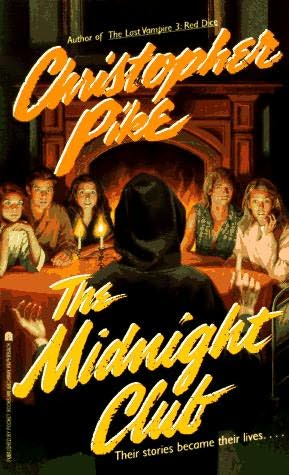
The Midnight Club by Christopher Pike (1994)

The Midnight Club (1994) is another one of those Christopher Pike books that came out a little too late for me to enjoy it in my junior high Pike heyday, but I picked it up a free copy when I worked at a bookstore in college and have been carrying it around with me for the past ten years. Now seemed like the perfect time to give it a read.

This book has one of the most somber settings of any Christopher Pike novel -- an old seaside mansion that has been converted into a hospice for terminally ill teenagers, most of whom are poor and/or alone and would be lonely and dying in some gross state hospital if they weren't rescued by the avuncular owner of the hospice.

Our hero is one of the dying teenagers, Ilonka, who has formed The Midnight Club with her roommate Anya, the sexy and dying Kevin (who Ilonka is secretly in love with), his roommate Spence, and the quiet and modest Sandra. Every night at midnight the five teens meet in the basement of the mansion to tell each other stories -- some of the stories are scary, some romantic, and all a little supernatural. After one meeting they start talking about ghosts and what happens when you die, and make the pact that whichever one of them dies first will do everything in his or her power to contact the rest of the group from the other side. And then one of them dies in the night!

At least that is what the back of the book wants you to think this story is about. And all of that does actually happen, but instead of being a freaky tale of ghosts and death, this is actually a rather sweet love story about growing up and forgiveness. I'm not sure how Pike did this (and maybe I was just feeling emotional this week), but this book is nicely written, engaging, and often very moving. I know! From Christopher Pike! I think part of the difference in this book is that he gave himself a structure for filling the novel with nicely told mini-stories (the ones the teens tell in The Midnight Club), which puts a little less pressure on his main characters, and allows their characters to develop and their relationships to evolve with out the full crush of Pike's usually rather ham-handed descriptions.

If you are looking for the usual Pike novel, this probably isn't for you, but I really found it worthwhile. Go Team Pike!

[Also, the one hilarious part of this novel is the guy sitting second from the right on the cover. It is hard to see in this picture, but he is wearing the most amazing green plaid shirt with the sleeves cut off, unbuttoned to his mid-chest. Hospice wear!]

Thursday, May 20, 2010

Woyzeck by Georg Büchner (1837)

The next stop on my journey through Harold Bloom's western canon is the play Woyzeck by Georg Büchner (written in 1837, unfinished because Büchner died [at the age of 23!], and not published until 1875 or staged until 1913).

I had some familiarity with Woyzeck through Werner Herzog's 1979 movie starring Klaus Kinski and Eva Mattes (trailer here -- no English subtitles, but you don't really need them). It's been quite awhile since I've seen the film, and now that I've read the play I'm excited to see it again. From what I can remember, Herzog follows Büchner's script pretty well. However, since Büchner never finished the script, several different versions of the play have been edited together and performed over the years, and each director or editor has been able to put his or her own mark on the sequencing and staging of the play.

In the play, Woyzeck is a soldier. He has a son with his common-law wife Marie, but they don't have enough money to get the proper papers to get married. There doesn't seem to be any war going on, so most of Woyzeck's soldiering involves digging ditches and shaving the commanding officers. He is a haunted man and doesn't seem to be particularly at ease with life, possibly in part because he is eating nothing but peas as part of a medical experiment to earn extra money for Marie and the baby. A handsome and fancy Drum Major catches Marie's eye and seduces her, and when Woyzeck finds out, he goes mad and kills her.

It may seem like I've given away the whole thing, but what is really interesting about the play doesn't have anything to do with the plot. The plot, in fact, was taken from a real life "true crime" case of a man (named Woyzeck) who killed his wife in a jealous rage. Rather than carrying the reader with its plot, Woyzeck brings us in through its episodic structure, the humanity and suffering of the characters, and the buffoonery of the authority figures. It is because of the strong characters and episodic plot that each director of the play can mold it to his or her own vision without losing Büchner.

I got Woyzeck as part of a larger book of Büchner's complete plays and other writings, and read all of them except Danton's Death (which is also on the western canon list). I'll do a second post for the other plays and works in the larger book because I am too excited about Büchner to put it all in one post!

[Awesome Woyzeck poster found here.]

Thursday, May 13, 2010

Renegade!

I feel like I've been beating this to death in other venues, but in case you haven't heard:

1. The Renegade Craft Fair is this weekend in Austin.
2. The awesome Mary P. from Pretty Good Things will have a booth there filled with wonderful things for you to buy.
3. I will be helping Mary P. sell those awesome things.
4. You should come say hi to us and experience all the awesomeness!

See you there!

Monday, May 10, 2010

The Quiet American by Graham Greene (1955)

Our latest book club read (Go DAFFODILS!) is The Quiet American by Graham Greene (1955). I had only read one other Greene book (The Man Within, Greene's first novel, which I reviewed here) -- but from what I heard it wasn't really representative of Greene's other work, so I was very interested to read some more.

I was, however, pretty familiar with the plot of The Quiet American, having seen both the Joseph L. Mankiewicz version from 1958 (starring Audie Murphy and Michael Redgrave), and the Phillip Noyce version from 2002 (starring Michael Caine and Brendan Fraser). I thought both versions of the movie were pretty good -- I liked the 50s one better, but Brendan Fraser gave a great performance as the American in the recent film.

The basic plot has our narrator, cynical British journalist Thomas Fowler living with his mistress of two years, Phuong, in an apartment in Saigon as he covers the French war and smokes his nightly opium. Fowler loves (or at least believes he loves) Phuong and would marry her except that his estranged wife back in England is a Catholic and won't give him a divorce. One night at a hotel bar, Fowler meets a naive young American government worker named Alden Pyle who just arrived in Vietnam from his college days at Harvard. Fowler enjoys playing the wise and experienced Englishman to Pyle's fresh-faced and straight-talking American. Or at least he does until Pyle falls in love in Phuong.

I won't get into too many of my thoughts on the book (since I want to try and remember those for book club), but I will say that I really enjoyed this. The book is expertly constructed and I could pull out dozens of sentences from the novel that couldn't be more perfect. Neither Fowler nor Pyle are admirable men, but the ways in which they fool themselves and each other make for an exciting psychological thriller, with a good dose of philosophy and politics on the side.

Thursday, May 06, 2010

The Gone-Away World by Nick Harkaway (2008)

The always-awesome Corie recently lent me a copy of Nick Harkaway's 2008 debut novel The Gone-Away World. This book is gigantic (532 pages), but that didn't daunt me much since one thing Corie and I share is a love for really long novels. I jumped right in without knowing much about the book and I thought it was... Okay. Not bad at all, but not particularly great. A blurb on the book compares Harkaway's writing to Catch-22 or Kurt Vonnegut, and I could see that, but mostly I got a big whiff of Tom Robbins -- who I loved in my youth and whose quirky humor, obvious politics and need to philosophize I am now a rather lukewarm about. So I was into this book but not loving it when I got about 350 pages in and all of a sudden the whole thing became really quite awesome.

Here's the set up: We start the book in a post-apocalyptic future. Everything is all Mad Max and the only thing resembling civilization as we know it exists right along the Jorgmund Pipe, which emits some kind of gas that keeps the bad things away. What the bad things are and how everything got like this won't be revealed for awhile. Our hero and his friends are a group of ex-military who specialize in putting out fires and containing hazardous situations. When the Jorgmund Pipe bursts into flames, the uber-corporate government gives them a call and they spring into action.

Then we go back in time to the narrator's pre-apocalypse youth, and learn of his close friendship with Gonzo Lubitsch and his family, his school days, his work with a master of an ancient Chinese martial art, his college days, his entry into the military, and his marriage. This is all sometimes funny, sometimes interesting, and sometimes has a lot of holes in it, goes on a little long, and is less humorous than the author thinks. Then we get back to the "present," and everything changes for our narrator.

I'm not going to reveal the catalytic event and subsequent twist, but I will say that I didn't see the twist coming until just a couple pages before it happened. And this twist did what twists almost never do: It didn't make me feel cheated and it made me re-evaluate the first two-thirds of the gigantic novel and really like what before I had thought was just okay. If you have some patience in you and like long sort of sci-fi / sort of political satire / sort of humorous novels, then give this one a try. I swear it is worth it just for flipping that switch in the narrative.

[Also, I just now found out that Nick Harkaway is John le Carré's son. Weird beard.]

Saturday, May 01, 2010

Little Women by Louisa May Alcott (1868)

I read Little Women by Louisa May Alcott (1868) about a billion times when I was a girl. I loved the relationships between the sisters, the rebelliousness of Jo, and the way that everyone took care of each other even when they were fighting over some little thing. And since Alcott and I share a birthday, I wrote numerous elementary school English papers on her life and times and the history of her books.

Recently my aunt loaned me a new biography of Alcott, which I'm very interested to read, but she suggested I re-read Little Women and its sequels -- Alcott published a second volume in 1869 after the success of the first volume (often titled Good Wives, but sometimes bound in together with Little Women), then Little Men in 1871 and Jo's Boys in 1886. I've read both volumes of Little Women before, but not any of the others, so I am keen to check them out.

In case you are one of the sad people on earth who has never read Little Women or seen any of the film adaptations, let me fill you in on the plot: The March family has four daughters (Meg, Jo, Beth, and Amy), and they live in a house somewhere in New England with their mother, who they all call Marmie. Their father is serving in the Civil War, even though he is a bit too old to be doing so. The family used to be quite wealthy but, for an unexplained reason, they have lost their fortune and both Meg and Jo have to go out and work to help bring some money into the household (Meg as a nanny and Jo as a companion to their rich and crotchety Aunt March).

Each of the daughters has a strong personality that guides the action of the book: Meg is the oldest, sometimes a little vain, and remembers when the family had money and misses that lifestyle; Jo is an impetuous tomboy who loves to read and write and make up stories and direct plays staring her sisters (Alcott modeled Jo on herself, and she is a pretty obvious favorite character for most readers); Beth is sweet and shy and giving, and loves to play the piano; Amy is the youngest, tries to act more worldly than she is, mispronounces words, is caught up in conventions, and wants to be a great artists.

The best thing about Little Women is that everything that happens is pretty ordinary, but because the characters are drawn so well and the reader has such sympathy for the family, the small victories and tragedies of everyday life are heightened and the book is really a fun read.

The one downside to modern readers (or perhaps adult readers, since it didn't really bother me as a kid) is the moralizing -- around every bend our little women are learning important lessons in being kind and understanding and not saying mean things or being selfish or rude, and each of those lessons is spelled out for the reader and rubbed in maybe just a little too much. Still, it is forgivable considering the time the book was written and its audience, and it definitely isn't a deal breaker.

Check this space for more Alcott updates in the near future!

[Also: My copy of Little Women (printed in 1926) was actually my grandmother's copy. I'm not sure if it is a copy she had from when she was a girl or if she bought it later in life, but it has great illustrations by C.M. Burd and an introduction by Albert Lindsay Rowland (Superintendent of Schools, Cheltenham Township, PA) that gives this advice to modern readers of 1926: "A superficial opinion would call it a far cry from the long dresses, the veiled faces, and the prim speech of the March sisters to the scanty frocks, the bobbed hair and the vigorous actions of a group of modern school girls. Yet all are little women and the tremendously interesting and important problem of growing up is essentially the same in both cases."]

Saturday, April 24, 2010

McSweeney's, No. 33: The San Francisco Panorama (2010)

I'm not usually much of a McSweeney's reader, but my cousin loaned me a copy of McSweeney's, No. 33: The San Francisco Panorama (2010), edited by Dave Eggers and his gang. In this experiment, the McSweeney's crew decided to celebrate everything that was great about traditional print journalism and the large canvas provided by newsprint -- kind of a eulogy to the dying format, as well as a call for its rebirth. What they ended up creating is an overwhelming thing of beauty -- beautiful because of the full-color printing and the striking layouts, and overwhelming because it is over 300 pages long. This is a seriously intense newspaper.

So here is a thing about me: I don't really like newspapers. Physically, I mean. They are hard to hold, make a lot of noise, and are practically impossible to read while laying down (which is my favorite way to read). I read most of my day-to-day news online, and for longer pieces of journalism I prefer magazines (shout out to Harpers, the best magazine on earth!). That being said, the Panorama really does take advantage of the large format and prints some gorgeous photographs and very smart infographics that wouldn't have worked in a smaller medium. So there could be something in this embrace of the newsprint medium for certain tasks.

It might be my reading preferences talking, but my favorite parts of the Panorama were the magazine enclosures (one for books and another more general magazine). And of course the comics -- comics are the exception to the rule in my dislike of big newspapers. The bigger the better for the comics pages. There is some first rate journalism in the Panorama, and the short story by George Saunders in the books section ("Fox 8") was worth the cost of admission alone.

While I initially balked at the size and "newspaperyness" of the whole thing, I'm very glad I stuck with the Panorama. Thanks McSweenoids! And thanks, cuz!

[There is a nice description of the project here, including some lovely pictures]

Sunday, April 18, 2010

Land of The Lost Souls: My Life on the Streets by Cadillac Man (2009)

Cadillac Man is a homeless guy from Hell's Kitchen, and Land of the Lost Souls: My Life on the Streets (2009) is a memoir distilled from the journals that he has been keeping for the past thirteen years. In his book, Cadillac Man introduces us to his friends and his enemies, memorializes other street people who died on the street or just disappeared, and takes us back into his childhood and his "outsider" life with his wife and children and job and explains how he got to where he is today.

His book is moving, often funny, sometimes scary, and always filled with his personality. After reading it, I felt like he had been talking in my ear for a few days, and after I was done I missed that voice. The writing is at its best when reflecting on his past and current life, or when giving the reader a look at the procedures of homelessness (how to set up camp, strategies for canning, how to win a fight, where to get food), and at its worst when he peppers his stories with lots of dialogue, which is often written in the stilted way dialogue gets when you tell it later as a story. And since Cadillac Man is a storyteller, I guess I can't fault him for that.

At the end of the book I found out that some guys made a documentary about Cadillac Man [trailer here], and I think I'd like to see it. Most of all, I'd like an update on his life -- has he been in touch with his children at all? Did he ever hear anything else from Penny (a runaway that he fell in love with and then helped get back to her family)? Is he still living under the same viaduct?

This book gives an interesting perspective on a prevalent way of life and tells it in a compelling way. Definitely recommended.

[I got this book through the highly recommended LibraryThing Early Reviewers program.]

Monday, April 12, 2010

The Immortal by Christopher Pike (1993)

Christopher Pike's The Immortal (1993) came out a little too late to be included in my youthful Pike party, but I got a discarded copy of it when I worked at a bookstore in college and have moved it around for so many years that I'm glad I've finally read it. And now I can give it away!

We all know that Christopher Pike doesn't age as well as we might like. The Immortal, on the other hand, seems like it wouldn't have set that well with me even at a tender age. The plot has Josie going for a week-long vacation in Greece with her best friend, Helen; her father, a Hollywood screenwriter; and his girlfriend Silk, a wannabe actress. Helen and Josie have just graduated from high school (although you would hardly guess it since they never talk at all about work, college, or what they plan to do with themselves). They also don't get along with each other very well, which is odd for best friends, but maybe not quite so odd when one learns that Josie dated Helen's boyfriend after he broke up with her. And then Helen tried to kill herself. And Josie was struck by a sudden and inexplicable heart problem. And they were both in the hospital and near death for awhile. But now everything is fine. So they are going to Greece!

Helen had been to the island of Mykonos the summer before (her parents took her there after she got out of the hospital), so she shows Josie around. Josie quickly falls in love with the island, feeling an inexplicable closeness to everything there, including Tom, an English summer worker who Helen had a fling with the summer before. So Josie, being Helen's best friend, naturally makes quick work of getting Tom to fall in love with her.

All pretty pedestrian, right?

But wait!: Josie and the gang take a tour boat out to the sacred island of Delos. She feels totally connected to the island, and begins having weird dreams about a goddess when she gets back. Later she spends an illicit night on the island after falling out of a boat and wakes up to find a statue of the goddess from her dreams next to her. Her dreams get more and more vivid, Helen acts more and more distant, and then she and Tom get really sick. But what can it all mean?

Even though this book was pretty dumb, I don't want to spoil it for other Pike enthusiasts, so I'll just say that the twist is hidden relatively well, but feels kind of underwhelming once it is revealed.

Half of this book is written like a vacation guide to the Greek island of Mykonos, there is a very tacked on sub plot where Josie and her dad discuss the plot of his science fiction screen play for pages and pages, none of the teenagers act very teenagery, and none of the adults act very adult.

I love you Christopher Pike!

Friday, April 09, 2010

The Stuff that Dreams are Made of

Don't freak out. This post is not about a book!

When I was growing up, there was a department store in Lincoln named Richman Gordman. In the center of this department store was an animal-themed indoor playground that parents could use to entertain their children while they got some shopping done. In the center of that playground was this amazing (and, in retrospect, extremely disturbing) elephant slide. And now, thanks to the power of Ebay, you can purchase that slide for a minimum bid of $521.00 as of this posting! Well not the exact same one, since the one that is for sale is apparently from Omaha, but you get the idea.

I still sometimes have weird dreams about this bizarre indoor playground filled with giant animal equipment. I was actually pretty scared to go on the elephant slide (with its blood red nose!) for quite awhile as a young girl. Thanks to Allison for posting a link to this on Facebook!

[Also, if you aren't familiar with this awesome slide, please note that you enter the slide from underneath the trunk, between the elephant's legs, then crawl up through the inside of the elephant and slide down his weirdly opened up trunk. Scary!]

Wednesday, April 07, 2010

Murder of a Medici Princess by Caroline P. Murphy (2008)

The always lovely Choo lent me this copy of Murder of a Medici Princess by Caroline P. Murphy (2008) awhile ago and it languished at the bottom of my ever-growing book reading pile for way too long. I have a thing for biographies of female nobles from the past, and this exploration of the life of Isabella de Medici in 16th century Italy totally fits in that category.

Isabella was the daughter of Cosimo de Medici, a savvy politician and strong businessman who strengthened the Medici family's grip on Florence and eventually worked his way up to being named Grand Duke of Tuscany. Cosimo was extremely dedicated to his family, particularly the women in it, and of all his children Isabella seems to have been his favorite. She was raised in style in a close-knit family, and educated every bit as much as her brothers. When she was married to Paolo Orsini, the playboy son of a powerful Roman family, Cosimo saw to it that Isabella remained the female anchor of the Medici family and made it possible for her to stay in Florence instead of joining her spendthrift husband in Rome or at his isolated country estate.

Isabella was able to lead a life that few Italian women in her era could -- educated and respected by her family, freed from any obligations as a wife, and funded by the deep pockets of her father, Isabella was the ultimate intellectual society party girl of her day. She sponsored musicians, artists and writers, mentored her beautiful cousin Leonora (who was married to her youngest brother), threw the best parties in Florence, and had some not-so-secret lovers -- all while deftly avoiding her husband's pleas for her to join him in Rome.

Everything was going pretty well for Isabella until the man who made it all possible, her father, died. After Cosimo's death, the leadership of Florence fell to his oldest son, Francesco. Isabella and Francesco had never really gotten along that well, and he never approved of her lifestyle. Francesco was not nearly the leader that his father was and the delicate balance of Florence society quickly began to fall apart. Francesco eventually took swift action to silence the dissenters and remove any obstacles to his power, which ultimately led to a very sad end for both Isabella and Leonora (one you could probably guess from the title of the book).

Murphy's book is nicely researched and illustrated, and reads almost like a novel -- she gives the reader enough context to understand what is going on, but doesn't dwell overly long on arcane details, names and dates. Highly recommended if you too have a thing for those crazy high-born ladies from history.

[Note: When I read The Agony and the Ecstasy (a historical novel about the life of Michelangelo that I didn't like that much), I vowed to read more about the Medici family. And I just did! I'd just like to congratulate myself on the follow through.]

Thursday, March 25, 2010

The Night Gardener by George Pelecanos (2006)

After Dr. M read The Night Gardener by George Pelecanos (2006) and liked it so much, I moved it up near the top of my reading pile, and I'm very glad I did.

The Night Gardener focuses on the life and career of Gus Ramone, a DC homicide detective. Early in his career, when he was still a regular cop, a serial killer took the lives of three young people and left their bodies in various community gardens in the city. Each of the victims had a first name that was a palindrome, and the media dubbed the murderer The Palindrome Killer, but inside the department everyone called him the Night Gardener. Gus was harnessed with a partner that he didn't get along with (Dan "Doc" Holiday) and the two of them admired the work of an older homicide detective on the case, T.C. Cook.

Twenty years later, Gus is a detective, Holiday is off the force (due to an investigation that Gus headed in his time at Internal Affairs), and Cook is long retired. And then another boy is found dead in a community garden. And his name is Asa.

The mystery part of the book revolves around this killing, but the core of the book is Gus and his family, Holiday and his solitude, and the city itself. More than just a "whodunnit," The Night Gardener gets deep into its characters, paints a three-dimensional world, gives us a police procedural that rings very true, and explores issues of race with a subtlety and depth that is unusual in a genre novel.

Occasionally Pelecanos falters and has one of his characters spout a diatribe or get up on a soapbox for awhile, but if you can set these rare missteps aside, you will have a very nice reading experience ahead of you when you pick up The Night Gardener.

You may know Pelecanos as a writer and producer on that little TV show that everyone was so ape shit over a few years ago called The Wire. I swear we are going to watch it sometime, but we tend to run 5-10 years behind the mainstream when it comes to television watching. We haven't even watched any of The Sopranos yet. But, I know there are tons of you out there that love The Wire in a serious way, and all of you should go out and get yourself some George Pelecanos novels.

Saturday, March 20, 2010

Sudden Fiction Latino: Short-short Stories from The United States and Latin America edited by Robert Shapard, James Thomas, and Ray Gonzalez (2010)

I got this copy of the anthology Sudden Fiction Latino: Short-short Stories from The United States and Latin America edited by Robert Shapard, James Thomas, and Ray Gonzalez (2010) from the always fabulous LibraryThing Early Reviewers program. This is part of a series of anthologies featuring "short-short" or "flash" fiction -- that is, short stories that are at the most a few pages long, and often even shorter than that.

In this anthology, the editors bring together stories from Latin American authors (in translation) and Latino authors in the United States. There are plenty of recognizable names (in fact, possibly every major Latin American or Latino author that I can think of is here: Junot Díaz, Gabriel García Márquez, Jorge Luis Borges, Sandra Císneros, Isabel Allende, Rudolfo Anaya, Roberto Bolaño, Julio Ortega, and the list goes on), as well as a whole slew of authors that I have never heard of before, but whom I now really want to check out. The stories are sometimes metaphorical, sometimes straightforward, sometimes experimental, sometimes comedic, and sometimes bitingly tragic. I love reading short stories, and the compressed nature of this "sudden" fiction highlights everything that makes the short story format great.

This is an astutely edited, wonderfully written book. And, as an aside, it is possibly the perfect thing to read in a crowded airport and a boring flight.

Saturday, March 13, 2010

The Complete Persepolis by Marjane Satrapi (2007)

This time around the DAFFODILS (Devilishly Affable Friendly Friends Optional-Drinking Invitational Literary Society) decided to bust out into the wonderful world of graphic novels with The Complete Persepolis by Marjane Satrapi (2007).

Persepolis is a graphic memoir about Satrapi's girlhood in Tehran during the Iranian revolution and later the Iran/Iraq war. Her parents are liberal and secular, and big supporters of the revolution who find themselves and their friends increasingly persecuted by the fundamentalist leadership. Satrapi is young, but smart, and her parents treat her with respect, give her her freedom, and don't hide much of the stark and repressive world outside of their apartment doors.

As she gets older and more headstrong, and as the dangers of the war and the threats of the conservative government increase, her parents decide to send her to high school in Austria. In this second part of the memoir, Satrapi relishes the freedom and variety of the west, but feels increasingly isolated and cut off from her family and homeland. Her coming-of-age journey leads her to some dark places, an eventual return to Iran, and into her life as a young married woman.

I really enjoyed this book -- Satrapi's crisp black and white drawings complement the straightforward and unsentimental story of her life. Parts of the book are very dark, but they are tempered by the obvious love and humor of Satrapi's family and friends. I haven't seen the film version yet (which was co-directed by Satrapi), but it is on my list. And I can't wait to hear what the other DAFFODILS have to say about this book.

Go DAFFODILS!

[And, to clarify the publication history (since I am a library nerd): Satrapi wrote four volumes of Persepolis in French between 2000 and 2003. They were translated into English and published in two volumes in 2004, and then made into a movie and collected into one English-language volume in 2007.]

Monday, March 08, 2010

Wuthering Heights by Emily Brontë (1847)

The next stop on my reverse alphabetical by title journey through Harold Bloom's Western Canon is Emily Brontë's first and only published novel, Wuthering Heights (1847). If I had to pick a favorite novel of all time, this one might be it. This is the third time I've read it (in fact I even wrote vaugely about it here the last time I read it, for the late, great Smarter Than You book club), and I like it better every time I work my way through it.

Wuthering Heights tells the story of two families living on the isolated moors in northern England. The Earnshaw's live at Wuthering Heights -- they have a son named Hindley, a daughter named Catherine, and an adopted son that the father found starving on the streets in London named Heathcliff. After the father and mother die, Hindley and his wife become the head of the family and he unleashes his pent up hate and jealousy of Heathcliff on the young boy. Heathcliff and Catherine, who have been inseparable, constantly feel the wrath of her brother, and the only stabilizing influence in their life is Nelly, their servant who grew up with them at the Heights and who is almost part of the family.

The nearest house to the Heights is Thrushcross Grange, the family home of the wealthy Linton's. They also have a son and a daughter, Edgar and Isabella, and their sheltered and well-mannered existence couldn't be more different from the outdoor wildness of Heathcliff and Catherine.

And yet, Catherine can't help but be intrigued by the bookish and fragile Edgar. And Edgar can't resist the beautiful and tempestuous Catherine. So much so that he asks her to marry him, and when she agrees Heathcliff runs away from Wuthering Heights and no one hears anything from him for three years.

What follows is a complicated, romantic, harrowing, and very human story of revenge, love and redemption. It crosses two generations, a whole host of Catherines and Earnshaws and Lintons, and it doesn't end until almost all the characters are finally at peace and in their graves. Instead of playing the story out in real time, Brontë bounces back and forth between the present day existence of her narrator, Mr. Lockwood, a tenant at the now empty Thrushcross Grange, and the past history of the Grange and the Heights as told to Lockwood by Nelly.

This book is so wonderfully dark and brooding and filled with comeuppance and revenge and hurt feelings and oppressive nature and horrible and wonderful humanity that I think everyone in the entire world should grab a copy and read it right away. Have you read your copy yet?