Friday, February 27, 2009

Leonard Cohen!

Exhibit A [A very excellent artistic rendering of Dr. M, me and Dan]


Exhibit B [The wonderful and legendary Leonard Cohen]


Exhibit C [Us at the Long Center enjoying a Leonard Cohen concert, thanks to the amazing ticket purchasing abilities of Dan]


Yay!

Sunday, February 22, 2009

Zadig (1747)

As part of my previously discussed quest to read all the books on Harold Bloom's Western Canon list (in reverse alphabetical order by title), I recently purchased a book containing Voltaire's Candide, Zadig, and fourteen selected stories. Since Candide is also on Bloom's list, I decided to save that for later, but I did read and enjoy Zadig and the other stories by Voltaire.

In this philosophical fiction, Zadig is a young nobleman in Babylon who has everything going for him. He is rich, smart, just, sensitive, and caring. And yet, every time he tries to do something good, a series of coincidences and misunderstandings conspire to have him punished. Fate being as it is, he ultimately escapes punishment after punishment, only to once again find himself jailed, torn away from his true love, hunted and/or enslaved.

Voltaire is an excellent satirist, and the footnotes in my copy of the book point out many parallels between the characters in Zadig's Babylon and Voltaire's contemporary French court. While my knowledge of Enlightenment history is pretty vague, I still found Voltaire's jabs at his rivals to be entertaining and his pokes at bureaucracy to be timeless. While this story is somewhat of a philosophical and political fable (which makes it sound kind of dry), it is also very very funny, insightful, and a quick and satisfying read.

The same can be said for the selected short stories also included in this volume. Although he sometimes gets a little bogged down in the religious feuds between the Jesuits and the Jansenists, in many of the stories Voltaire focuses his keen eye on social and philosophical issues that still ring true today.

I can't wait until the year 2034 when I finally get to the C's on this list and dig this book back out for Candide...

[And if you fancy it, you can read the complete text of Zadig here!]

[Also, did you know there is some kind of fashion line called Zadig & Voltaire? It makes doing an image search for the book cover much more difficult than one would imagine.]

Sunday, February 15, 2009

ttyl (2004)

I borrowed a copy of Lauren Myracle's ttyl (2004) from one of the librarians at work, who bought it after it was banned from the Round Rock middle school libraries last year so she could see what all the fuss was about. I was also interested in investigating the fuss, as well as curious as to how engaging (or annoying) a novel written entirely in instant messages could be.

While it is occasionally more annoying than engaging, and sometimes the dialogue rings a little false, for the most part Myracle has constructed a nice novel exploring the politics of high school, the freakiness of adolescence, and the importance of good friends. The IM conversations are a clever gimmick for the book, one that mostly works, although it is sometimes more like an adult writing the way she thinks teenagers would write than the way they would actually write themselves: for example, everything is spelled correctly (except when one girl gets drunk at a frat party and comes home to type about it) and while a handful of abbreviations are used consistently -- mostly u and ur -- most things are spelled out.

As far as all the "fuss" goes, there are some curse words in the book -- although not nearly as much as you would expect from high school sophomores, and nothing worse than shit. None of the girls actually have sex, although they do talk (and joke) about it a lot. Some of the conflicts of the book read a bit like an after school special (high school teacher flirting with girl! racy pictures from a party emailed to everyone in the school! popular girl is mean then nice then mean!), but the informal and first person nature of the instant messages cuts the drama a little and lets the issues be explored in a relatively realistic and sensitive manner.

So: totally not as bad as I thought it would be, and worth picking up if you like young adult lit and are interested in what the kids are up to these days...

Saturday, February 14, 2009

V-Day

I'm not the world's biggest Valentine's Day fan -- I don't really like chocolate or candy, I don't wear jewelry, and while I love going out to dinner, I hate overpriced "special" menus and crowded restaurants. Dr. M did buy us a bottle of wine to drink today in honor of the big V, but that's about as far as we will go. I also think it is crazy that Valentine's Day is held up as this time when single people are all supposed to feel sad and couples are supposed to feel obligated to spend lots of money and demonstrate their love in the form of something pink and heart shaped. Bah, humbug!

So, with all of that in mind, will you all be my Valentine?

[photo from "T" altered art's photostream]

Tuesday, February 10, 2009

The Listening Walls (1959)

The cover for my copy of Margaret Millar's The Listening Walls (1959) might not be as great as the cover for Beast in View (which was the cover that inspired me to pick the both of them up at a garage sale), but this is another very strong mystery novel with Millar's same focus on characterization, psychology, and suspense.

In this book, two best friends, Amy and Wilma, go off to Mexico on a vacation away from their husbands. Amy has always been the quiet one who aims to please, while Wilma is brash, loud, sometimes depressed, and often drunk. When Wilma buys an expensive silver box with Amy's husband's initials on it, the two of them have a fight over what that implies, then drink way too much tequila with an American gigolo in the bar. After they go back up to the room, Wilma jumps (or falls? or is pushed?) off the balcony and dies. While plenty of people on the busy street saw her land, no one saw or heard what happened in the hotel room except Amy and Consuela, the maid who often rests in the broom closet and curses her dumb boss and her flighty American boyfriend while listening to the guests through the thin hotel walls.

After Amy's husband, Rupert, brings her home from Mexico, he calls her overly-protective brother, Gill, and tells him that Amy decided to go away for awhile and wouldn't tell anyone where she was going. Gill doesn't really buy this, and when Rupert starts acting nervous, Gill hires a private detective to look into Amy's disappearance. What he finds is that Rupert is entangled in a trickier situation than anyone would have imagined...

Although the ending is a little stiff and the final twist pretty goofy, this is still a great book. More than the plot and the mystery, the characters -- particularly the supporting cast of secretaries, bartenders, and wives -- are what make this book stand apart from other perfectly fine mystery novels and make it something with a little more to bite into.

Thursday, February 05, 2009

The Wordy Shipmates (2008)

I don't listen to NPR all that much (I like singing more than talking) and I'm not always the hugest McSweeney's fan (which I think I inherited from Dr. M), but I love love love love Sarah Vowell. I really enjoy everything she writes and her most recent book, The Wordy Shipmates (2008) is no exception.

Now, you'd think a book-long exploration of the Puritans who came to the colonies as part of the Massachusetts Bay Colony, created the town of Boston, and splintered off into the state of Rhode Island due to a series of hair-splitting theological beliefs might be a little dry. And it probably would be if Vowell wasn't writing it. Lucky for the readers of the book, Vowell possesses a light touch when it comes to the names and dates and theologies of history, a good eye for making connections to present-day politics and beliefs, and a contagious enthusiasm for early America. Seriously, there are so many ways this could go wrong -- too many personal anecdotes, too smug interpretations, too detailed historical analysis. And in every one of those ways, plus many more, Vowell goes right.

The book loosely follows the journey of John Winthrop, the appointed governor of the new colony, who gives his constituents the Reagan-friendly "city on a hill" sermon as they make their way across scary seas to start a new city, make peace and war with the Native Americans, and practice their version of Christianity away from the eyes of the Church of England. Vowell does a nice job of fleshing out the Puritans -- pointing out that many of them had some nice ideas about sharing with others, supporting one another, and even religious freedom (although that guy was kicked out and sent to live with the Indians in Rhode Island). And she doesn't hide the fact that these people were also strict, scared, unforgiving, and in a very tricky political position.

I have to admit that I had only a vague idea of all this history -- not being from the east coast and with a family who came to the U.S. in the early 20th century, and not the 1600s, I've always felt a little distanced from early colonial history. Vowell brings that history a little closer. I can't wait to see what she'll do next...

Wednesday, February 04, 2009

Sunday, February 01, 2009

Origami Foodstuffs

Looks tasty, right? We were the lucky recipients of an origami fast food and origami dessert set this xmas, thanks to the always awesome Nick and Mary P.. When some friends invited us over for a craft night this weekend, we figured beer and moral support were all we would need to turn a handful of colorful squares of paper into the delicious three-dimensional feast pictured on the outside of the packaging. We had a few strikes against us like not reading Japanese, and my general impatience with folding. Our secret weapon, however, was the totally awesome and patient Dan who very nicely assembled a beautiful dessert and most of the very complicated hamburger after I gave up on it and took solace in my totally presentable "Fried Potato." Overall I think we did a pretty good job, if you ignore my cold drinks. And there are several tasty paper items still to be assembled, so this is really the gift that keeps on giving. Thanks Nick and Mary!

[Complete photo documentation here.]

Wednesday, January 28, 2009

I wonder...

If anyone has ever designed a special hat for people with mohawks. Because I saw a dude with a full-on mohawk shivering down the sidewalk this morning and he looked cold and confused. Maybe I'll work up a few sketches and make my millions with the hawk-hat!

Monday, January 26, 2009

Fall into Darkness (1990)

So, after a series of conversations with some of my friends about how much we loved Christopher Pike books when we were in junior high, I happened to spot a cache of them on a bookshelf in my parent's house when I was home for Christmas and found a spot in my suitcase to smuggle them back to Austin. Because revisiting guilty pleasures of one's childhood is never ever disappointing, right?

Color me a little bit disappointed by Pike's Fall into Darkness (1990), with which, to be honest, I think I was a little disappointed when I read it nearly twenty years ago (yikes).

The book starts with Sharon McKay, a high school senior and accomplished pianist, standing trial for the murder of her best friend, the rich and beautiful Ann Rice (yes. Ann Rice. And Pike uses her full name almost every time he mentions her.) Sharon and Ann had been camping up on a ridge with Ann's fiance, Paul, his brother (and Ann's gardener), Chad, and Sharon's newish boyfriend Fred. After the girls went off together for a walk, the boys heard Ann shout "Don't!" and when they got to the edge of the cliff they found Sharon crying that Ann had gone over the side.

But no one could find her body...

The story is told by flipping between flashbacks from the perspective of different friends and the present-day trial and its aftermath. Sharon, who swears she is innocent, is helped through the trial by her seriously creepy court-appointed attorney, John Richmond, who keeps putting his hand on her leg and making very inappropriate sexual banter. So you know that is going to go well.

Of course, nothing is as it seems and the whole thing turns into a vicious circle of double-crossing, lies, misunderstandings, and manipulations. And some seriously fucked up high school students with apparently no parental supervision or interaction with the ordinary world. But they are so damn attractive!

Here's Paul -- the slightly older fiance of the rich and beautiful (and dead?) Ann Rice:
Black suited his dark gypsy features. It suited the smoldering look in his deep brown eyes. It was his eyes that had first attracted her to him. He was a couple of years older than she was and had already spent a year in the navy. It seemed when she looked into his eyes that she could see a gray storm approaching over a turbulent sea. But only if she looked deep. On the outside, he was calm.

And here is the lovely Ann:
Her eyes were cool liquid green, her lips pouty and red. People occasionally thought her long fall of dark hair was a wig, it was so fine and perfect.

So, the descriptions may be more compelling than the plot for much of this young adult suspense novel, but Pike does throw in a few twists that I had forgotten, and even though I rolled my eyes through the first half of the novel, I did get caught up in it towards the end.

[And I used that teeny tiny version of the cover because I didn't want to use the TV movie cover that is all over Google images, and I was too lazy to scan my cover in. That TV movie looks bad, and you can read all about it at my new favorite Christoper Pike-related blog, which also features a complete plot synopsis of this novel, should you care to spoil the suspense.]

Thursday, January 22, 2009

Player Piano (1952)

A few days ago I finished the latest pick for our yet-to-be-named literary society, Player Piano (1952) by Kurt Vonnegut. Of course, I don't want to say too much about it since 1) most of my friends in the literary society also read this blog; 2) most of those friends also have not read the book yet; 3) I don't want to say everything I want to say about the book here, because then why even have a literary society!? (Answer: to drink beer with friends while all holding a copy of the same book.)

Anyway, Player Piano is a dystopic science fiction novel in which, after a great war, mechanization and efficiency have reached new heights and all manual labor is performed by computerized machines. The only people who have jobs are those with high enough IQs to be managers or engineers. Everyone else is either in the army or the Reconstruction & Reclamation Corps (also known as the Reeks and Wrecks), which is kind of an overstaffed city maintenance crew. [Sadly (or happily, I guess), women are left out of this whole new social structure and still do things the old way, by just marrying somebody and then being whatever class he happens to be. I like Vonnegut, but he just isn't all that imaginative when it comes to female characters...] Our hero is Dr. Paul Proteus, an engineer and the son of the man who started the whole mechanization scheme rolling. Paul is dissatisfied and wants to make a change, but will one of the key gears have any luck at leaving the rest of the machine behind?

This is Vonnegut's first novel, and while his trademark humor and cynicism are here, they are more hidden in a traditional narrative than in some of his other novels. Overall this is very readable and often surprisingly topical look at modern society, seen from the future-gazing lenses of 1952.

Saturday, January 17, 2009

Kansas Chimey Guy!

Every year when we drive to and from Nebraska, we drive past this cheery chimney sweep on the side of I-135 in central Kansas. This year I finally got it together to take two (really bad) pictures of him. It is hard to take a picture of something on the side of the interstate when you aren't quite sure when it is going to show up and your windows are all dirty. For future reference, it is between Wichita and Salina, near McPherson (which is where the actual business the little guy advertises is located -- this site also includes a better picture of him). He is about nine miles north of the exit for Moundridge, Kansas, which is one of my favorite vaguely sexual place names that we drive by every year (also on that list: Flower Mound, Golden Triangle, and Braman). So everyone wave to the Chimney Guy! We will make sure to say hi for you when we drive by him again next year...

Wednesday, January 14, 2009

Three Minutes on Love (2008)

I got a copy of the recently released Three Minutes on Love (2008) by Roccie Hill through the always lovely LibraryThing Early Reviewers program a couple of weeks ago. I have a tendency to just request most of the novels that LibraryThing puts up and see what they give me. If I had read the publishers description of this one, however, I don't think I would have picked it (and don't read the suggested reading group discussion questions on that page -- they make the book sound really awful).

Actually the book is pretty readable and not as bad as the title and description make it sound. This is the story of Rosie Kettle, a young photographer in the 1960s who concentrates on shooting musicians. She has a flirtation with the up-and-coming songwriter and rocker, David Wilderspin (the name!), that eventually leads to a serious relationship, then prego, then marriage. She also has an odd Hungarian friend named Peter. Things go good, then things go druggy, then things go bad, then things go better, then really bad, then okay again. Got it? While there are some interesting characters here and the plot of the novel moves quickly, the overall story is predictable and occasionally uneven. In one key plot point, David is extremely jealous of his lawyer's flirtation with Rosie. The lawyer, in fact, is madly in love with Rosie, but as far as the reader knows, they only met a few times, and the reactions of both men are really disproportionate. And the climax is almost deliciously ridiculous, although I'm pretty sure that isn't what Hill was going for.

So, not a wholehearted recommendation, but you could certainly do worse if you are looking for a 1960s California musician-based romance...

Sunday, January 11, 2009

Anne of Green Gables (1985)

My lastest dip into the dailylit.com universe was the eternally fantastic Anne of Green Gables (1908) by Lucy Maud Montgomery. I think the only book that little Kristy read more than this one was Charlotte's Web. And the 1985 TV movie! Oh! Seriously one of my favorite things on earth. I even played Marilla in a high school theater production of Anne of Green Gables (I got to spray my hair with gray dye and act all elderly and stern, it was pretty fun).

I hadn't read this book for almost 20 years, but it hasn't aged a bit. And since it was written one-hundred and one years ago, that is a testament both to Montgomery's writing and the universal experience of being a young girl. Anne is the ultimate outsider -- an orphan girl, too old for most people to want to adopt, who is accidentally sent to brother and sister Matthew and Marilla Cuthbert when they request a boy orphan to help them on their farm. She has red hair, which she hates. She is smarter and more dramatic and more romantic than anyone on Prince Edward Island. She is overly sensitive, extremely confident, and can hold a serious grudge. And even though I'm not really anything like Anne Shirley, I always felt like we were kindred spirits.

I just love Anne. And I have a box set with the next three books in the series at my parent's house that I can't believe I forgot to bring home with me after Christmas. Hopefully she will wait to keep growing up until I can revisit the rest of the series...

Sunday, January 04, 2009

The Evolution of Useful Things (1992)

In The Evolution of Useful Things: How Everyday Artifacts -- From Forks and Pins to Paper Clips and Zippers -- Came to be as They Are (1992), Henry Petroski unleashes his research skills on the entirety of invented and designed material culture and asks the question: why? Rather than follow the traditional wisdom that "form follows function," Petroski argues that form really follows failure. Instead of there being one, predestined, "right" way for something to work, invention and design work as a form of evolution where new ideas build on the failure of old ideas to accomplish things as well as the inventor would like.

Petroski covers an admirable amount of stuff in this one volume -- some objects in brief case studies, and others in more detailed chapters. The archivist in me particularly loved the chapter on fasteners (straight pins, ribbons, seals, paper clips, staples, etc.), since I have come across many a rusty ancient and oddly-shaped paper fastener in my day. Research in patent files, corporate histories, and biographical information on little-known inventors all enrich the author's argument.

At his best when analyzing and admiring the ideas and people that change material culture, the flow of the narrative is occasionally brought to a halt when Petroski stops to hammer on his "form follows failure" thesis to excess and brings the discussion away from the physical artifacts and into the land of theory. He also throws in a few weirdly curmudgeonly rants against poorly designed forks and people who throw half-full bottles of soda into plastic garbage cans.

Overall this is an excellent book for anyone interested in engineering, design, or why a paperclip looks like a paperclip. Also recommended: Petroski's The Book on the Bookshelf, which is one of my favorites.

Friday, January 02, 2009

Would you drink this?

At a fun xmas eve eve party back home, we were presented with the opportunity to have a shot of some unknown type of liquor that our friend's dad brought back from China. Looks like fun, right? Dr. M certainly thought so, and after all giving it a good smell (it smelled kind of like soy sauce and bean curd), a select group of party-goers took the plunge. The first taste made us all think a little bit, and the aftertaste sealed the deal. If you ever get the chance, you should check this out. Really. I can't wait to see what you think...

Tuesday, December 30, 2008

Yay for Austin!

It is so lovely to be back home. For the past two weeks I've been subjected to constant below-freezing temperatures, including a few nights that got down into the negative digits (with the exception of one really warm day in the 50s that made all the snow melt). Today I have short sleeves on and the windows are open. Wonderful.

I've got a million things to do and lots of piles to sort and stuff to put away, so while I'm busy with all of that, please amuse yourselves with a short video of the as-yet-unnamed family band that will soon be topping the charts.

Monday, December 29, 2008

Almost home

We would actually be on the road home right now had we not had a totally shitty tire blowout on the Kansas Turnpike last night. Here are some lessons learned:

1. Dr. M is a good guy to have in the driver's seat if your tire blows out when you are driving 75 on a busy interstate.

2. Kansas state troopers are nice guys and they will help you change your tire.

3. Always, always, always check the air pressure in your spare before a long trip (mine was at zero. Whoops).

4. Triple A is a good investment when you find yourself on the side of the interstate with no air in your spare.

5. Driving for fifty miles on your tiny spare is freaky when you can't go over 50 and everyone else is going 80.

My current hope is that Rick, who the ladies at the front desk of our hotel recommended, has our tire size in stock and is a fast worker. I'm ready to be home right now...

Sunday, December 14, 2008

Oh yeah...

With holiday times and holiday travels, don't expect too much spacebeeriness over the next couple of weeks. Although, who knows, maybe I'll surprise you...

Thursday, December 11, 2008

God Bless You, Mr. Rosewater (1965)

The always wonderful JLowe gave me his copy of God Bless You, Mr. Rosewater or Pearls Before Swine (1965) by Kurt Vonnegut. It had been rescued from the bin behind Half Price Books, and doesn't have its cover, yet is still perfectly up to a re-reading.

I'm not sure when I read this last -- probably in high school, but possibly in college. I loved Vonnegut back then and tore through all his books multiple times. And he is an easy guy to tear through, with his short chapters and pastiche-style narratives. He is also an easy guy to get mixed up with himself. I remember reading all of Vonnegut's books, but little about what I thought of individual novels. So even though I don't remember how I felt about God Bless You, Mr. Rosewater when I first read it, I did really enjoy it this second (third? fourth?) time.

God Bless You, Mr. Rosewater is the story of (as you might imagine) Mr. Rosewater. Actually two different Mr. Rosewaters. One, Eliot Rosewater, comes from a huge amount of money and has the non-responsibility of distributing large chunks of that money as president of the Rosewater Foundation. The other, his distant cousin Fred Rosewater, is a struggling insurance agent in Rhode Island who will inherit the Rosewater fortune if his lawyer can prove that Eliot is insane. And to his family, particularly his father, the Senator, Eliot does seem pretty insane. He left his big house and his fancy life in the city to live back in the town of Rosewater, Indiana. He is obsessed with volunteer firemen. He drinks constantly, sleeps in a dingy one-room apartment, and answers every phone call, any time of day or night, with "This is the Rosewater Foundation. How can we help you?" And then he does whatever he can to help the person on the other end of the phone.

He also has some words of wisdom. For a time he wrote the following in every men's room he visited:

If you would be unloved and forgotten, be reasonable.

And when asked to baptize some twins, even though he is not religious, he comes up with the following plan:

Go over to her shack, I guess. Sprinkle some water on the babies, say, "Hello, babies. Welcome to Earth. It's hot in the summer and cold in the winter. It's round and wet and crowded. At the outside, babies, you've got about a hundred years here. There's only one rule that I know of, babies --: God damn it, you've got to be kind."

So, yeah, Eliot Rosewater probably is a little crazy. But in the nicest, most sane way possible. Just like Vonnegut, whose books manage to be cynical and naive and funny and heartbreaking all at once.

Now, who can I give this poor coverless book to? You know you want to read it...

Tuesday, December 09, 2008

Is life worth living?

Well this 1933 publication (endorsed by the Catholic Church) certainly seems to think so. I'd say it would at least be worth living long enough to read some of the other booklets published by this company, including: "What is Love?," "Dorothy's Divorce," "Companionate Marriage," "Unreasonable Mothers," "Can You Say No?," "Are You in Style?," "What Price Popularity?," Everyman: A Three Act Morality Play on Marriage," and "The Terrors of Being Engaged"

Sunday, December 07, 2008

The Exorcist (1971)

For some unknown reason, I bought this copy of William Peter Blatty's The Exorcist from the library book sale. I think I was just interested to see how closely the movie followed the book. And I do like the movies (well, the first one and the third one, the second one is a little goofy but still occasionally entertaining). And, with the exception of the first couple chapters and a few heavy-handed metaphors, I was not disappointed.

As most of you are probably aware, The Exorcist is the story of Chris MacNeil, a famous actress (who was actually based on Shirley MacLaine, who is a friend of Blatty), and her daughter Regan. Things start out slowly, with Regan complaining of bumps in her room and an demonstrating an increasing fascination with her Ouija board. Regan's problems soon escalate into a barfing, cussing, coma-ridden, linguistically enhanced, religiously-tinged masturbatory freak out, at which point her mother and the rest of the household seek outside help. They first turn to doctors, then psychologists, then a doubt-ridden priest who is also a psychologist (Father Karras), and finally an un-doubting old priest who comes right away when he is called to exorcise the demon Pazuzu out of little Regan. (Pazuzu! It never stops being funny to say. If you watch Exorcist II, you will get to spend a lot of time with Pazuzu.)

Overall the book is fast-paced and well written, although it occasionally gets a little too drawn down into its science vs. religion, doubt vs. belief motifs. And the first chapter almost made me just put the book down and walk away (which I almost never do) -- it is told from the perspective of Chris MacNeil, and has some of the hammiest metaphors and stupid use of sentence fragments and italics I have ever seen. The first paragraph of the book gives you a taste of it: "Like the brief doomed flare of exploding suns that registers dimly on blind men's eyes, the beginning of the horror passed almost unnoticed; in the shriek of what followed, in fact, was forgotten and perhaps not connected to the horror at all. It was difficult to judge." If you can get through that, the rest of the book is a breeze.

Finally, I know I have posted this clip before (which is from Exorcist III, although the carp in question is actually mentioned by the detective in the book of The Exorcist), but I can't get enough of George C. Scott and his carp:

Tuesday, December 02, 2008

Special Secret Boyfriend update!

Thanks to our digital TV converter box, I have renewed my love affair with a feisty pair of secret boyfriends, the San Diego private detectives Rick and A. J. Simon. Now that we are receiving digital waves from our antenna, we get the Retro TV Network, and as far as I'm concerned we never need to buy cable for the rest of our lives. In addition to the sexy brothers on Simon and Simon, we also get the Rockford Files, The Incredible Hulk, The A Team, Dragnet, and so much more.

But back to those Simon boys. A.J. is the straitlaced, play by the rules brother who usually gets the girl. Rick is a Vietnam vet who takes chances and plays by his own rules. And often also gets a girl. The girls change from episode to episode. Every episode is really excellent, although the last one I watched has Rick and A.J. investigating a man who disappeared from a nudist colony, which naturally involved quite a bit of nudity on the part of the brothers, often with hilarious and charming results. I believe this is the only instance of two naked SBs together in a single one hour television show, and it might be hard for any of my Secret Boyfriends to top that...

Don't believe me about how awesome Simon and Simon is? Just watch the intro, and you will be hooked for life:

Saturday, November 29, 2008

32 years of excitement

This year I have been driving just as long as I haven't been driving. My plans so far are to drink a lot of coffee, eat a lot of meatloaf, and then drink some beer and possibly take a tequila shot. Yay birthday!

Wednesday, November 26, 2008

Newsflash!

This just in: Pickled garlic is awesome. That is all.

Tuesday, November 25, 2008

The Prague Orgy (1985) and Zuckerman Bound (1985)

Finished! After reading the three novels and novella that make up Philip Roth's Zuckerman Bound: A Trilogy & Epilogue, I sort of feel like this has turned into the Nathan Zuckerman blog. 800 pages of masculine Jewish angstiness is kind of a lot all at once, and it might have been a better plan to break up these novels with a palette cleansing pulpy something between each onslaught.

The final entry in this batch of Zuckerman books (Roth wrote five more, most recently 2007's Exit Ghost, which he says is the last one) is The Prague Orgy (1985), an epistolary novella that has our hero meeting a gregarious Jewish Czech exile in New York. The Czech is also a writer, and is traveling with a beautiful and sad Czech actress. After a bit of conversation and quite a few drinks, Zuckerman is set on a quest to Prague to try and get the Yiddish manuscripts written by the author's martyred father (killed by the Nazis) away from his beautiful and sad (and a bit crazy) estranged wife, Olga.

Once in Prague, Zuckerman soon finds himself in the cynical and depraved world of a group of Czech intellectuals who are consistently repressed and constantly spied upon by the Communist government and their fellow citizens. Their most satisfying activity appears to be having sex, asking to have sex, and talking about having sex, so Zuckerman fits right in. Zuckerman quickly finds Olga, and she admits to having the manuscripts, but will Zuckerman have sex with her? And why does the doorman in the hotel act so oddly?

The novella provides a partial respite from the inside of Zuckerman's mind, which has been extensively explored in the three previous novels (especially The Anatomy Lesson) and nicely explores some of Roth's common themes including fame, the social responsibility of an author, and sex.

Although it was a bit tiring at times, I did really enjoy this group of novels (again, especially The Anatomy Lesson), and I plan to read some more Zuckerman (and other Roth) soon, although I think I'll give it a little time before I jump in.

[All my Zuckerman reviews can be found here.]

Sunday, November 23, 2008

The Spacenecks

Many myths surround the creation of the lovely sounds of The Spacenecks, but the most plausible and entertaining may be this one:

"Josh Spaceneck, Joel Spaceneck, and Jamey Spaceneck were three feral children found in the woods behind a Ben and Jerry's ice cream shop. Taken in and raised by a kindly rock and roll band, the trio seemed to be deaf-mutes. However, when exposed to strobe lighting and fog, the Spaceneck boys picked up their foster parents' instruments and unleashed a tsunami of blistering rock and roll. The government officially denies the existence of The Spacenecks to this very day."

Poor quality video of live Spaceneck hijinks and rocking available here.

Saturday, November 22, 2008

Gifty

I might have the best mail carrier in the world. Her name is Peggy. Yesterday Dr. M drove away just as she was getting to our apartment (to come pick me up from work -- thanks Dr. M!), but we had a bunch of little packages and she doesn't like to leave them by our door. To save us a trip to the post office, Peggy made a special trip by our apartment this morning to drop off our packages. She wasn't even delivering the rest of the mail for the apartment building -- she just stopped by here for us. Thanks Peggy!

Most of the packages were presents I'm trying to be smart about ordering early (I am actually almost done with my xmas shopping and I'm pretty proud of that). And in one of the packages were these awesome vintage watch movement hair pins that I bought as a birthday present for myself (a week early, but I don't mind the promptness). They look even cooler in person. Thanks me!

Friday, November 21, 2008

Mellowed

Some fellow archivists and I had dinner/late happy hour at the Mellow Mushroom on Guadalupe last night.

Cons:
LOUD
Long wait for food
Stupid theme
Chainy

Pros:
$1.25 Lone Stars all the time
$3 well drinks all the time

Food was fine (I had a BLT), but I will go back for a cheap drink any day. I'm a sucker for a bargain.

Wednesday, November 19, 2008

The Anatomy Lesson (1983)

In Philip Roth's The Anatomy Lesson (1983), the third book in the Zuckerman Bound trilogy (which will close with The Prague Orgy, a novella), our hero, the successful author Nathan Zuckerman, is in pain and all out of ideas.

His father died at the end of the last book, and his beloved mother died three years ago. His only other family, a brother with whom he was never that close, has completely cut off ties with him, blaming their father's death on the shame caused the family by Zuckerman's last book, Carnovsky. But more than all that, more than anything else, is the horrible pain in his neck and shoulders that has incapacitated him for the past 18 months. No doctor can diagnose it. No alternative therapies help it. The best he can do is take Percodan, drink vodka, and spend most of his time lying flat on his back on a playmat he has installed in the center of his living room. Since he is currently between wives, Zuckerman has accumulated a set of four women (his financial consultant's wife, an heiress attending the nearby college, a rather hilariously depressive Polish immigrant who treats Zuckerman at the hair loss clinic, and a wholesome artist who lives in the country) who come to his apartment and cook him food, run his errands, listen to his complaints, tell their stories, and not infrequently have sex with him in various pain-free positions. They are, however, of little comfort to Zuckerman who can't write and isn't even sure if he still wants to.

The sometimes stifling inaction of the first half of the book explodes into a drug-fueled trip to Chicago in the second half of the book where Zuckerman spends part of his time pretending to be a pornographer and the rest of his time trying to get into medical school. As you might imagine, neither of these pursuits has really come to anything by the end of the novel, although after a nicely constructed climax, Zuckerman does find himself spending time with the hospital interns as they go through their rounds.

Zuckerman is a jerk, insensitive, difficult to please, unyielding, parasitic, and cruel. He is also often very funny, lonely, misunderstood, forgiving, and easily hurt. His art has been primarily motivated by his tension with a hard working Jewish father who never understood his son, and now (after a crushing last word) is dead, and his Jewish neighborhood in New Jersey that all the Jews moved away from. He has plenty of money. He's famous. But he is unable to write, unable to be satisfied, and even if he stops writing and becomes a doctor, it is hard to picture Nathan Zuckerman ever being happy.

Maybe The Prague Orgy has a happy ending?

Uncomfortable equation

((Flu shot + tetanus shot) left arm) + ((blood draw) right arm) = sore.

However, as an added bonus, my tetanus shot has also protected me from diphtheria and whooping cough. Thanks science!

Thursday, November 13, 2008

Why mornings are nice:


This doesn't happen all that often, but when it does it kind of makes that early alarm worth it...

Wednesday, November 12, 2008

Zuckerman Unbound (1981)

In the second book in the Zuckerman Bound trilogy, Zuckerman Unbound (1981), it is 1969 and Philip Roth's fictional author, Nathan Zuckerman, has found just the kind of success with his new novel, Carnovsky, that hounded Roth himself after the publication of Portnoy's Complaint (1969).

Carnovsky is a coming-of-age story in which the titular hero grows up in New Jersey, comes of age, and has a family, experiences, and relationships that are quite similar to those of Nathan Zuckerman (so also quite similar to those of Roth). Naturally everyone assumes that his stories of Carnovsky and his neuroses, sexual desires, and horrible parents are all reflected in Zuckerman's real life. Zuckerman, on the other hand, would be the first person to deny all that -- and dealing with the accusations from his friends, family, and perfect strangers, not to mention his sudden wealth and fame, have left Zuckerman generally unbound.

Throw in a little Alvin Pepler (a New Jersey veteran with a photographic memory who made it big on a 1950s game show, lost it all, gave evidence against the show's producers, and then quietly went just a little bit crazy -- and who is now one of my favorite literary characters of all time), a little starlet dating, an earnest soon-to-be ex-wife, a sick father, and a mother who just wants Zuckerman to be happy and you have a pretty complicated, funny, occasionally frustrating, and ultimately rewarding novel.

Now on to round three!

Saturday, November 08, 2008

The Ghost Writer (1979)

As you might remember, Dr. M and I have concocted a lifelong reading goal of reading all the books listed in Harold Bloom's The Western Canon. Well, I've finally embarked on my second book from the list (alphabetized by title, starting at the end): Zuckerman Bound: A Trilogy and Epilogue by Philip Roth. This is a collection of Roth's first three novels (and one novella) in his Zuckerman series. Since they were all published separately, I've decided to write about them separately.

First in the trilogy is The Ghost Writer (1979), where we follow Nathan Zuckerman, a young writer with a background that closely matches that of Roth himself. Zuckerman has recently cut himself away from his life with a girlfriend in New York and his friendly relationship with his father in New Jersey to live at a writer's retreat in New England and focus on his work. His idol, E.I. Lonoff, a famous older Jewish author, lives in a secluded house near the retreat and Zuckerman writes to him, shares some of his writing, and gets a coveted invitation to join the author and his wife for dinner.

The novel moves along through a series of tensions: between the young writer who wants to impress and the established author who doesn't want to be fawned over; between Lonoff and his wife; between Zuckerman and his recently estranged father; and between everyone and the mysterious young house guest, Amy Bellette, who may or may not be who she says she is.

This is a very tight and narrowly focused novel (my favorite kind), and Roth's character of Zuckerman is the perfect guide through this story of misunderstandings, miscommunications, ambition, desire, disappointment, and routine.

Tuesday, November 04, 2008

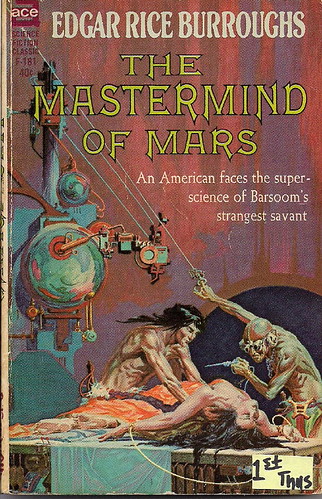
The Mastermind of Mars (1928)

Choo lent me The Mastermind of Mars by Edgar Rice Burroughs (1928) about a million years ago. I put it at the bottom of my pile because it is the sixth book in Burroughs' Barsoom series (hint: Barsoom is what the Martians call Mars), and I had only read the first one. Eventually, though, the cover called out to me too strongly and I decided to just take the plunge. Lucky for me Burroughs completely changes direction in this book, which serves as a pretty much stand-alone entryway into the world of Barsoom.

Our hero, Ulysses Paxton (yes), is dying on a WWI battlefield in France. He has always loved reading Burroughs' books about John Carter and his adventures on Mars, and in his final thoughts he focuses on the stars and thinks about how much he wishes he could have seen this amazing world. Then, through the wonder of astral projection (or something), he wakes up in the compound of a scientist on the red planet. Yay!

The scientist, Ras Thavas, quickly teaches Paxton the Barsoomian language and gives him a new name: Vad Varo. Ras Thavas has perfected a method of transplanting the brain and soul of one person into the body of another, and is charging wealthy Barsoomians tons of money to trade into younger and better looking bodies. He can also bring the dead back to life and transplant limbs and organs. It's a pretty good system really.

Paxton plays along as his lab assistant until he meets Valla Dia, a beautiful and benevolent young woman who has had her body switched against her will with an old and ugly empress. Paxton falls in love with Valla Dia's mind, even though she is stuck inside a crappy body, and vows to reunite her with her proper form. This leads to all kinds of adventures, and Paxton teams up with a revived assassin, a giant ape that has half of a man's mind (one of Ras Thavas' many experiments), and a proud warrior whose body was stolen by an evil courtier to woo away the woman he loved. Confused yet? Top that all off with some pretty funny critiques of religion and the masses and you have a very fun science fiction book that shows Burroughs at the top of his form. An excellent read.

Sunday, November 02, 2008

My new career:

Zombie make-up artist. The neck wound is just so-so, but I'm not Tom Savini for christ's sake. The face whitening/shading, on the other hand, is excellent.

[Further evidence here.]

Thursday, October 30, 2008

Pedernales Falls

Even though the falls didn't have that much water in them, I declare Pedernales Falls State Park to be lovely! I'd like to go back and do some of the hiking trails -- we spent all our time crawling over rocks, sliding through sand, and looking at beautiful blue water.

Further photographic evidence here.

[And if you are interested, the rest of my pictures from the LBJ ranch are here.]

Tuesday, October 28, 2008

Farm Life

My parents were in town for a visit over the weekend, and for a little day trip we headed out to the Lyndon B. Johnson State Park and Historic Site between Johnson City and Fredericksburg, before finishing our afternoon at Pedernales Falls State Park. I don't have all my pictures up yet, but I do have some shots of my favorite surprise of the trip: the Sauer-Beckmann Farmstead.

The Farmstead (which is part of the LBJ State Park) is a "living farm" where interpreters in period clothing plant, cook, clean, and live like it is still 1918. This was particularly effective on our visit, since it was a cool Monday morning and there was only one other tourist in the park. All the farm buildings and the farmhouse are open and filled with turn-of-the century equipment and furnishings. There are no velvet ropes or interpretive signs, which made it really seem like we were intruding on these old timey people as they fried up their sausage in the kitchen (we came around lunchtime), hoed the sweet potatoes in the garden, and scrubbed the floor with homemade lye soap (pictured above). The docents pitched their story just right, and didn't come off too practiced or hokey. The best part of it is that most of the time they just left you alone to explore the farm, take pictures, and watch the chickens, sheep, turkeys, and cows that wandered around loose.

Since I was really only mildly interested in the "Texas Whitehouse" and LBJ's ranch (although they were also pretty neat), this was a lovely surprise. Everyone should go! But try to do it when no one else is around so that you can have your run of the living farm...

[Note: Best thing of all -- the LBJ State Park and Historic Site are 100% free, now that they are letting cars drive through on a self-guided tour of the ranch instead of making you pay to take a tour bus. Although you do have to pay $1 for a guided tour of LBJ's office, the only room in the "Texas Whitehouse" that has been opened since Ladybird's death.]

[Growing set of pictures from the weekend, including the living farm, here.]

Sunday, October 26, 2008

Eeek!

Please enjoy the scariest pumpkin ever, carved by my sister, Jill. Try not to have nightmares:

Thursday, October 23, 2008

Blindness (1997)

The lovely Julia lent me a copy of José Saramago's 1997 novel Blindness, and I would go so far as to say it is one of the best novels I've read in a long time.

In a contemporary unnamed city, a man goes blind while sitting in his car waiting for the light to change. A stranger helps him home and his wife takes him to the optometrist. Nothing seems to be wrong with his eyes so the doctor sends him home to await more tests in the morning. But that night, while researching the strange eye problem, the doctor goes blind too. And the stranger who brought the man home. And the other patients in the waiting room at the doctor's office. The government quickly orders a quarantine of all the people struck by the "white blindness" in an abandoned mental institution. The population grows and grows and the social order quickly deteriorates. Yet one woman, the doctor's wife, inexplicably retains her sight.

This book is filled with large and small allegories and written in an experimental style with page-long sentences, unusual punctuation, and little explanation of who is saying what and if thoughts were spoken or only thought. And yet, it also has a clear narrative, strong characters, and draws an overwhelming picture of a horrifying and desolate world that is occasionally pierced by hopefulness and life. And the ending was perfect.

You should read this one...

Monday, October 20, 2008

Soured on Beer and Given to Claims

Yay! Achewood Volume IX: Soured on Beer and Given to Claims has made it to my door! Any true Achewood fan should not be without this fine collection of selected strips that originally ran from September 2006 through May 2007, including one of my favorite story arcs -- Mister Band (which you can read online starting here). Yay for Achewood! But when will they announce the Austin date for the book tour?

Thursday, October 16, 2008

The Man Who Ate Everything (1997)

The always lovely choo lent me Jeffrey Steingarten's The Man Who Ate Everything (1997) quite awhile ago and it somehow got buried in my pile even though I love food, I love reading, and I love reading about food.

This is an enjoyable collection of essays originally published in Vogue , HG, and Slate, by Steingarten, a lawyer-turned-food-writer. The author is at his best when he obsessively attacks a food-related question (how do you make the perfect pie crust? can microwaved fish taste good? what is the best-tasting ketchup?) by concocting messy experiments in his kitchen, interviewing experts, and pouring over the scientific literature. I also love it when he gets all crotchety and debunks common food myths (low-fat is good! alcohol is bad! meat is bad! salt is bad!). Some of the essays are a little dated (like a weirdly gushing piece about how awesome Olestra is), and Steingarten's humor is definitely more suited to a single piece of journalism than a whole book. This one is way more fun to read if you space it out over time instead of plowing through one piece after the other, but definitely worth dipping into.

Yay food!

Monday, October 13, 2008

Stop Looking at Me!

Ah, Flickr, I never know what weird connections you will bring about. I already know that if I tag one of my photos with "boob" or "feet" or "pee" it will suddenly become very popular. I had no idea that there is a whole group out there who are totally turned on by women wearing bandanas. That last link isn't really safe for work, although it isn't particularly graphic or anything. If you don't mind people seeing you look at a mixture of pornish-looking pictures of women tied up with bandanas together with obviously personal shots of people just wearing bandanas, then go for it. I've got no problem with someone like Flickr user sexybutt99 (if that is his real name) liking to look at some bondage photos, but seriously dude, me wearing a bandana while I am out hiking is not an invitation for you to favorite my picture and try to add it to your group pool. Ew.

Blocked!

Sunday, October 12, 2008

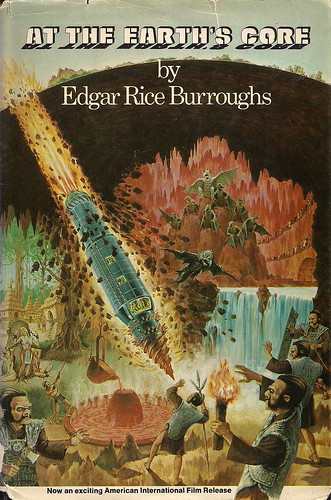
At the Earth's Core (1914)

Way back before I went on vacation last week, I seem to recall reading Edgar Rice Burroughs' 1914 book At the Earth's Core. This is the first book in Burroughs' Hollow Earth series, the second of which I uncharacteristically read first. Obviously that didn't trip me up much since I give a pretty solid run down of the plot of this book in my review of the second book. The only thing I can really add after actually reading the first book in the series is that adorable tiny little whales live in some of the ponds on Pellucidar, but that doesn't stop our hero from catching them and eating them raw when he is on the run from the freaky lizard rulers of the inner-earth kingdom.

Like much of Burroughs, this is a fun and dated sci-fi/adventure novel, but if you like that kind of thing (and I surely do), then you can't go wrong with the manly hero, freaky creatures, and staunch early 20th century American idealism of this series.

[My copy (which features the cover pictured above) is a 1976 Nelson Doubleday Book Club edition, produced to accompany that year's film of the same name. To make it even sweeter, it features 8 black and white photo stills from the movie, which starred Peter Cushing and Doug McClure (half the namesake of Troy McClure, who I'm sure you remember). And if you can't get your hands on your own copy, then read the whole thing online here.]

Thursday, October 09, 2008

Get Big Bended

Big Bend was beautiful -- I'm so glad I decided to overcome my fear of peeing outside and my general dislike of bugs and sleeping on the ground to go camping for a few days. Of course no pictures ever do any big awesome nature experience justice, but I tried. There were lots of landscapes, plants, pictures of me that I took myself, hiking, camping, spiders (okay not lots of spiders, but definitely one big one), and friends.

I'm still slowly getting back to "real life," but luckily that feeling of deep relaxation has stayed with me for a few days. Yay for vacation!

[Exhaustive photographic evidence here]

Wednesday, October 08, 2008

Reaclimating to the indoor life...

It involves sleeping like a rock, being way less productive than anticipated, going through my pictures, drinking a bunch of coffee, doing a ton of laundry, going to the grocery store (hopefully soon or I'll end up eating more trail mix), and catching up on those crazy internets.

I had a wonderful time, my friends are the best in the world, and I am very relaxed even with all these "things" I have to "do."

More later...

Friday, October 03, 2008

Oh yeah!

I almost forgot to mention, I'm going on vacation today for several days of West Texas & Big Bend fun! I anticipate having an awesome time. See you all next week!

[Photo courtesy of Joolie because I haven't been out there yet. But when I get back, expect a photo explosion.]

Wednesday, October 01, 2008

To Dr. M:

Happy Anniversary to my only boyfriend who isn't secret. Click here to feel four years of love (previous five years mostly not pictured)....

Sunday, September 28, 2008

SB RIP

Let's hear it for Paul.

Saturday, September 27, 2008

The Yiddish Policemen's Union (2007)

A new and as-yet-unnamed bookclub is in the forming stages, and our first reading choice is The Yiddish Policemen's Union by Michael Chabon (2007). The only other of Chabon's books that I've read is Werewolves in Their Youth (which google shows me I even wrote about on Spacebeer back in 2006). I really liked that book, and I'm not sure why I hadn't read any more of him (especially The Amazing Adventures of Kavalier & Clay -- can I borrow that from somebody?).

I really liked The Yiddish Policemen's Union as well -- briefly it is the story of an alternate universe where instead of settling in Israel, Europe's displaced Jews are given temporary control over a portion of Alaska (this was a real plan that in our version of reality did not have a lot of support). They build a large city, everyone speaks Yiddish, and a couple generations come and go. Then the US decides to take the territory back and the people are once again without a homeland. Our hero is the police detective Meyer Landsman, and even though his department will cease to exist and all his open cases will be thrown out after Reversion, he just can't stop working on the case of a mysteriously murdered man who was assassinated in the same fleabag hotel that Landsman calls home.

I won't say too much more about it since half the people I know are reading this right now and I want to save some juicy tidbits for bookclub, but I will say that I think the book works well as genre fiction (which we all know I love) and as a more "serious" novel (which I also love). I also think that what I wrote a couple years ago about Werewolves in Their Youth is actually pretty applicable to this book too:

Everyone is getting divorced, splitting away, and growing apart. But then, somehow, they end up clinging to something or someone new, or falling back into the same relationship that went so bad at the beginning. Rather than being depressing, the stories are more dark and weirdly hopeful, even when nothing works out by the end.

Tuesday, September 23, 2008

Harriet the Spy (1964)

Because Choo is awesome and also buys many books she somehow ended up with two copies of Louise Fitzhugh's Harriet the Spy (1964). This means that now I am the proud owner of the extra copy. Yay!

Like many a young girl, I loved this book when I was a kid. And even though I'm a horrible journal writer, it made me attempt to keep one on many many many occasions, and may still be responsible for my lack of control when it comes to buying new notebooks that I then proceed to never write anything in. I know for sure that it inspired game number two in my list of weird games I made up as a kid.

The book is still pretty awesome, although I don't think I picked up on all of Harriet's flaws when I was a kid. And she (and her family, and her neighbors, and her friends) is pretty flawed -- just like people are in reality (except me). I also didn't pick up on some very odd scenes. For example, in the second scene of the book, Ole Golly -- Harriet's nanny -- whisks Harriet and her friend Sport away for an unannounced visit to Ole Golly's mother's house. Harriet's family is rich (that is why they have a nanny), and Ole Golly's mother is poor. But she is also a little touched in the head. And the whole potential lesson of being grateful for what you have and thinking about others is kind of lost in the weirdness of the situation.

Later in the book Harriet's mother asks her if she "went to the bathroom" as she is leaving for school and Harriet yells back "no" and hurries to class. Then she has a day at school where things happen, including her overhearing some other girls talk about her while she is in a bathroom stall. Then she runs home:

First she went to the bathroom because she hadn't in the morning, and when she was sitting there she wrote in her notebook:

I LOVE MYSELF


Okay, Harriet is taking a shit, right? I love that.

[There is a good article about the book here, which also includes a little plot summary and some lovely quotes.]

Friday, September 19, 2008

Reformatting

I still love Kitchen Nightmares, and Gordon Ramsey will always be a secret boyfriend (although after some searching, it looks like I never officially posted about his secret boyfriend status), but what bonehead changed the old format where Gordon would take his shirt off about halfway through the episode and change into his chef outfit while confiding to the camera about how fucked up the restaurant was and how he hoped they could pull it together before the end of the night? Because I miss that part...

[Also, I am an information professional, but I could not find a picture of Gordon Ramsey with his shirt off. That is why I made the Gordon Ramsey / Daniel Craig (also a secret boyfriend) mash up you see above. Can you tell I don't have Photoshop? That is all Paint, baby!]

[Also, I'm home sick from work today. Is this a good use of my time?]

Wednesday, September 17, 2008

Requiem, Mass. (2008)

The lovely Milk and Cake loaned me (with the help of the US Postal Service), her advance reader's copy of John Dufresne's new novel Requiem, Mass (2008), because good readers need to stick together.

This book initially seems like one that we've seen a million times before -- the narrator had a troubled, and yet hilarious, youth growing up in a crazy family that ultimately loved one another even though they were falling apart. Dufresne likes to play the "is it a memoir or is it fiction" game and so the narrator, naturally, is also the author of the book. But is the author the narrator? And does it matter?

A nice balance to the childhood memories in this book is a peek at the narrator's present day life. I actually liked these sections a little better than the crazy family stuff -- in them the narrator seemed more real, and less like an entertainer trying to distance himself from his childhood by making fun of it. Of course, the childhood sections are also very readable and often quite funny -- but without the present day action to temper them, the book would be exhausting and a little too light.

I liked this book overall (except for the ending which I liked, but felt was a little forced). And if you are a fan of the crazy childhood memoir/fiction genre, I don't think you will be disappointed.

[Anyone want to have this copy? I'd like to keep the loaning system going...]

Sunday, September 14, 2008

Eggstatic

My neighbor / work friend keeps some chickens in her backyard, and after a few casual discussions of how wonderful fresh eggs are, she very nicely gave me a dozen. I'm not that great of an omelette-maker, but I threw together a couple of them with these eggs yesterday and they blew my mind. Fluffy, rich-tasting, and one million times better than any omelette I have ever had before. Yay for backyard chickens!

Wednesday, September 10, 2008

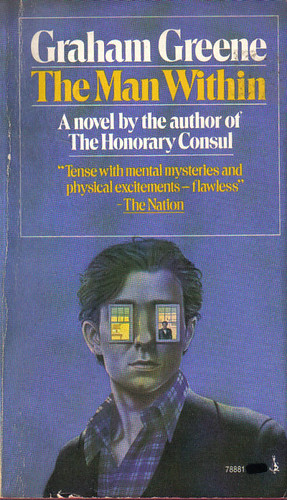
The Man Within (1929)

The Man Within (1929) is Graham Greene's first published novel, and it really shows. While this psychological semi-thriller is ultimately redeeming, overall it is pretty heavy handed, plodding, and occasionally rather dull.

The Man Within is the story of Andrews, a young man who was orphaned after his long-suffering mother died while he was in boarding school, and his hated booze smuggling father was shot on his own ship. Andrews is met at school by the enigmatic Carlyon, his father's first mate who is a stereotypical heavy with an unusual romantic side that quickly becomes Andrews' only friend. Andrews joins the smugglers, but later double-crosses them, turns them in to the police, and finds himself on the run from his former friends and the law (which is where the book starts). And that is where he meets the girl -- alone in an isolated cottage with her dead guardian/lover in a coffin on the table.

The characters are mostly one-dimensional (and their other dimensions are laid on thick), and the dialogue is pretty stilted, but Greene still manages to find some poetry and interest in the life of his cowardly and self-critical protagonist. And, as a person who loves some nice structure, the ending is just about perfect and potentially redeems the rest of the book.

That being said, I can't wait to read some more Greene. I realize that this is an early work and isn't representative. I hear he is great....

Tuesday, September 09, 2008

Cords: Or how I may be an idiot, but AT&T was pretty okay

Warning: boring story ahead!

So last night just before Dr. M was going to bed, our DSL stopped working. Bleh. I woke up and checked some connections and turned the modem on and off with no response. In the morning I got up a little early, did all that again, and then called the AT&T tech support number. The guy had me do all the things I'd just done again and then put a work order in to the line technicians to check the line. After a couple hours, they called and I talked to a different help desk guy who said the line was fine, but they would like to send someone over to the apartment to check the line inside and do some troubleshooting. Yay! Dr. M and I worked it so that at least one of us was home all afternoon. Thank god it wasn't me when the technician came and figured out that the problem was the little connector I had hooking two phone cords together (since our modem is far away from our phone jack). The little guy had cracked and wasn't holding together all the way. So even though I totally wasted AT&T's time and a bunch of my own energy, the technician guy was nice about it and gave us a free really long phone cord so that we don't have to use the connector deal any more.

And now, even though I had productivity plans for this evening (cleaning the bathroom! writing about this book that I read awhile ago!), I am worn out from reassembling all the computer bits and re-hooking up the wireless router so instead I'm going to have a drink and read a new book. Zip!